
No-Deposit Offers: Smaller Amounts, Clearer Terms



Free money with no strings sounds too good to be true, and with a no-deposit bonus the truth is in the strings. These offers, a little free cash or a handful of free spins handed out just for signing up, remain one of the most popular ways to try a new casino, but they have quietly changed shape: the headline amounts have shrunk, while the terms attached to them have become clearer and easier to read.
That combination sounds contradictory but makes sense once you see the logic. Operators cannot afford to give large sums to people who have not spent a penny, so the free amount is kept small and capped. At the same time, tighter advertising rules and sharper competition have pushed brands to spell out the conditions plainly rather than bury them, so the modern no-deposit offer is less generous on paper but far more honest about what it really is.
This piece explains how no-deposit offers work, the two forms they take, why the amounts are small, and the single term that matters most, the maximum cashout. The goal is to help you claim them for what they are worth, a low-risk trial, rather than mistaking them for a shortcut to a big win.
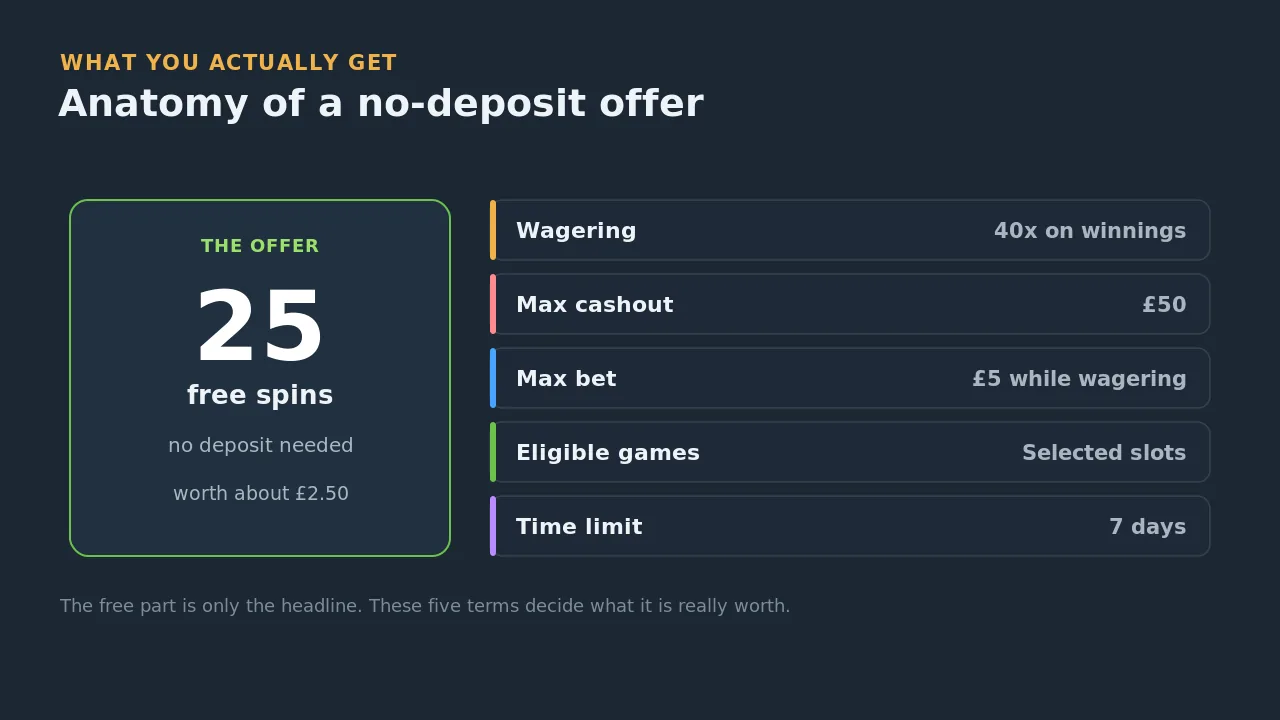
What a no-deposit offer is
A no-deposit bonus is exactly what the name says: a reward you receive without having to deposit any of your own money. Register an account, and the casino credits you a small amount of bonus cash or a set of free spins to use straight away. It is a marketing tool, designed to let a curious player experience real-money play risk-free and, the operator hopes, stay on to deposit later.
Because there is no deposit to recoup, the economics are entirely different from a matched deposit bonus. Every no-deposit offer given out is a pure cost to the casino until a player converts, so the terms are built to keep that cost contained and to deter the bonus-hunters who would otherwise farm free money across dozens of accounts. That is why the amounts are modest and why the conditions, especially the cashout cap, are stricter than on bonuses you pay into.
The two flavours: free cash and free spins
No-deposit offers come in two main forms, and the difference affects how you use them. Free cash, sometimes called a free chip, is a small bonus balance, perhaps five or ten pounds, that you can spread across eligible games as you choose. Free spins are a fixed number of slot spins, commonly ten to fifty, locked to one or a few specific games, each spin usually worth around ten pence.
Neither is automatically better; it depends on the terms. Free cash offers flexibility, letting you pick the games and stakes within the rules, while free spins are simpler and sometimes carry lower wagering on the winnings they produce. The smart approach is to ignore which sounds more generous and compare the two numbers that actually decide value: the wagering requirement and the maximum cashout.
How you claim one
Claiming a no-deposit offer is usually quick, but the exact steps vary. Some are credited automatically the moment you finish registering, others require a bonus code entered during sign-up or in the cashier, and a few ask you to opt in from a promotions page. If a code is needed and you miss it, the offer often cannot be added afterward, so it pays to check the terms before you register rather than after.
Two rules are near-universal. First, the offer is limited to one per person, household and sometimes device or IP address, and opening extra accounts to claim it again will get them closed and any winnings voided. Second, you will need a valid, verifiable identity, because a licensed casino has to confirm you are a real, single, adult customer before it pays out. Claim honestly with accurate details and the process is smooth; try to game it and you will simply lose whatever you win.
Why the amounts have shrunk
The shrinking headline is a direct response to how these offers were abused and what they cost. Because a no-deposit bonus is free to claim, it attracts organised bonus-hunting, where players open many accounts purely to farm the free money, never intending to become real customers. Larger free amounts made that behaviour more profitable, so operators pulled the amounts down to a level where abuse is not worth the effort.
Rising costs elsewhere play a part too. As licensing, verification and compliance have become more expensive, the budget for pure giveaways has tightened, and a small no-deposit offer is simply easier to justify than a generous one. The result is that the typical no-deposit bonus today is deliberately modest: enough to sample a site and maybe enjoy a small win, but not enough to be worth gaming the system for.
Why the terms are getting clearer
If the amounts are the bad news, the clarity is the good news, and it is largely the product of pressure from two directions. Advertising standards in several markets now require the significant conditions of an offer, the wagering, the cap, the key restrictions, to be presented clearly rather than hidden in dense terms, so operators have had to surface them. A bonus that once looked huge with a punishing catch in the small print is harder to advertise that way today.
Competition reinforces it. With players more informed and comparison sites highlighting the real terms, transparency has become a selling point, and brands that state their conditions plainly earn trust that translates into sign-ups. The modern no-deposit offer tends to show its wagering and cashout cap upfront, which is a genuine improvement even if the free amount is smaller than it used to be. If any of the terms are unfamiliar, our casino glossary explains the bonus vocabulary in plain English.
The catch that defines them: max cashout
If you remember one thing about no-deposit offers, make it this: the maximum cashout is the term that defines them. It is a hard ceiling on how much of your winnings you are allowed to withdraw, regardless of how much you actually win, and on no-deposit bonuses it is usually low, commonly between fifty and a hundred pounds.
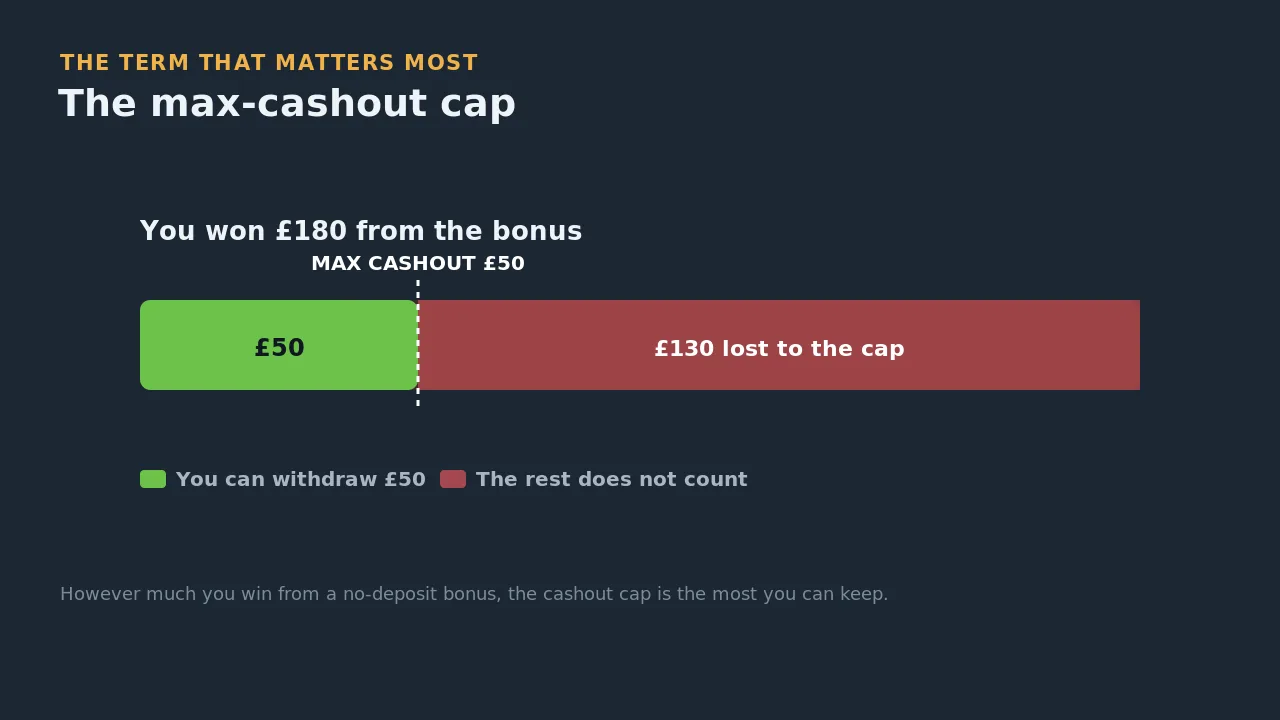
The example makes the point starkly. Turn a handful of free spins into a lucky 180 pound win, and a 50 pound cap means exactly that comes out; the remaining 130 pounds simply vanishes when you convert the bonus. This is not a scam or hidden trick when it is stated clearly, but it is the reason no-deposit offers are a trial rather than a jackpot. Understanding the cap before you play stops the disappointment of winning big on paper and keeping only a fraction of it.
What you can realistically win
It helps to walk a no-deposit offer through end to end, because the headline and the reality can look very different. Take a typical 25 free spins, worth around £2.50 in total, and follow what happens to any winnings they produce.
| Stage | What happens |
|---|---|
| You receive | 25 free spins, worth about £2.50 in total |
| You win | Often nothing, sometimes a few pounds, occasionally more |
| Wagering | Say 40x on a £20 win means £800 to bet before withdrawal |
| You verify | Prove your identity and age before any payout |
| Max cashout | Whatever is left is capped, often at £50 |
| Realistic result | A small win or nothing, with the cap as the ceiling |
Read that way, the honest expectation is clear: a no-deposit offer most often returns a small amount or nothing, occasionally rewards you up to the cap, and never delivers the life-changing sum a free-spins banner might hint at. That is not a criticism, it is simply what the format is, and going in with the right expectation turns it from a letdown into a pleasant, cost-free flutter.
Then versus now
Set an older no-deposit offer beside a modern one and the trade-off is easy to see. The past favoured bigger headline numbers wrapped in dense terms that hid the catch; the present favours smaller numbers with the catch shown plainly.
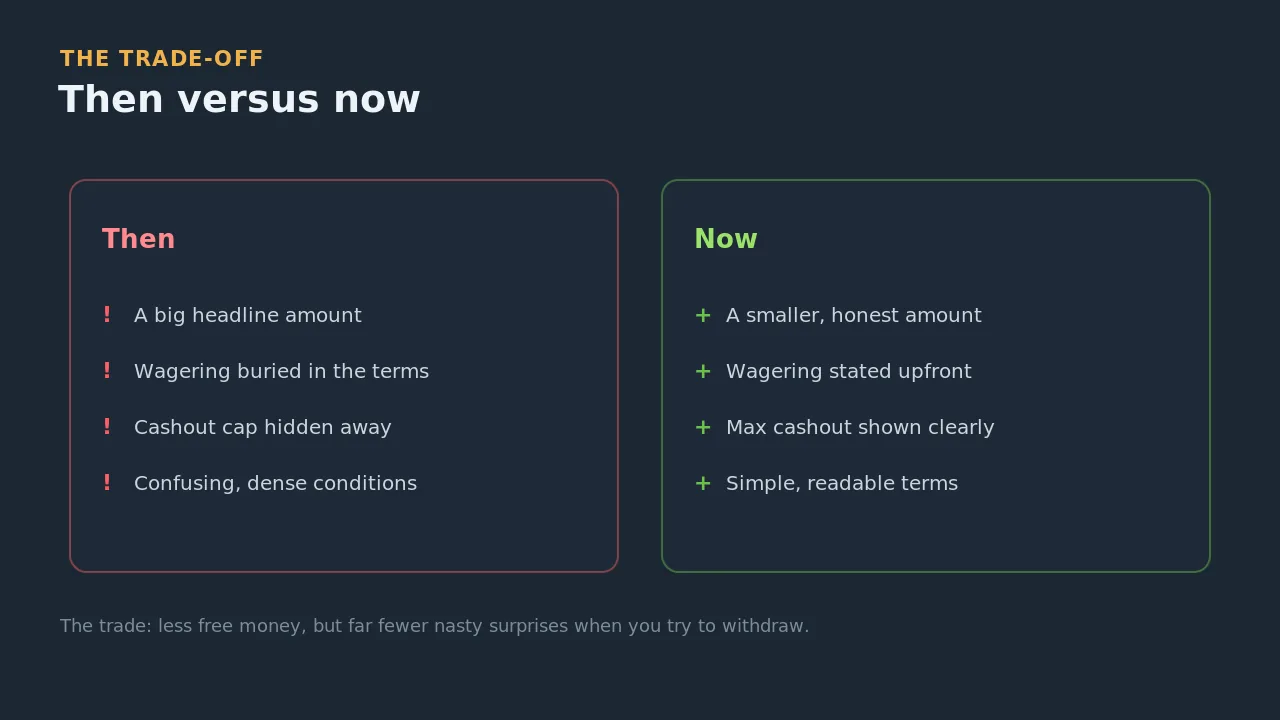
For players, this is a fair exchange. A smaller offer whose terms you can actually understand is more useful than a larger one designed to look generous while quietly ensuring you keep almost nothing. Transparency lets you make a real decision, and a real decision is worth more than a flashy number you cannot trust.
The verification step
One part of the no-deposit journey surprises newcomers: you still have to verify your identity before you can withdraw, even though you never deposited. This is deliberate. Free money is exactly what fraudsters and multi-account bonus-hunters target, so licensed casinos confirm who you are, and that you are of legal age and hold only one account, before releasing any no-deposit winnings.
The practical tip is to complete verification early rather than at the moment you try to cash out, so a rare win is not held up by paperwork. It is the same identity check expanding across the whole industry, which we cover in our report on identity and source-of-funds checks. Treat it as routine rather than an obstacle, and the process is quick and painless.
No-deposit versus deposit bonuses
It helps to see where no-deposit offers sit against the deposit bonuses they are often confused with. They serve different purposes, and neither is simply better; they suit different moments.
| Feature | No-deposit offer | Deposit bonus |
|---|---|---|
| Your money at risk | None to claim it | Yes, you deposit first |
| Typical size | Small: spins or up to about £50 | Larger: a percentage match |
| Max cashout | Low cap, often £50 to £100 | Usually none or much higher |
| Wagering | Often high, 30x to 60x | Varies, and increasingly lower |
| Best for | Trying a casino risk-free | Extending a real bankroll |
The short version is that a no-deposit offer is a free sample and a deposit bonus is a top-up. If you want to test a new site without commitment, the no-deposit route is ideal; if you are going to deposit and play anyway, a deposit bonus with fair terms usually delivers far more value. The falling wagering we cover in our report on wagering requirements trending lower applies mainly to that second category.
How to judge a no-deposit offer
Because the free amount tells you so little, judge a no-deposit offer by its terms in a fixed order. Look at the maximum cashout first, since it caps everything else and is the true measure of the upside. Then check the wagering requirement and whether it applies to the winnings or the bonus, followed by the eligible games and the time limit, which together decide whether you can realistically clear it at all.
A good no-deposit offer is one where those terms are stated plainly and are achievable: a reasonable cashout cap, wagering you could clear within the time on games you would enjoy, and no awkward surprises. A poor one hides a tiny cap or an impossible requirement behind a tempting number of free spins. Once you know the order to read them in, telling the two apart takes seconds.
Common mistakes to avoid
Most no-deposit disappointments come from a handful of avoidable errors, and knowing them in advance keeps a rare win intact. The most common is breaching the maximum bet while the wagering is still active, which can void the bonus and everything won from it in a single oversized spin. Check that cap, usually just a few pounds, and stay under it until you have cleared the requirement.
The rest cluster around terms people skip. Playing games that do not count, or barely count, toward the wagering quietly wastes the bonus. Letting the time limit expire erases any unmet wagering and the winnings attached to it. Forgetting that the max cashout caps your return leads to the classic let-down of a big on-screen win and a small actual payout. And leaving identity verification until the withdrawal stage is another frequent stumble, since it can hold up a payout you were looking forward to. None of these are traps when the terms are stated clearly, which today they usually are, but clarity only helps if you read the terms before you spin rather than after.
Claiming one sensibly
No-deposit offers are low-risk by nature, but a sensible mindset still makes them more enjoyable. Treat them as a free trial: a chance to see whether you like a casino's games, interface and feel, with a small win as a bonus rather than the aim. Going in expecting entertainment rather than income is the difference between a fun ten minutes and a frustrating chase.
Be wary, too, of the deposit prompt that usually follows. The whole point of a no-deposit offer, from the operator's side, is to encourage a first deposit, so the moment your free credit runs out you will be nudged to pay in. There is nothing wrong with that if you planned to, but let it be your decision, not the offer's. Our guide to responsible gambling and staying in control covers the limits that keep any bonus fun.
Where to find genuine offers
No-deposit offers are easy to find but not all are what they seem, so where you look matters. Reputable comparison sites and the promotions pages of licensed casinos are the safe sources, listing an offer alongside its real terms. Treat any site promising an unusually large no-deposit sum with suspicion, because a genuine offer is modest by design, and an outsized one is a classic lure used by unlicensed operators to harvest sign-ups.
The simplest safety check is the licence. A no-deposit offer is only as trustworthy as the casino behind it, and only a licensed operator is bound by the rules that make the bonus, and any winnings, real. Before you hand over your details for a free bonus, confirm the site is licensed in your market, because a free offer at an unlicensed casino can cost you far more than it ever pays, in data and in risk.
The bottom line
The no-deposit offer has matured. Where it once dangled larger sums behind terms designed to disappoint, today it tends to give a little less and explain itself far better, and on balance that is a change for the better. A small, honest free trial is more useful than a big number you were never going to keep.
The key is to read one for what it is. Check the max cashout first, judge the wagering and restrictions on top, verify your account early, and treat the whole thing as a risk-free sample of a new casino. Do that, and no-deposit offers become exactly what they should be: a pleasant, cost-free way to look around, with the occasional small win as a happy extra rather than a promise the format was ever going to keep. Read it that way, and the no-deposit offer is one of the few genuinely risk-free ways to explore a new casino before you commit a penny.
Frequently asked questions
What is a no-deposit bonus?
A no-deposit bonus is a small reward a casino gives you just for registering, with no deposit required. It usually comes as a little free cash or a set of free spins, and it lets you try real-money play without risking your own money.
Can you really win real money with no deposit?
Yes, but within limits. You can win real, withdrawable money, though you must first meet the wagering requirement, and a maximum cashout caps how much of your winnings you are allowed to keep, often around 50 to 100 pounds.
What is the max cashout on a no-deposit bonus?
The max cashout is the ceiling on how much you can withdraw from a no-deposit bonus, no matter how much you win. It is commonly set between 50 and 100 pounds, and anything you win above it is simply lost, which makes it the single most important term to check.
Why are no-deposit amounts so small?
Because the casino is giving money to people who have not spent anything, so the cost has to be tightly controlled. Small amounts, capped cashouts and wagering requirements keep the offer affordable while still letting new players sample the site.
Do I need to verify my identity to withdraw?
Almost always. Before paying out no-deposit winnings, a licensed casino will verify your identity and age to prevent fraud and multiple accounts. Completing that verification early makes the withdrawal far smoother when the time comes.
Free spins or free cash: which is better?
It depends on the terms. Free cash can be spread across more games, while free spins are tied to specific slots but sometimes carry lower wagering on the winnings. Compare the wagering and the max cashout rather than the headline, since those decide the real value.
Are no-deposit bonuses worth claiming?
They can be, as a risk-free way to try a casino and perhaps win a little, but treat them as a sample rather than a payday. The small amounts and capped cashouts mean the realistic upside is modest, so claim them for the trial rather than the jackpot.
Go deeper
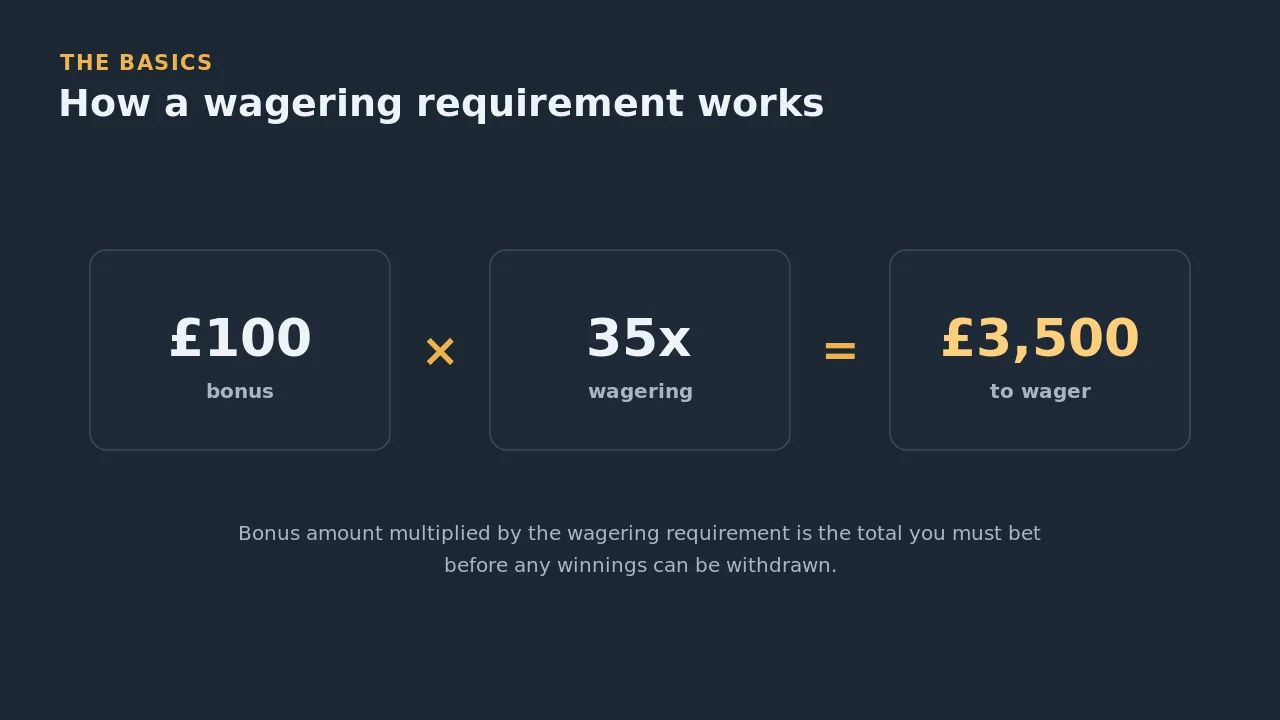
Wagering requirements trend lower
Why newer brands are cutting wagering, and how to judge a bonus beyond the headline.
Read article →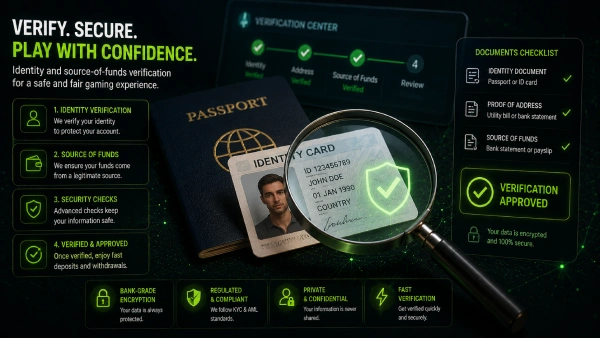
Identity and source-of-funds checks
Why you must verify your account before a no-deposit win can be paid out.
Read article →
Responsible gambling and staying in control
How to enjoy free offers without letting the deposit prompt push you further.
Read guide →Editorial note
This article is independent editorial coverage of casino bonus terms, not sponsored content, and no brand has paid for inclusion. The amounts, caps and wagering figures are illustrative and typical rather than offers from any specific casino; real terms vary widely, so always read a bonus's full terms and conditions before claiming. Nothing here is betting advice. Play only at licensed casinos, 18+, and within limits you set in advance.