
Payout-Speed Lookup



Withdrawal speed depends heavily on the payment method you choose. E-wallets and crypto are usually fastest; bank transfers and cards take longer. Filter the table by method to compare typical processing times across sample casinos.
Casino names and times below are illustrative placeholders for demonstration and should be replaced with verified, sourced data before publishing.
| Casino | E-wallet | Card | Bank transfer | Crypto |
|---|
How to use this payout-speed lookup
The lookup above compares typical withdrawal times across a set of sample casinos, broken down by payment method. Use the method filter to focus on the option you actually plan to cash out with: tap E-wallet, Card, Bank or Crypto to hide the other columns, or leave it on All to see the full picture side by side. The figures are illustrative ranges rather than promises, but they mirror the usual pecking order you will find at real money online casinos.
Reading the table is only half the job, though. To know what a payout time actually means for you, it helps to understand what a withdrawal goes through before the money lands in your account.
Why casino withdrawal times vary
Two casinos can offer the exact same payment method and still pay out days apart. That is because a withdrawal moves through three separate stages, and each one adds time. The payment method most players worry about is only the last of the three.
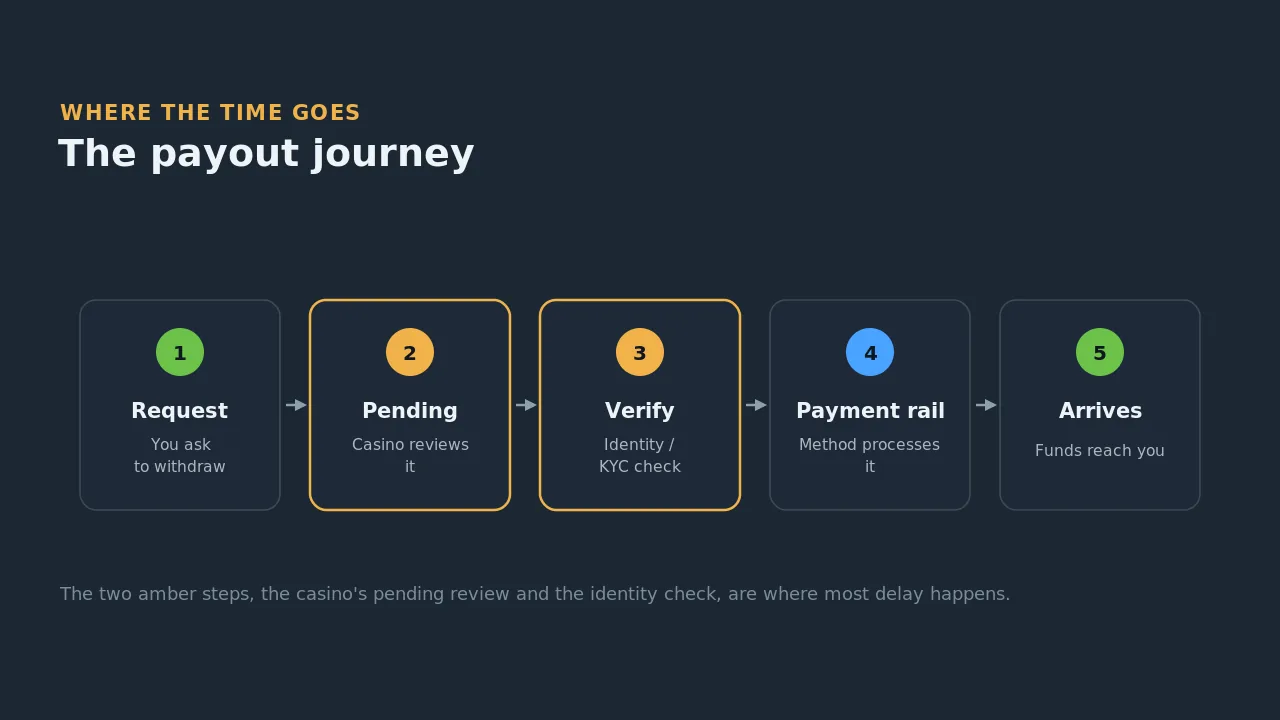
1. The casino's pending time
When you request a cashout, most casinos place it in a pending state while they run internal and responsible-gambling checks. A fast-payout brand keeps this window short, sometimes only minutes, while slower operators can sit on a request for 24 to 48 hours. Some casinos also use this period as a deliberate reverse withdrawal window that lets you cancel and keep playing, which is worth switching off if you simply want your money.
2. Identity verification (KYC)
Licensed casinos have to confirm who you are before they release funds. These Know Your Customer (KYC) checks usually ask for photo ID, proof of address and sometimes proof of payment. The first withdrawal is where this bites, because the review often happens the moment you request money rather than when you sign up. Uploading your documents early, before you ever hit the cashier, is the single most effective way to avoid a stalled payout.
3. The payment rail
Only now does the payment method set the pace. E-wallets move almost instantly once released; debit and credit cards depend on your bank's posting times; bank transfers travel through slower clearing systems; and crypto settles on-chain in minutes. The same casino can therefore look fast or slow purely based on which option you picked at the cashier.
Typical payout times by method
Once a withdrawal is approved, the method decides how quickly you actually see the money. Here is the usual order from fastest to slowest, and it lines up closely with what the lookup shows.
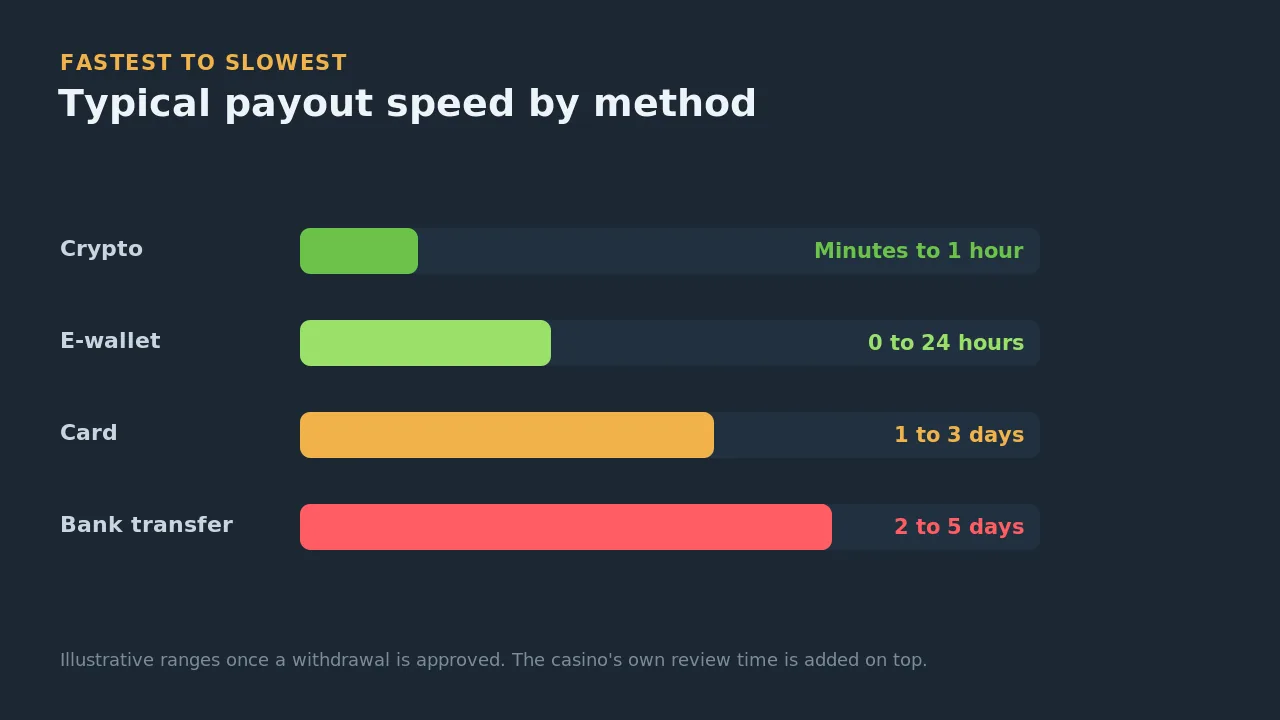
| Method | Typical speed | Good to know |
|---|---|---|
| Crypto | Minutes to 1 hour | Fastest once approved, but not offered everywhere |
| E-wallet | 0 to 24 hours | Fast, widely supported and easy to verify |
| Debit or credit card | 1 to 3 working days | Depends on your bank's posting times |
| Bank transfer | 2 to 5 working days | Slowest, and often stalls over weekends |
What slows a payout down, and how to speed it up
Most of the delay in a casino withdrawal is avoidable. A handful of the same culprits show up again and again, and nearly all of them are within your control before you ever click withdraw.
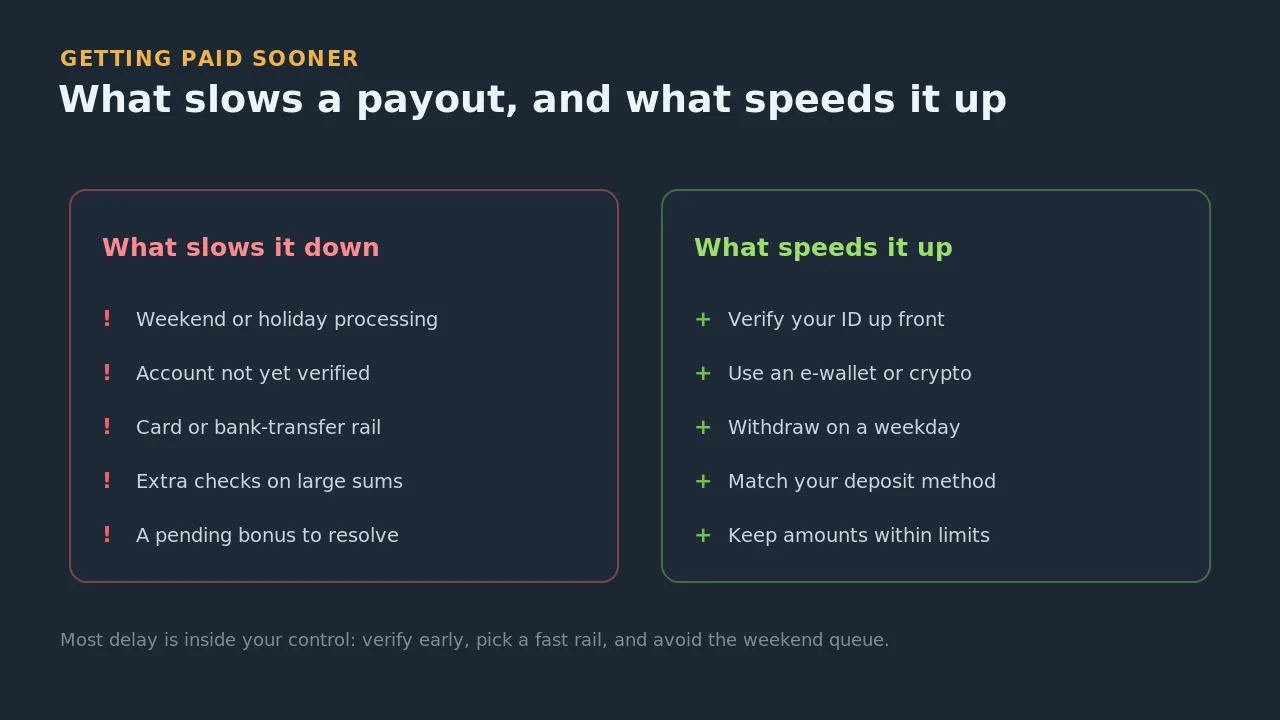
The biggest single time-saver is verifying your account before you request money, so KYC never becomes a bottleneck. After that, choosing a fast rail and steering clear of the weekend queue does most of the rest. If speed is your priority when picking where to play, our list of fast-payout casinos filters for brands with short pending times, and the payments guide walks through each method in more detail.