
Casino Payments & Payouts
Everything that happens between your bank and the casino, from the moment you deposit to the day your winnings land, explained in plain English so your next payout is fast and painless.



Depositing at an online casino is almost always instant and effortless. Getting your winnings back out is where players hit the friction: pending statuses, verification requests and waits that stretch from hours to days. None of it is random, though. Once you understand how casino payments actually move, you can pick the right methods, avoid the common hold-ups and cash out with the least possible fuss.
This guide walks through every stage of the money journey: the ways you can deposit, the ways you can withdraw and why payouts run slower, the verification step that trips up so many players, the processing times and limits to expect, the fees that can quietly appear, and a set of practical tips for keeping your payouts smooth and fast.
Key takeaways
- Deposits are instant; withdrawals are not. Payouts pass through the casino's own review before the payment network even begins.
- Verify early. Completing KYC when you register removes the single biggest cause of slow cashouts.
- E-wallets and crypto are fastest. Cards sit in the middle and bank transfers are slowest.
- Watch the limits. Weekly or monthly withdrawal caps can stretch a big win out over several payments.
- Fees are usually external. Most good casinos do not charge, but your bank or currency conversion might.
Deposit Methods
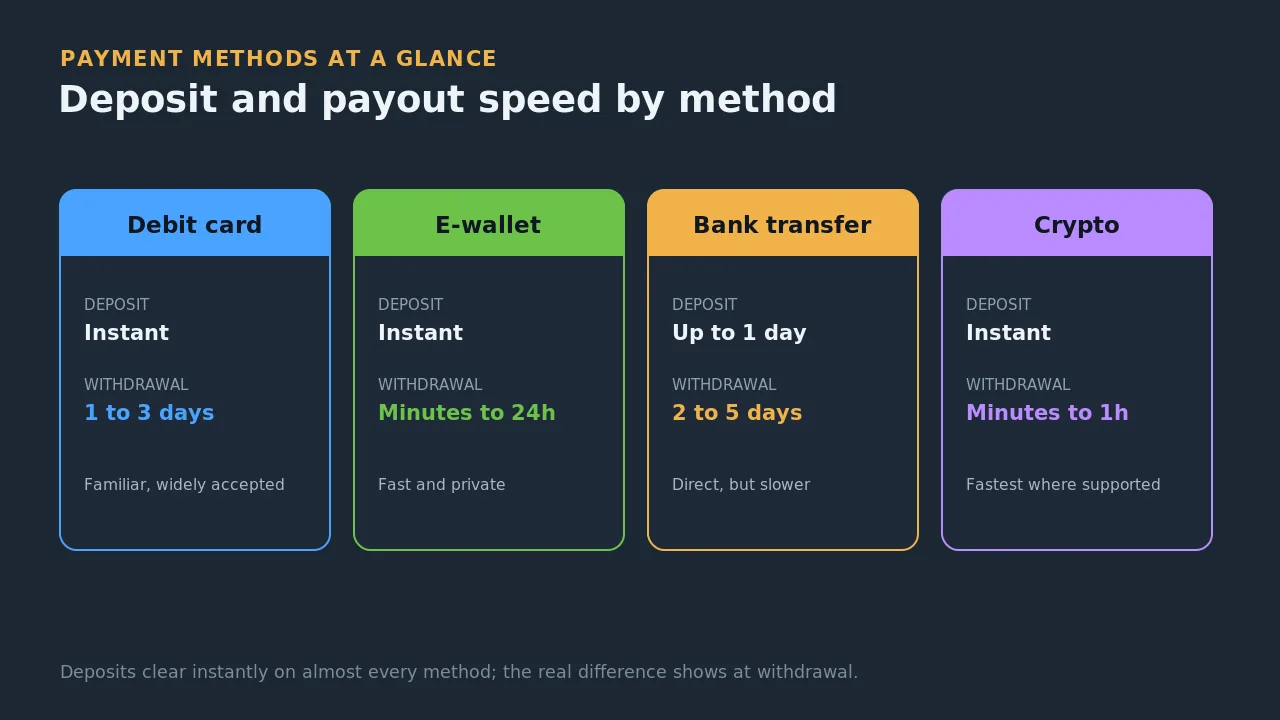
Adding funds is the easy half of casino payments, and most sites offer a broad menu of options. Each method has its own trade-offs in speed, privacy and how easily you can later withdraw to it, so it pays to choose with the whole round trip in mind rather than just the deposit.
Debit cards
Visa and Mastercard debit cards are the most familiar choice: fast, widely accepted and simple to use. In some markets credit-card gambling is restricted or banned, so debit is the norm. Deposits are instant, and thanks to the same-method rule your winnings will usually head back to the same card first.
E-wallets
E-wallets such as PayPal, Skrill and Neteller sit between your bank and the casino, which adds a layer of privacy and, more usefully, tends to make them the quickest option at withdrawal. If a fast cashout matters to you, funding your account with an e-wallet is one of the simplest ways to get one.
Bank transfers and Pay N Play
Instant bank transfers and Pay N Play services, built on open-banking providers like Trustly, let you deposit straight from your bank account. Some Pay N Play casinos even register and verify you automatically, so you can be playing within minutes and skip a separate KYC step entirely.
Prepaid vouchers
Prepaid vouchers such as Paysafecard let you deposit a fixed amount with no bank details at all, which makes them a tidy budgeting tool. The catch is that you usually cannot withdraw back to a voucher, so you will need a second method lined up for payouts.
Cryptocurrency
At crypto casinos, deposits in Bitcoin, Ethereum, stablecoins and other coins are fast and borderless wherever they are legal and supported, and they frequently carry the quickest payouts of any method. The trade-offs are price volatility and a short learning curve if you have never used a wallet before.
| Method | Deposit | Typical payout | Withdraw back to it? |
|---|---|---|---|
| Debit card | Instant | 1 to 3 working days | Yes |
| E-wallet | Instant | Minutes to 24 hours | Yes |
| Bank transfer / Pay N Play | Instant to 1 day | 2 to 5 working days | Yes |
| Prepaid voucher | Instant | Not supported | No |
| Cryptocurrency | Instant | Minutes to 1 hour | Yes |
Withdrawal Methods and Why Payouts Are Slower
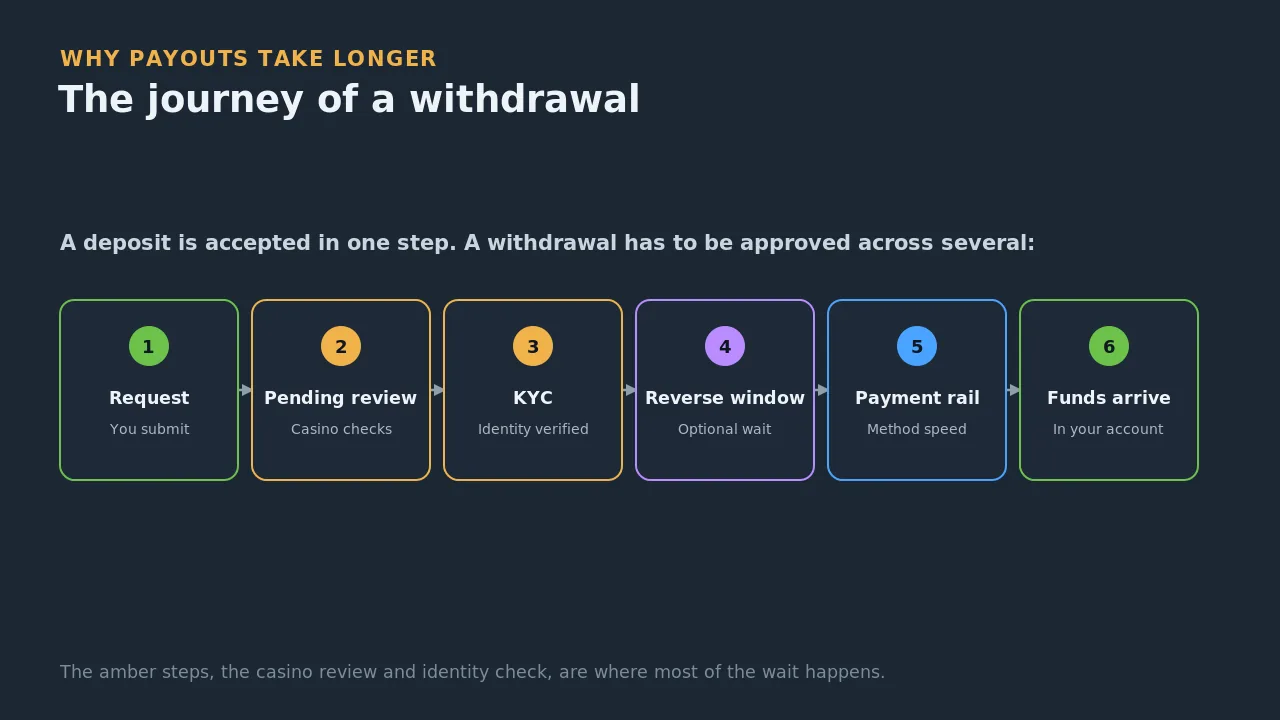
Withdrawals use the same families of methods as deposits, but the experience feels very different, because a payout has to clear a hurdle a deposit never faces. A deposit only has to be accepted. A withdrawal has to be approved.
The casino's internal review
The main reason payouts are slower is the operator's own review. Before any money moves, the casino confirms that your identity is verified, that you have no outstanding bonus wagering, and that the request does not look fraudulent. Only once it clears this pending stage does the payment reach the banking or e-wallet rails, which then add their own processing time. Many casinos also apply a deliberate reverse or cooling-off window during which the request simply waits.
The same-method rule
Most casinos return funds to the method you deposited with, at least up to the amount you put in, for anti-money-laundering reasons. Deposit by card and your winnings head back to that card first. Because of this, choosing a fast withdrawal method at the deposit stage, an e-wallet or crypto, is one of the simplest ways to speed up the eventual payout.
Reversible withdrawals
During the pending window many casinos let you cancel a withdrawal and return the money to your balance. It is convenient, but it is also a trap, because it makes it far too easy to gamble back winnings you meant to keep. Switching the feature off, where the casino allows it, is a small discipline that protects your payout.
KYC and Verification: Do It Early
Know Your Customer (KYC) verification is a legal requirement at every licensed casino, not an optional extra. The operator must confirm your identity, age and often your address and payment method before it can release a payout, and this is where the majority of "slow" withdrawals actually stall.
What you will be asked for
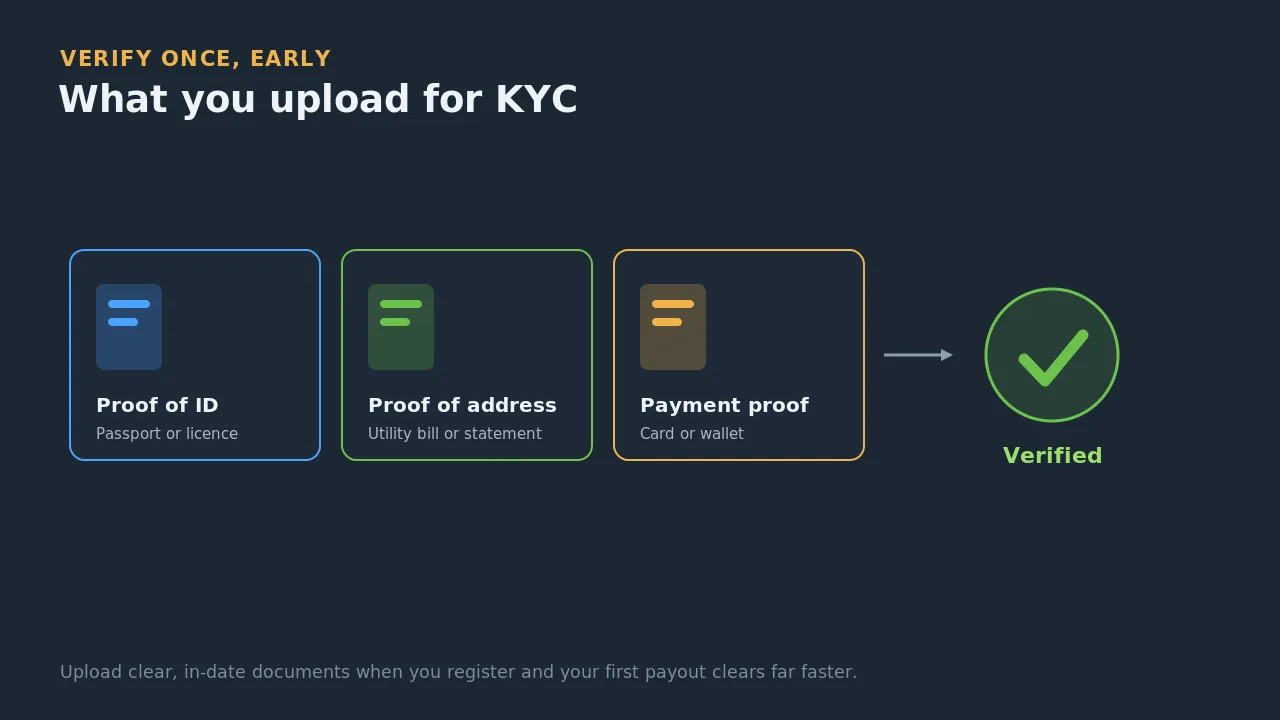
Expect to provide proof of identity such as a passport or driving licence, proof of address such as a recent utility bill or bank statement, and sometimes proof of payment method such as a photo of your card or an e-wallet screenshot. Larger balances can also trigger a source-of-funds check, which asks for evidence like a payslip or bank statement and is a standard anti-money-laundering step.
Why verifying early matters
The single best thing you can do is complete all of this the moment you open the account, rather than waiting until you request your first withdrawal. Verify early and a payout that might otherwise take days can clear in hours. Our guide to how online casinos work explains why these checks exist in more depth.
Processing Times and Withdrawal Limits
Once your account is verified and any bonus is cleared, two things decide how and when your money arrives: the method you use, and the limits your casino applies.
How long each method takes
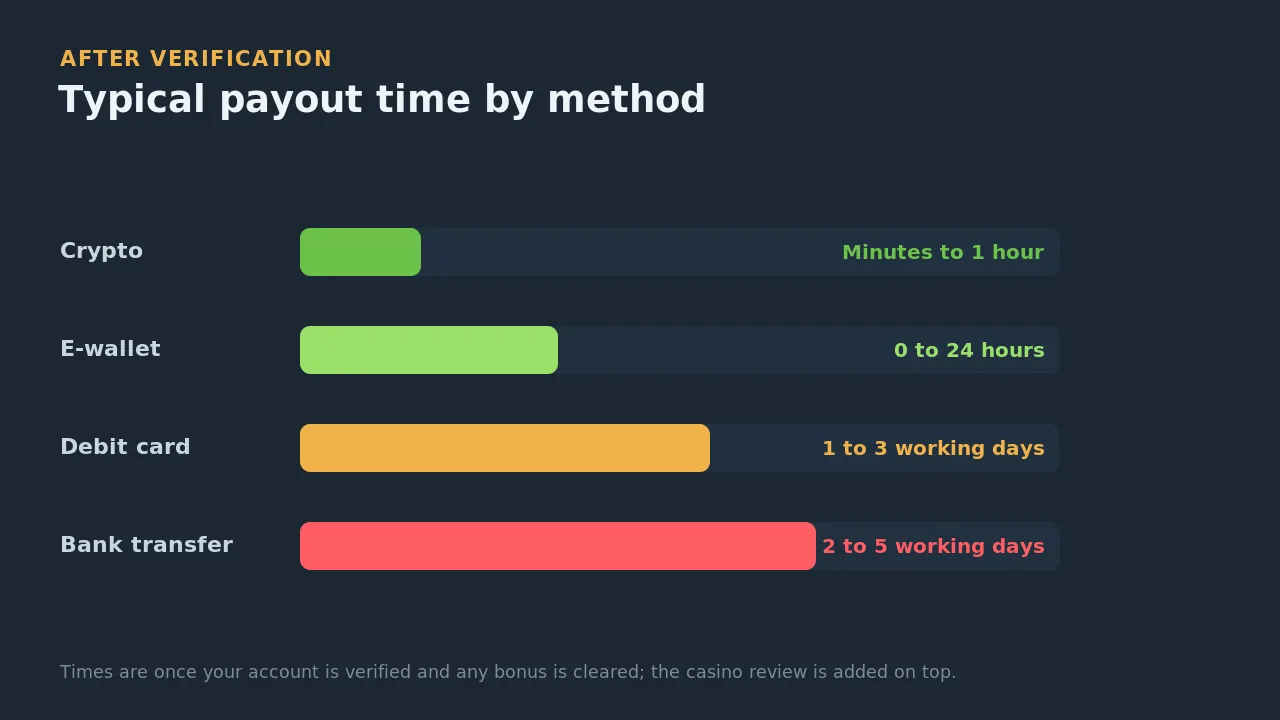
As a rough guide, e-wallets and crypto pay out within minutes to a few hours, debit cards take one to three working days, and bank transfers take two to five. The payment network is usually the fast part; the casino's own review time is the variable that matters most, which is exactly what our payout-speed tool is built to compare.
| Method | Time after approval | Biggest delay |
|---|---|---|
| Cryptocurrency | Minutes to 1 hour | Casino review |
| E-wallet | Minutes to 24 hours | Casino review |
| Debit card | 1 to 3 working days | Banking rails |
| Bank transfer | 2 to 5 working days | Banking rails |
Withdrawal limits and how they work
Beyond speed, watch the withdrawal limits. Many casinos cap how much you can take out per transaction, per day, per week or per month. Land a large win at a site with a low weekly cap and you may find your winnings paid in instalments over several weeks rather than in one go. Check these limits before you deposit, especially if you are chasing a big jackpot, and favour operators whose caps suit how you play. Sites that specialise in quick, high-limit payouts are collected in our fast-payout casinos list.
Fees to Watch For
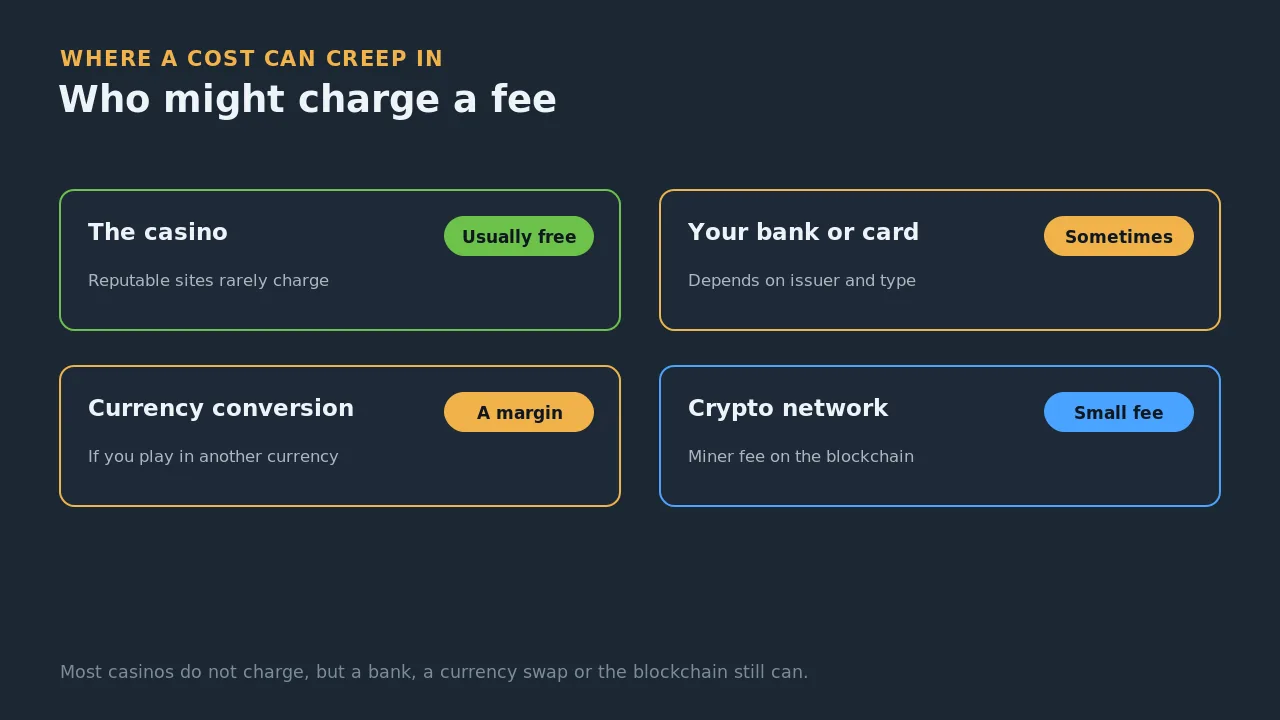
The headline is reassuring: most reputable casinos do not charge their own fees on deposits or withdrawals. That does not always mean a transaction is completely free, though, so it helps to know where a cost can quietly appear.
Third-party and bank fees
These are the most common. Your bank, card issuer or e-wallet provider may apply its own charge on certain transaction types, entirely separately from the casino. It is worth checking your provider's terms for anything labelled as a cash-related or gambling transaction, which can occasionally attract a fee.
Currency conversion
If you play in a currency different from your bank account, either the casino or your bank will apply an exchange margin, and that margin is easy to overlook. Playing in your home currency, or holding an account in the casino's currency, is the simplest way to avoid it.
Crypto network and repeat-withdrawal fees
Crypto transactions carry a small network (miner) fee that goes to the blockchain rather than the casino. Separately, a minority of casinos charge for very frequent withdrawals or for a second and later payout within a short window, so spacing out your cashouts can sometimes save a little.
| Fee source | Likely? | Notes |
|---|---|---|
| The casino | Rarely | Most reputable sites charge nothing |
| Bank or card issuer | Sometimes | Depends on issuer and transaction type |
| Currency conversion | If cross-currency | An exchange margin is applied |
| Crypto network | Always (crypto) | Small miner fee paid to the blockchain |
Is Your Money Safe? Payment Security
Handing card or bank details to a website is a reasonable thing to be cautious about. At a licensed casino, though, several layers work together to keep your deposits, your winnings and your personal data protected.
Encryption and secure processing
Reputable casinos encrypt every transaction with the same SSL and TLS technology banks use, and their payment processors are PCI-DSS compliant, the security standard for handling card data. In practice, your full card number is never exposed to the casino in a usable form.
Segregated player funds
Strong regulators require operators to keep player balances separate from company operating money. That segregation means your funds stay protected and available to withdraw even if the business runs into trouble, which is one of the clearest advantages of playing at a properly licensed site.
The licence and audits
Behind the technology sits oversight. A licence obliges the casino to protect funds, offer only fair certified games and follow anti-money-laundering rules, while KYC checks guard your account against someone else cashing out in your name. Independent audits keep the whole system honest.
Practical Tips for Fast, Smooth Payouts
Putting all of this together, a handful of habits will consistently get your money out faster and with fewer headaches. None of them require special knowledge, only a little preparation before you play.
Your fast-payout checklist
- Verify on day one. Upload clear, in-date ID and address documents when you register, not at cashout.
- Pick a fast method. Use an e-wallet or crypto for both deposit and withdrawal, remembering the same-method rule.
- Clear any bonus first. An outstanding wagering requirement blocks the whole payout until it is met.
- Mind the limits. Check per-day and per-week caps before depositing, especially for a big win.
- Turn off reverse withdrawals. It stops you gambling back money you meant to keep.
Treat any winnings as a welcome bonus rather than expected income, keep your account details accurate, and give yourself the best start by preparing before you deposit rather than scrambling at the cashier. If play ever stops feeling fun, our responsible-gambling guide explains the tools and support available.