
How Online Casinos Work
From the software that decides every spin to the licence that protects your money, here is the whole machine, explained in plain English.



Click into an online casino and the experience feels effortless: you choose a game, set a stake, tap once, and a second later you have either won or lost. Behind that single tap, though, sits a surprisingly deep stack of technology, money-handling and regulation, all working in the background to keep the game fair and your balance safe. Learning how those parts fit together is the difference between gambling blindly and playing with your eyes open.
This guide walks through the entire machine, one piece at a time: the software that decides outcomes, the mathematics that lets an operator stay profitable, the checks that confirm who you are, the way deposits and withdrawals actually move, and the licences that give you rights when something goes wrong. None of it requires a maths degree, only a clear explanation, which is exactly what follows.
Key takeaways
- Outcomes are random. Games are decided by certified random number generators, or real equipment in live dealer games, and every round is independent of the last.
- The house always has an edge. A small statistical margin is built into the rules, and its mirror image is the RTP. No betting system removes it.
- You verify once. Expect to register and complete identity checks (KYC) before your first withdrawal.
- Bonuses have strings. Almost every offer carries wagering requirements, so read them before opting in.
- The licence is your safety net. A casino's licence sets the rules it must follow and where you can complain.
What Is an Online Casino?
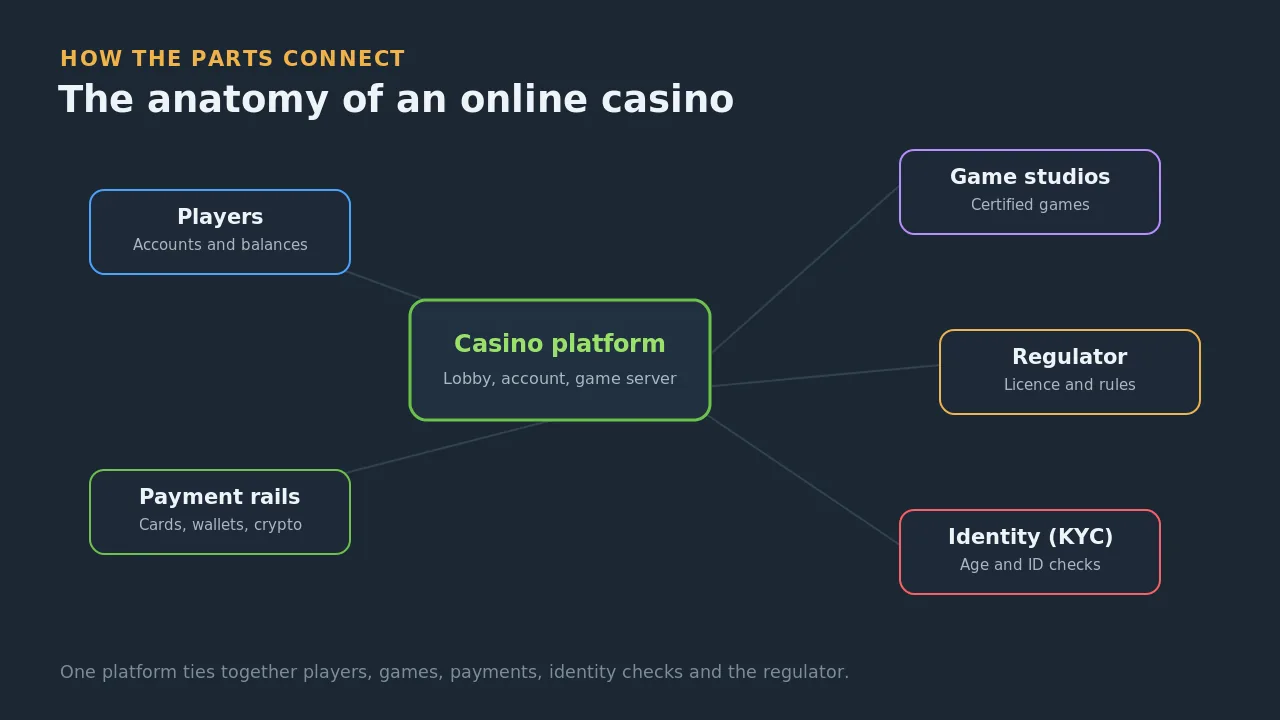
At its simplest, an online casino is a licensed website or app that lets you play games of chance for real money. That tidy definition hides a lot of moving parts, though, and they only work when they are joined together. It helps to picture a casino not as a single program but as a set of connected systems, each with one clearly defined job.
The core systems behind the screen
The front-end lobby is the part you see: shelves of slots, live tables, the search bar and the promotions. The account system holds your profile, balance, limits and history. The game server runs or connects to the games themselves and records every bet. The payment rails move money in and out through cards, e-wallets, bank transfers and cryptocurrency. Underneath all of it sits the licence, the legal foundation that decides how the operator has to behave.
| Part of the casino | What it does for you |
|---|---|
| Front-end lobby | Displays and organises the games, search and promotions |
| Account system | Stores your balance, limits, history and verification status |
| Game server | Runs or connects to the games and logs every bet and result |
| Payment rails | Handle deposits and withdrawals across cards, wallets and crypto |
| Licence | Sets the rules the operator must follow and gives you somewhere to complain |
Why casinos rarely build their own games
One detail surprises many newcomers: casinos almost never make their own games. Instead they license titles from specialist studios and slot them into the lobby, which is why the same popular game turns up across dozens of different sites. The operator's real craft is curation, payments, support and trust, not game design.
That separation matters for fairness. Because the games are built and certified independently of the casino, the operator cannot quietly change how a slot pays. It simply hosts a sealed product that has already been tested and locked down by its maker and an external lab.
Game Fairness and Random Number Generators
The most common worry about online play is a simple one: are the games rigged? In a licensed market the honest answer is no, and the reason comes down to two things working together, a piece of software called a random number generator and the independent labs that test it.
What an RNG actually does
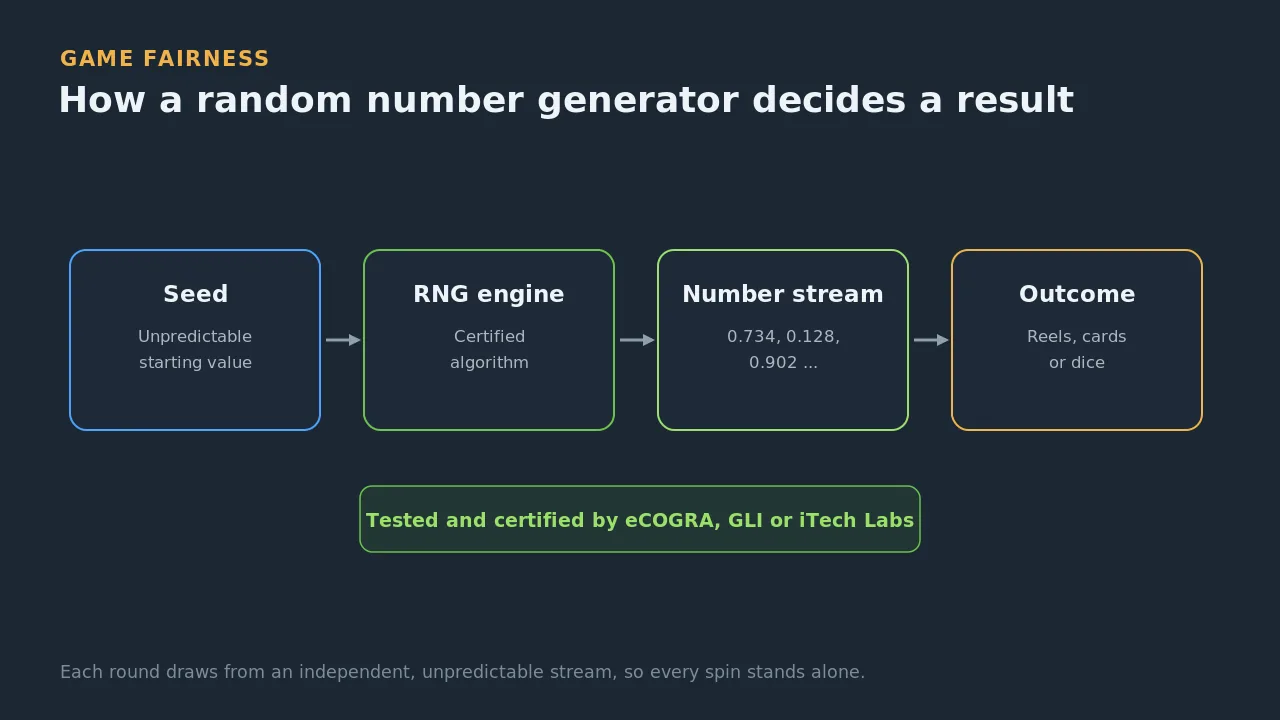
A random number generator (RNG) produces a constant stream of unpredictable numbers, and each number maps to an outcome: a card, a dice roll or a set of reel positions. A good RNG is both unpredictable, so you cannot guess the next result, and unbiased, so every allowed outcome appears at its correct probability. Just as importantly, each round is independent of the last. A slot is never "due" to pay, and a losing streak does not make the next spin any likelier to win.
Independent testing and certification
Studios do not just promise their games are fair, they prove it. Reputable developers send their games and RNGs to independent test houses, which run millions of simulated rounds and confirm that real results match the declared mathematical model. Licensed casinos are then required to offer only certified games, and the operator cannot alter them afterwards.
| Test house | What it checks |
|---|---|
| eCOGRA | RNG integrity, RTP accuracy and fair-play standards; founded in 2003 |
| GLI (Gaming Laboratories International) | Game maths, RNG and security testing across many jurisdictions |
| iTech Labs | RNG and game-fairness certification; now part of the GLI group |
Live dealer games
Live dealer games work a little differently. The randomness comes from real equipment, a physical wheel, real cards or real dice, streamed from a studio in high definition, while the software only handles the bets and payouts. Cameras, trained dealers and optical character recognition keep the results honest, so here the fairness question is answered by what you can watch rather than by code alone.
Provably fair crypto games
Many crypto casinos add a further layer known as provably fair. Using cryptographic hashing, the casino commits to a result before you bet and lets you verify afterwards that nothing was changed mid-round. It is a neat, mathematically checkable way to show a specific outcome was not tampered with, and it is unique to the crypto side of the industry.
The House Edge and RTP
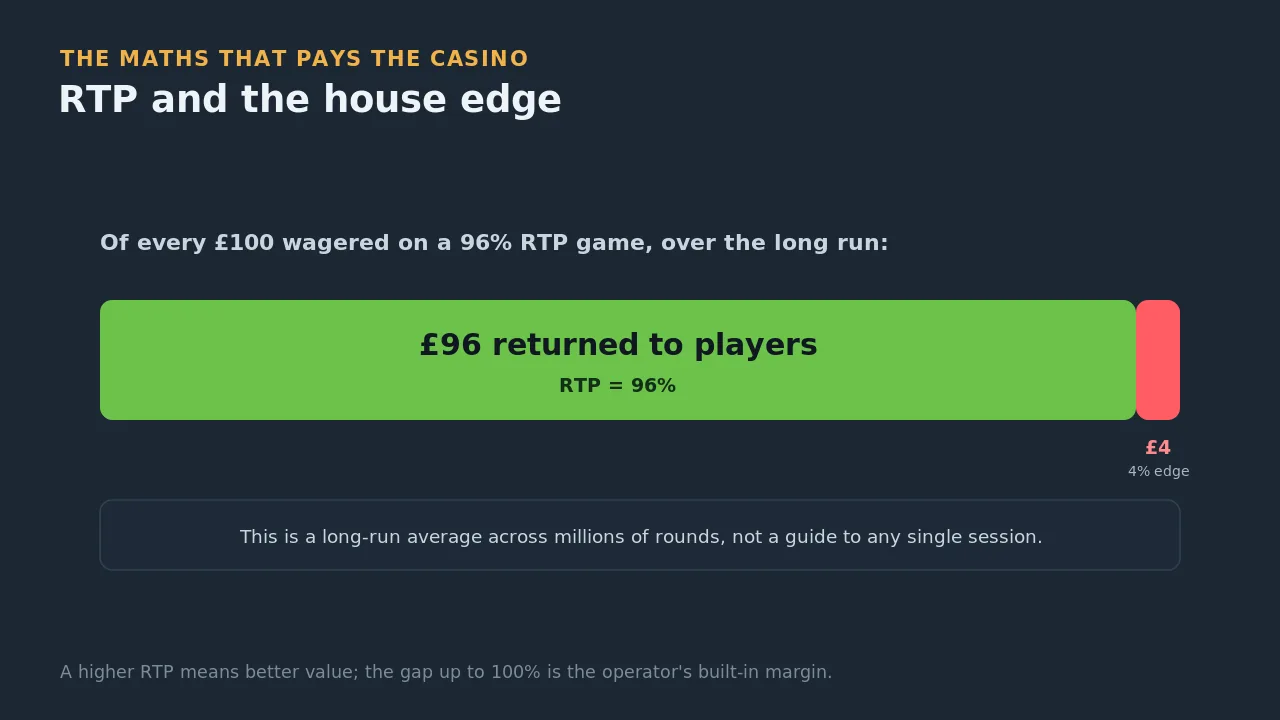
Every game is designed to return a set share of all stakes to players over the very long run. That figure is the return to player, or RTP. A slot with a 96% RTP is built to pay back about £96 for every £100 wagered across millions of spins, which leaves a 4% house edge for the operator. That small, permanent margin is how casinos make money, and it is why, averaged over enough play, the house comes out ahead.
What RTP really tells you
The number to hold on to is that RTP is a long-run average, not a promise about your session. Real results swing above and below it constantly, and how wildly they swing is described by a game's volatility. A high-volatility slot can pay nothing for a long stretch and then land a huge hit, while a low-volatility game trickles out smaller wins. A higher RTP is always better value, so it is worth checking a title's published figure before you play. Our RTP checker and the RTP and volatility guide go deeper on both ideas.
The house edge, game by game
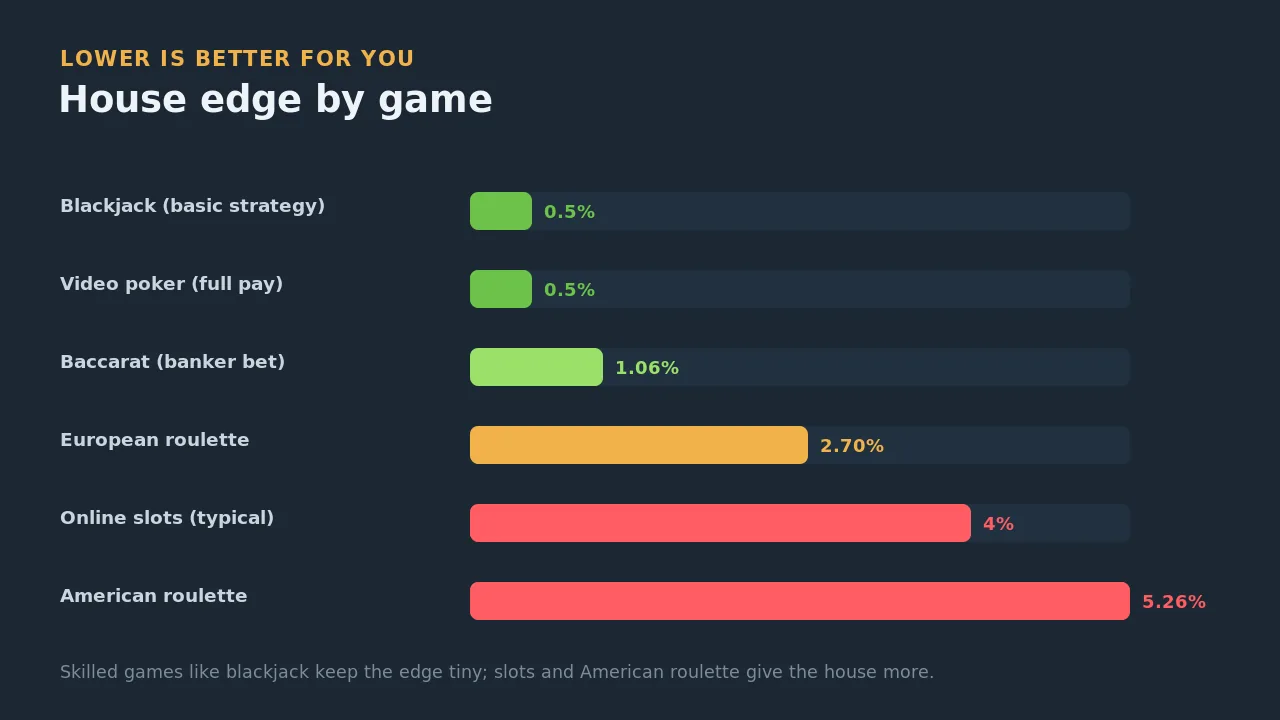
The edge is not the same across the lobby. Skill-based and low-margin games give the house very little, while slots and some roulette variants give it more. The chart and table below show typical figures.
| Game | Typical RTP | House edge |
|---|---|---|
| Blackjack (basic strategy) | 99.5% | ~0.5% |
| Video poker (full pay) | 99%+ | ~0.5% |
| Baccarat (banker bet) | 98.94% | 1.06% |
| European roulette | 97.3% | 2.70% |
| Online slots (typical) | 94% to 97% | 3% to 6% |
| American roulette | 94.74% | 5.26% |
Can you beat the house edge?
Not over the long run. No betting system, staking pattern or "hot" streak overcomes a built-in mathematical margin on a game of chance. Skill elements help at the margins, basic strategy shrinks the blackjack edge to around half a percent, but they never erase it. The healthiest way to read all of this is simple: the edge is the price of the entertainment, so play with money you are comfortable spending.
The Lobby and the Game Studios
Open any casino and the lobby can look overwhelming, but almost everything falls into a handful of categories, supplied by a fairly small group of studios you will quickly start to recognise.
The main game categories
Slots dominate, from three-reel classics to Megaways engines and cluster-pays grids with bonus rounds and free spins. Table games cover blackjack, roulette, baccarat and poker variants against software. Live dealer games stream a real host from a studio for blackjack, roulette, baccarat and TV-style game shows. Jackpots pool a slice of every bet into a prize that can climb into the millions, and a newer wave of instant or crash games settles in seconds around a rising multiplier.
The studios behind the games
Because operators license rather than build their catalogue, the same trusted names appear almost everywhere, and their presence is a useful quality signal.
| Studio | Best known for |
|---|---|
| Pragmatic Play | High-energy slots and a large live casino suite |
| Evolution | The market leader in live dealer tables and game shows |
| NetEnt | Landmark video slots such as Starburst and Gonzo's Quest |
| Play'n GO | Book of Dead and a deep, mobile-first slots library |
| Microgaming (Games Global) | One of the oldest catalogues and progressive jackpots |
How games reach the lobby
Operators plug into studios directly or, more often, through an aggregator, a single technical gateway that bundles thousands of titles from many developers. That is why a mid-sized casino can offer a library in the thousands without signing a separate deal for every game, and why the same new release can appear across dozens of sites in the same week.
Accounts and Verification (KYC)
Playing for real money means opening an account, and that account is where the casino meets its legal duties around fraud, money laundering and age. The process is quick, but knowing what to expect saves a lot of friction later.
Registration
Signing up takes a few minutes: an email address, some personal details and a password. Some crypto-first sites let you start playing almost immediately, but every licensed operator will need to verify you before it releases winnings.
Why verification exists
Identity checks, known as Know Your Customer (KYC), are a legal requirement rather than a casino's whim. Expect to provide proof of identity such as a passport or driving licence, proof of address, and sometimes proof of the payment method you used. The checks confirm you are old enough to play, that you are who you say you are, and that funds are not being laundered.
Source of funds and verifying early
If you deposit or win larger amounts, an operator may also ask for source of funds evidence, for example a payslip or bank statement, which is a standard anti-money-laundering step. The single best habit is to complete verification when you open the account rather than at cash-out time. Do it early and withdrawals are far smoother; leave it to the last minute and it becomes the biggest cause of delay.
How Money Moves: Deposits and Withdrawals
Money handling is where casinos are judged most harshly, and rightly so. Getting funds in is almost always effortless; getting them out is where the differences between operators show.
Deposits
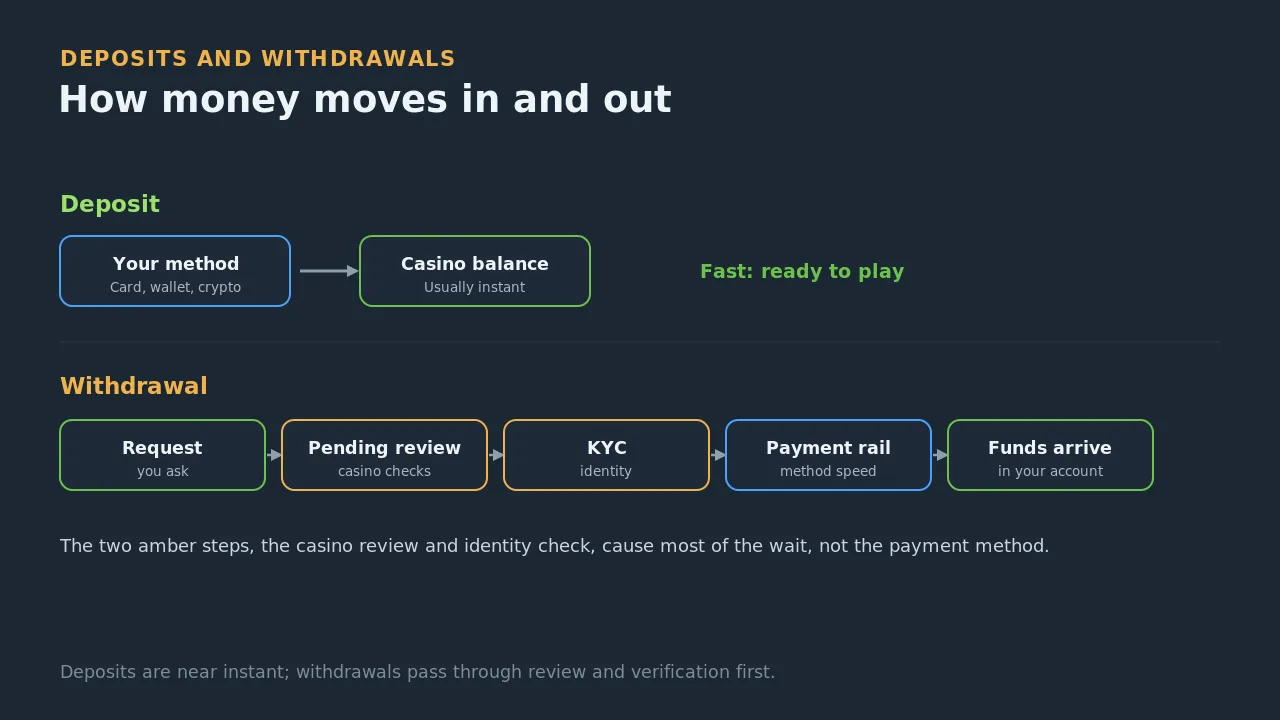
Deposits are usually instant whatever the method, and the money is ready to play the moment it clears. Most casinos support debit cards, e-wallets, bank transfer and, increasingly, cryptocurrency.
Why withdrawals take longer
A withdrawal is not one step but several. First the casino holds it in a pending state for its own review, then verification has to be complete, and only then does the payment rail do its part. The operator's internal processing time often matters more than the method itself, which is why two casinos offering the "same" e-wallet can pay out days apart. Our payments guide breaks down each route in detail.
| Method | Deposit | Withdrawal | Fees |
|---|---|---|---|
| Debit card | Instant | 1 to 3 working days | Usually free |
| E-wallet | Instant | Minutes to 24 hours | Usually free |
| Cryptocurrency | Instant | Minutes to an hour | Network fee only |
| Bank transfer | Up to 1 day | 2 to 5 working days | Bank dependent |
Bonuses and Wagering Requirements
Bonuses are the loudest part of any casino, and also where players most often get caught out. Understanding the mechanics turns a flashy headline into a number you can actually judge.
The main types of bonus
A deposit match tops up your payment with bonus funds at a set percentage. Free spins come tied to specific slots. A no-deposit bonus gives a small amount just for registering. Cashback returns a slice of net losses, and reload offers reward deposits after your first. Ongoing rewards like cashback and reloads are often better long-term value than one huge welcome headline.
Wagering requirements explained
A wagering requirement is how many times you must bet a bonus before winnings from it can be withdrawn. A £100 bonus at 35x wagering means £3,500 in bets first. Two other rules shape the real value: game contribution, where slots usually count 100% but table and live games often count 10% or less, and maximum bet and expiry rules that can void a bonus if you break them.
| Bonus type | Typical wagering | Slots contribution |
|---|---|---|
| Welcome deposit match | 30x to 45x | 100% |
| Free spins winnings | 20x to 40x | 100% |
| No-deposit bonus | 40x to 60x | 100% |
| Cashback | 0x to 5x | Often none |
Licensing and Your Rights
The licence is the foundation everything else rests on. It is the difference between a casino that must treat you fairly and one that can simply keep your money.
What a licence guarantees
A regulator sets standards the operator has to meet: only certified fair games, player funds kept separate from company money, responsible-gambling tools, data protection and a formal complaints route. If a licensed casino treats you unfairly you can escalate to its regulator, a right you simply do not have at an unlicensed site.
The main regulators
| Regulator | Market |
|---|---|
| UK Gambling Commission | Great Britain |
| Malta Gaming Authority | Common for internationally facing sites |
| Spelinspektionen | Sweden |
| Kansspelautoriteit (KSA) | Netherlands |
How to check a licence and raise a dispute
A genuine licence links to the regulator's public register, where you can confirm the operator is listed and in good standing. If a problem cannot be resolved with the casino directly, licensed markets provide alternative dispute resolution and, ultimately, the regulator itself. Verifying the licence is the first thing we do in every review, and our licensing guide shows how to do it yourself in a couple of minutes.
Responsible Gambling
Knowing how the machine works does not change the maths. The house edge means a casino is designed to win over time, so the only sustainable way to play is to treat every stake as the cost of entertainment, never as a way to make money.
Tools that keep you in control
Every licensed casino must offer controls that put you back in charge: deposit and loss limits, session reminders, cooling-off time-outs and full self-exclusion. Set a deposit ceiling on day one, never chase a losing session, and take regular breaks. If play ever stops feeling fun, our responsible-gambling guide explains every tool and where to find free, confidential support.
Play should always feel optional
If gambling starts to feel tense or compulsive, or like a way to fix money worries, step away and use the casino's limit and self-exclusion tools. Support is free and confidential, and reaching out early makes a real difference.
How to Choose a Casino Safely
Once you understand the parts, picking a good casino becomes a short checklist rather than a guess. Run any new site through these questions before you deposit.
A quick pre-deposit checklist
- Licence: is it listed on a recognised regulator's public register?
- Games: are they from certified studios, with RTP figures shown?
- Bonus terms: are the wagering, contribution and max-bet rules reasonable?
- Payments: are your preferred methods supported, with clear withdrawal times?
- Support and tools: is live chat responsive, and are limits and self-exclusion easy to find?
If a site clears all five, it is very likely a safe, fair place to play. If it stumbles on any of them, especially the licence, walk away. There is always another operator that gets the basics right.