
RTP & Volatility Explained
Two numbers shape your time at a casino more than any bonus: how much a game pays back, and how bumpy the ride is. Here is how to read both.



Two numbers do more to shape your time at an online casino than any welcome bonus ever will: RTP and volatility. One tells you how much a game hands back over the long run; the other tells you how bumpy the road there is likely to be. Most players glance at neither, then wonder why one slot drips out steady little wins while another eats their balance for an hour before suddenly erupting. Learning to read both turns that mystery into something you can plan around.
This guide unpacks RTP and volatility in plain language. It shows what a genuinely good RTP looks like, explains why the headline percentage is a long-run average rather than a promise for your session, and helps you match a game's volatility to your budget and your mood. By the end you should be able to read a game's numbers the way an experienced player does, and pick titles that actually suit how you like to play.
Key takeaways
- RTP is the long-run payback. Higher is better, and 96% or more is good for slots.
- Volatility is about swing, not payback. Low means frequent small wins; high means rare big ones.
- Same RTP, different ride. Two games can pay the same over time yet feel nothing alike.
- RTP is an average, not a session guarantee. Short-run results can sit far above or below it.
- Match volatility to your bankroll and goal and you will enjoy the game far more.
What RTP Actually Means
RTP stands for return to player, and it is simply the share of all the money wagered on a game that the game is built to pay back to players over time. If a slot has an RTP of 96%, then across a huge number of spins it returns roughly 96 units for every 100 staked, keeping the other 4 as the house edge. That 4% is how the casino makes its money, and it is the same figure viewed from the other side.
A few things are worth pinning down straight away. RTP is a theoretical figure calculated from a game's design and confirmed by independent testing over millions of simulated rounds. It is expressed as a percentage of turnover, not of your deposit, so it applies to every unit you bet, including winnings you wager again. And it is an average across all players, not a personal forecast. Your own results will bounce around it, sometimes wildly, which is exactly where volatility comes in.
You will sometimes see two RTP figures quoted: a theoretical RTP taken from the game's design, and a measured or actual RTP that casinos and trackers report from real play over a period. The two should be close, and a big gap usually just means the sample is still too small to mean much. The theoretical number is the one to compare between games, because it is the fixed design target that real results gravitate toward.
What Counts as a Good RTP
Because RTP is a percentage, comparing games is easy once you know where the goalposts sit. For online slots, anything from about 96% upward is considered good, and 97% or higher is genuinely strong. Dip below 94% and you are giving up more than you need to. Table games tend to be more generous: blackjack played with basic strategy and baccarat's banker bet both clear 98% to 99%, which is part of why seasoned players gravitate toward them.
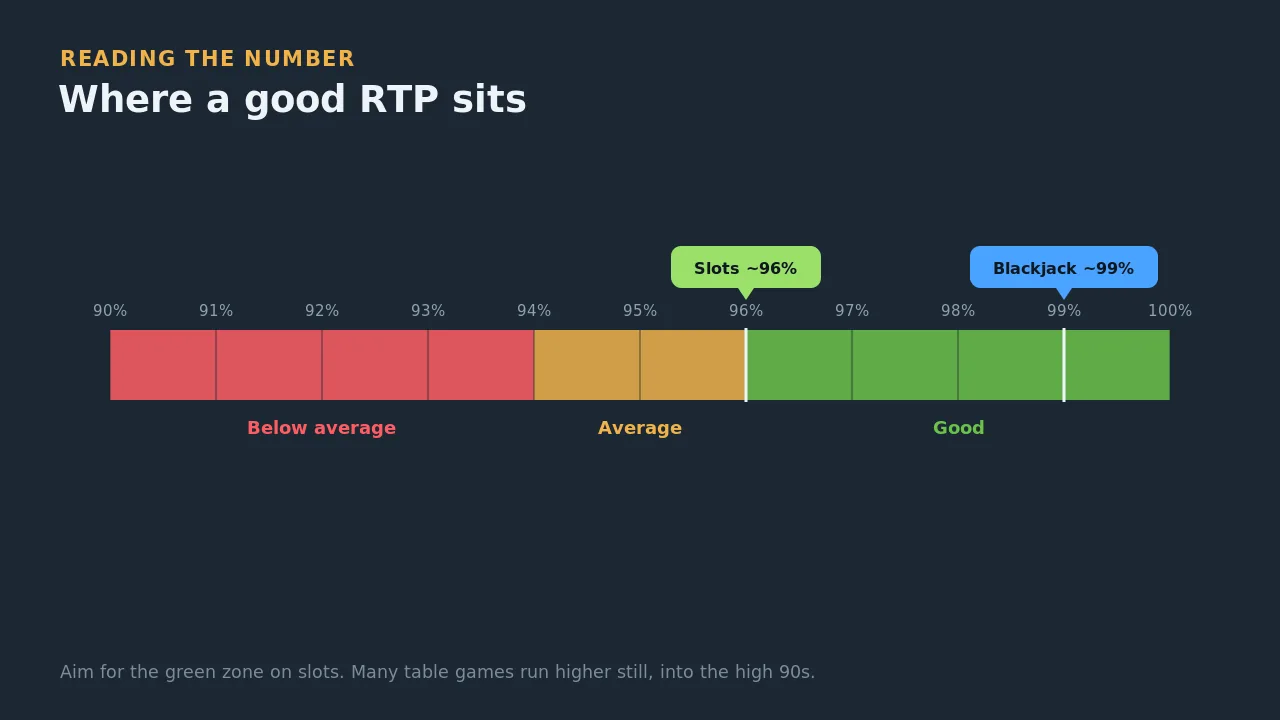
The table below shows typical figures by game type, with a rough sense of how volatile each tends to be. Treat the RTP numbers as ballpark ranges: the exact figure varies by title and, for some games, by the version a casino chooses to run.
One nuance the headline number hides is that some games offer a range of RTP versions, and the casino can choose which one to run. A provider may release the same slot at, say, 96.5%, 95% and 94% settings, and a site is free to load the lower version to widen its margin. The active figure is always disclosed in the game information panel, so it pays to check, especially if you play the same title across several different casinos.
| Game type | Typical RTP range | Typical volatility |
|---|---|---|
| Online slots | 94% to 97% | Low to very high, varies by title |
| Blackjack (basic strategy) | 99% or higher | Low |
| Baccarat (banker bet) | Around 98.9% | Low |
| European roulette | Around 97.3% | Medium |
| American roulette | Around 94.7% | Medium |
| Video poker (full-pay) | Up to 99.5% | Medium |
| Live game shows | 92% to 96% | High |
The pattern is clear: classic table games played well return more of your stake than most slots, while the flashier, more entertaining formats tend to give a little back for the spectacle. None of this makes one choice right and another wrong; it simply tells you how much the maths is costing you, so you can decide what you are happy to pay for the experience you want.
RTP Is a Long-Run Average
The single most misunderstood thing about RTP is the timescale. That 96% is a theoretical figure that only reveals itself across millions of spins. Over your own session of a few hundred, your actual return can sit far above or far below it, which is exactly why a 96% slot can empty your balance one night and double it the next. The percentage is a long-run tendency, not a forecast for your next hour.
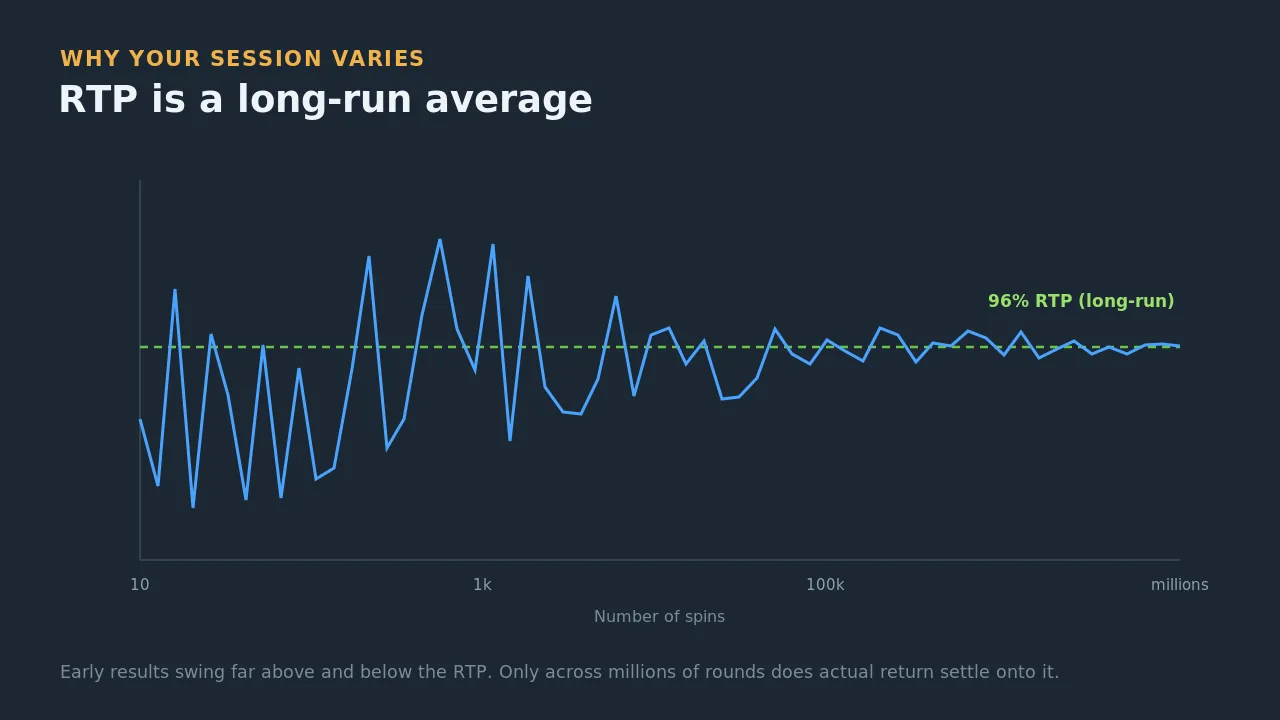
The chart makes the point. Early on, real return bounces far above and below the RTP line, and only as the number of spins climbs into the tens of thousands and beyond does it settle onto the stated figure. No casino resets this and no strategy speeds it up. Grasping it is what stops a good night convincing you a game is "hot", or a bad one convincing you it is broken.
RTP and the House Edge
RTP and the house edge are two views of the same coin. Whatever a game does not return to players over the long run is the operator's margin, so the two always add up to 100%. A 96% RTP means a 4% house edge; a blackjack game running at 99% leaves an edge of just 1%. That edge is why, on average and over time, the house comes out ahead however honest the game is.
The practical takeaway is simple: a higher RTP means a smaller edge and better value for you, every single time. It does not remove the edge or promise a win, but it does mean more of your stake, on average, finds its way back to you. Over a long run of play that difference compounds, so favouring a 97% game over a 94% one can leave noticeably more in your pocket for the same time and stake. Our guide to how online casinos work shows where this margin sits within the wider machine.
What Volatility Actually Means
If RTP tells you how much a game gives back, volatility, sometimes called variance, tells you how it gives it back. A low-volatility game pays small amounts often, so your balance drifts gently up and down and a session feels smooth and steady. A high-volatility game pays rarely but larger, so you can grind through a long, quiet stretch of losses before a single big hit puts you back in front. Crucially, two games can share exactly the same RTP and still feel like completely different experiences because their volatility differs.
This matters because volatility shapes the emotional ride far more than the RTP does. Low volatility suits players who want a relaxed session that lasts, who enjoy frequent small wins and who are playing on a modest bankroll. High volatility suits players chasing a memorable payout, who have the patience to sit through dry spells and the budget to keep spinning until the big win, if it comes, arrives. Neither is better in the abstract; the right choice is simply the one that matches your mood, your budget and how you like the game to feel.
The Volatility Spectrum
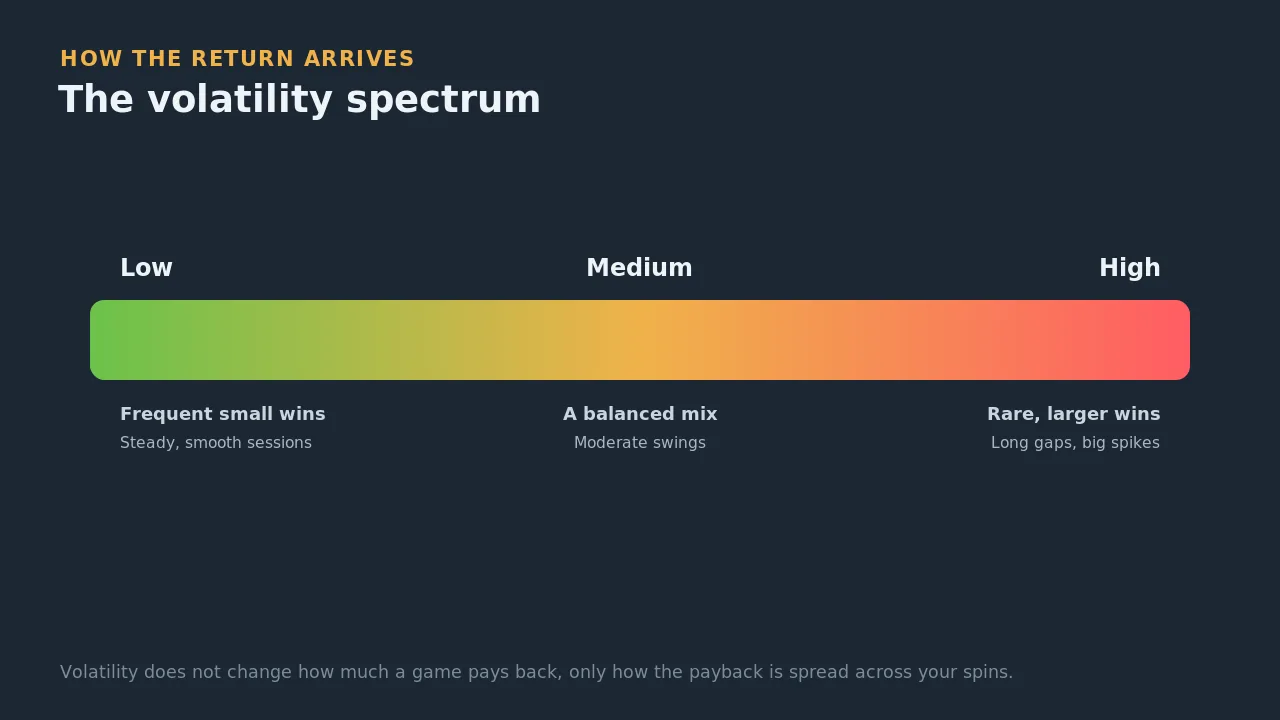
Volatility is not a switch but a slider, and most games sit somewhere along a spectrum from calm to wild. Providers usually label a slot low, medium or high, and understanding the three bands makes it easy to pick a title that matches the session you want.
Low volatility
Low-volatility games pay small amounts frequently. Your balance drifts gently, sessions last a long time on a modest budget, and the experience is relaxed rather than thrilling. They are ideal for stretching a bankroll, clearing wagering requirements steadily, or simply unwinding without big swings.
Medium volatility
Medium-volatility titles sit in the middle, mixing regular smaller wins with the occasional bigger hit. They are the all-rounders of the slot world, which is why so many of the most popular games land here: enough action to stay interesting without the long droughts of a high-variance machine.
High volatility
High-volatility games pay rarely but large. Expect long stretches with little back, punctuated by the occasional outsized win from a bonus round or big combination. They demand patience and a bigger bankroll, and they reward players who are chasing a memorable payout rather than a long, steady session.
| Volatility | Win frequency | Win size | Best suited to |
|---|---|---|---|
| Low | Frequent | Small | Long, steady sessions and smaller bankrolls |
| Medium | Moderate | Mixed | A balance of playtime and excitement |
| High | Rare | Large | Big-win chasing with patience and budget |
Putting RTP and Volatility Together
The two numbers only make full sense side by side. RTP sets the value; volatility sets the feel. A couple of worked examples show how they interact in practice.
One game over 1,000 spins
Imagine a slot with a 96% RTP. In theory, across every 100 staked you get 96 back, but that average only emerges over an enormous number of spins. Stake 1 a spin for 1,000 spins and you will have wagered 1,000; the maths says you should end near 960, yet on a high-volatility title your real result could easily land anywhere from a heavy loss to a sizeable profit. On a low-volatility title over the same 1,000 spins, your result will usually huddle much closer to that 960 figure, with far smaller swings on the way.
Two games, same RTP
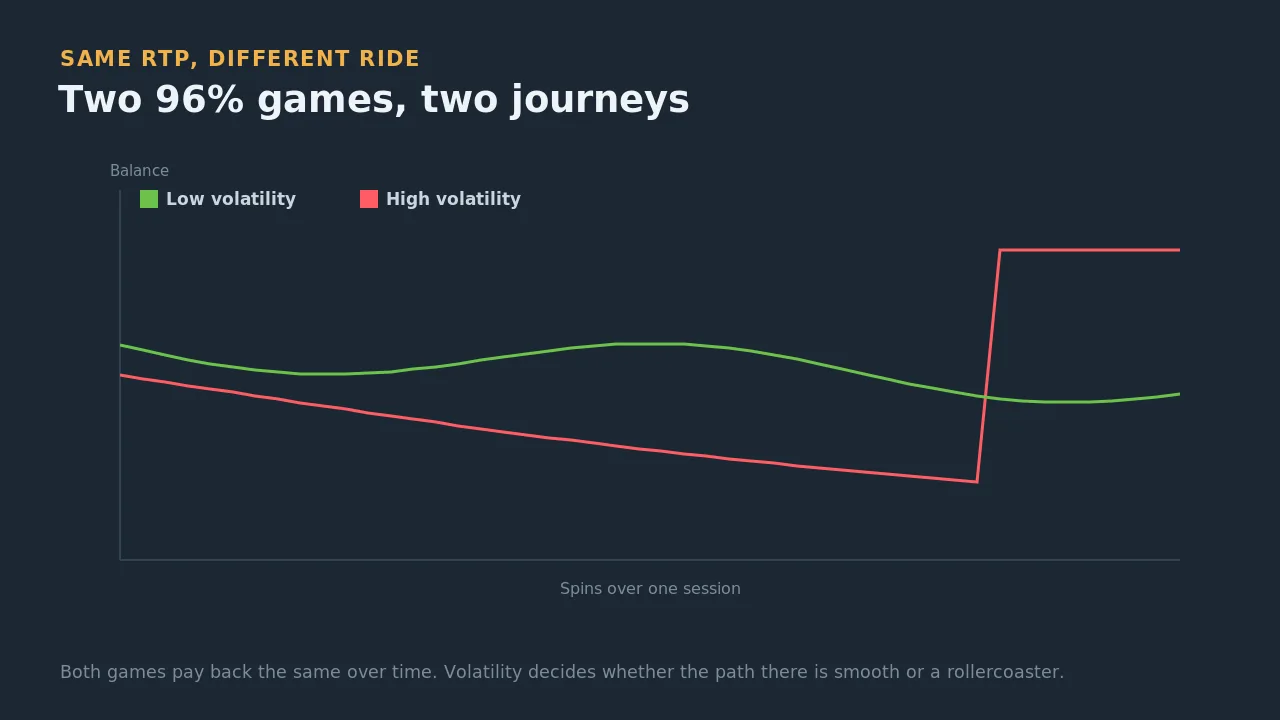
Now compare two games at the same 96% RTP. Wager 200 on a low-volatility slot and you might finish on 185 after a gentle, drawn-out session of small wins. Wager the same 200 on a high-volatility slot and you might be down to 40 with most of your spins gone, then land a bonus round that lifts you to 260 in a single spin. Same payback percentage, same stake, wildly different journeys, and that gap is exactly why the headline RTP alone never tells you what a session will feel like.
Bankroll and Session Length
Once you can read both numbers, the last piece is matching them to your budget. Volatility, even more than RTP, decides how big a bankroll you need and how long a session is likely to last, so it pays to set your stake with the game's temperament in mind.
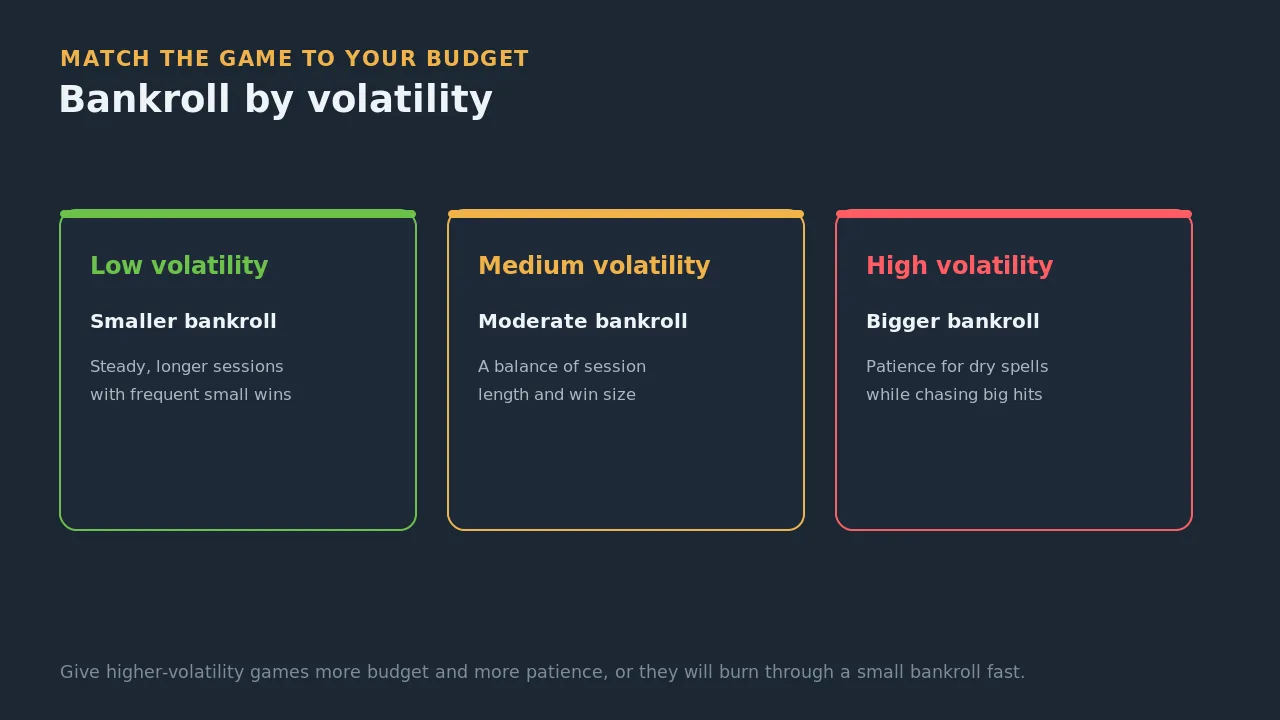
As a rule of thumb, lower-volatility games are forgiving, because wins arrive often enough to keep a smaller bankroll topped up. Higher-volatility games are the opposite, and a common mistake is playing them with a bankroll built for a calm slot, then busting out long before the big win has any chance to land. Give them more budget, smaller stakes relative to that budget, and the patience to ride out the quiet spells. Whatever you pick, set a limit you are comfortable losing before you start and treat any winnings as a bonus rather than income; our responsible-gambling guide covers the tools that help you stay in control.
| Volatility | Bankroll needed | Session style |
|---|---|---|
| Low | Smaller | Long and steady, with frequent small wins |
| Medium | Moderate | Balanced playtime and swings |
| High | Larger | Patient, with long gaps between big hits |
How to Check a Game's RTP
Finding a game's numbers is easier than most players think. The RTP is almost always listed in the game's information or paytable panel, usually behind the small "i" or menu icon, and the same figure appears on the provider's own website. Some casinos also publish RTP lists for their whole library. Our RTP checker lets you look up popular titles at a glance, and the bonus calculator shows how RTP feeds into the real value of a bonus.
A few practical habits will serve you well. Always check the game's info panel before you play, because the active RTP can differ from the provider's headline figure. Treat RTP as a long-run tendency, never a per-session promise: it describes what happens across millions of rounds, not what will happen in your next hour. Match volatility to your bankroll and your goal, giving high-volatility games more budget and more patience. And remember that a higher RTP is simply better value, so when two similar games appeal, the one that pays back more is the sensible pick.
Common RTP and Volatility Myths
A handful of stubborn myths lead players astray. Each one sounds plausible, which is exactly why it persists, and each one quietly costs players money or peace of mind. Clearing them up protects both your bankroll and your enjoyment.
"The game is due to pay"
It is not. Every spin is independent, so a long losing run does not make a win any more likely on the next one. RTP emerges across millions of rounds; it does not "balance out" within your session to reward a drought.
"A higher RTP means I will win"
A higher RTP improves your value over the long run, but variance rules the short run. A 94% game can easily out-pay a 97% one in a single night. RTP tilts the odds slightly in your favour, it does not decide your session.
"Casinos secretly change the RTP while I play"
They cannot flip a certified game's RTP mid-session. What can differ is the published version a casino chooses to run, which is fixed and disclosed in the game information, so check it there rather than assuming the worst.
"Volatility changes how much a game pays back"
It does not. Two games at the same RTP return the same over time; volatility only changes how that return is distributed, whether in many small wins or a few large ones.