
RTP Checker

Turn a game's return-to-player percentage into real numbers. Enter an RTP, your stake and how long you plan to play, and see what you are likely to get back, and lose, on average.
The checker shows a long-run statistical average, not a prediction for one session. Real results swing with volatility.
How the RTP checker works
The tool does the arithmetic that RTP is really describing, in two small steps. First it works out how much money you will put through the game, which is your stake multiplied by the number of spins. Then it applies the house edge, the slice the game keeps, to estimate how much of that turnover you are likely to lose on average. The house edge is simply 100% minus the RTP, so a 96% game keeps 4%.
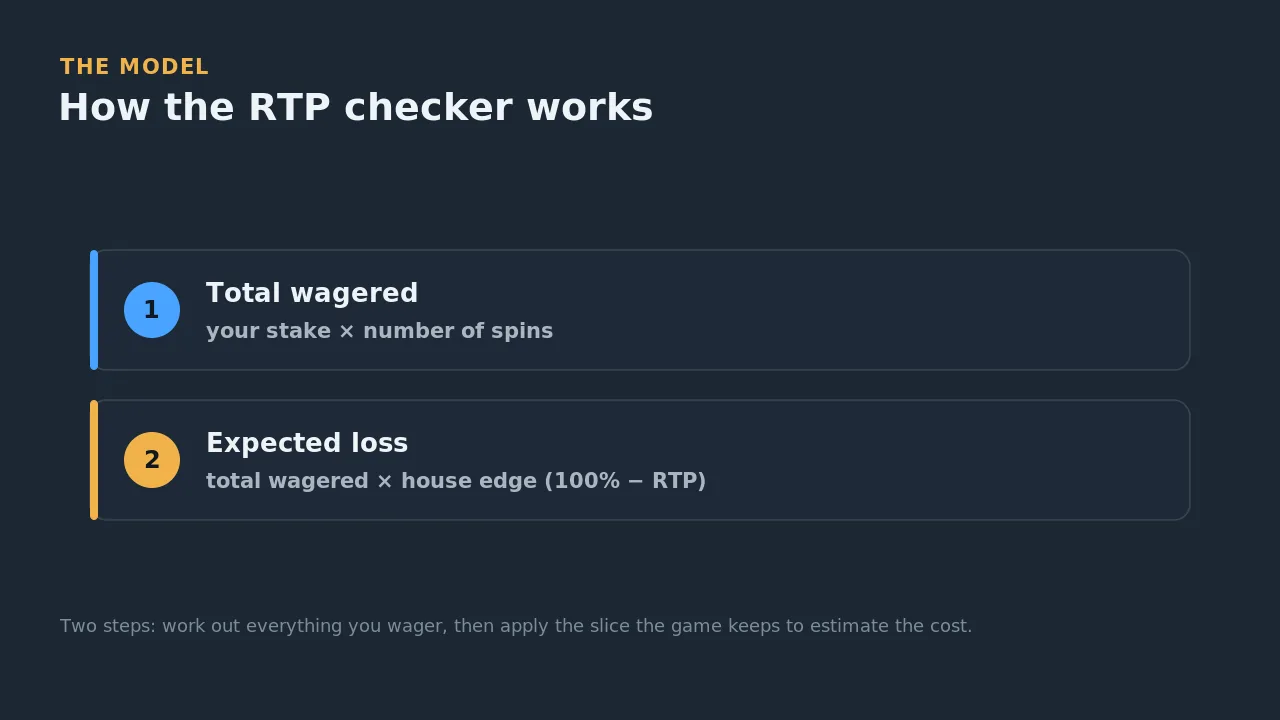
Notice that the figure is based on turnover, not on your deposit. Because winnings get wagered again, a modest starting balance can put far more than its value through a game across a session, and it is that total turnover the house edge nibbles at. It explains why a night's play can cost more than the size of your first deposit suggests, even at a high RTP.
Two things the estimate deliberately leaves out are bonuses and side bets. A bonus changes how much you can wager for your money, which our bonus calculator handles separately, while side bets and extra features often carry their own, usually worse, RTP than the base game. For a clean comparison, feed in the base-game RTP and treat any extras as a decision of their own.
How to read your result
The result gives you three numbers: what you wager in total, what you are likely to get back, and the difference, which is your expected loss. Think of that expected loss as the price of the entertainment, the same way a cinema ticket has a fixed cost. A lower number is better value, but none of the games are free, because every one keeps an edge.
| RTP | House edge | Average cost per £100 wagered |
|---|---|---|
| 99% | 1% | £1 |
| 97% | 3% | £3 |
| 96% | 4% | £4 |
| 94% | 6% | £6 |
| 90% | 10% | £10 |
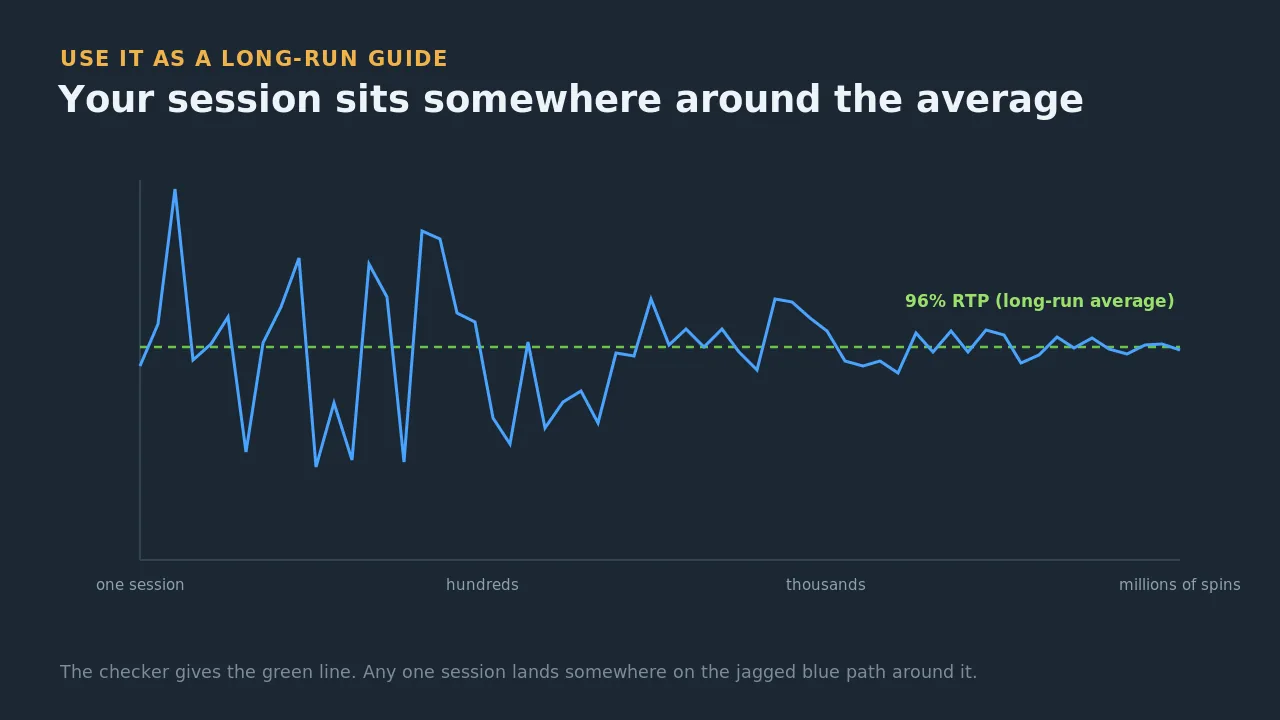
One important caveat: this is an average across a huge number of rounds, not a forecast for tonight. In a single session variance takes over, so you can finish well ahead or lose your balance quickly regardless of the RTP. The estimate tells you the long-run tendency, which is exactly how to use it: as a value comparison, not a promise.
Try it with a quick example. Enter a 96% game, a £0.50 stake and 300 spins, and you will see £150 wagered, about £144 returned and roughly £6 of expected loss. Lower the RTP to 94% and that expected loss climbs to about £9 on exactly the same play. The tool makes those otherwise invisible differences concrete.
Why the RTP number matters
Small differences in RTP look trivial but add up. Because the edge applies to everything you wager, a couple of percentage points quietly change how long your money lasts. The chart below shows the average cost of putting £500 through games of different RTP, and the gap between a 94% and a 97% game is larger than most players expect.
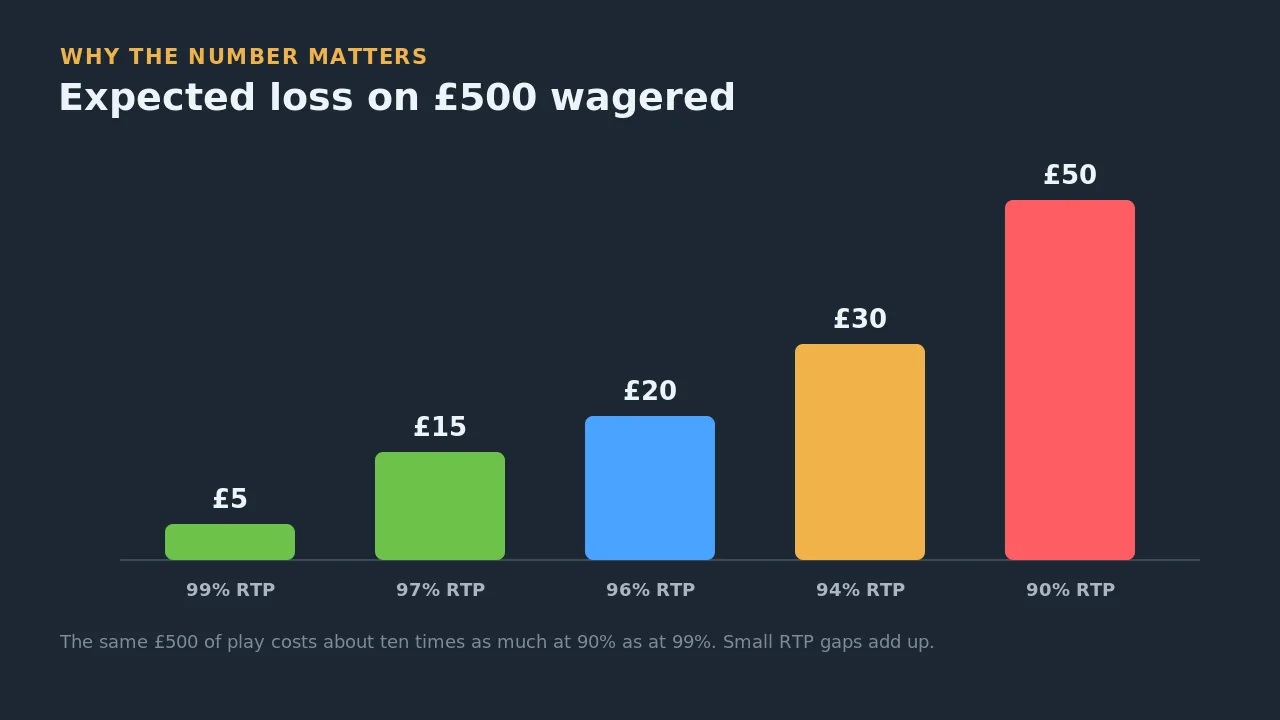
This is why checking the RTP before you play is a genuine, if modest, edge. You cannot beat the house over time, but you can choose to give up less of your money to it, and over many sessions that choice is worth real money. For the full theory behind the number, our RTP and volatility guide goes deeper.
RTP and volatility work together
The checker deals in averages, but averages hide the ride. Volatility, or variance, decides how your money actually behaves on the way to that long-run figure. A low-volatility game pays small and often, so your balance drifts down gently and predictably. A high-volatility game can swallow your stake for a long stretch and then hand it back in a single hit, even though both games might share the same RTP and therefore the same expected loss on the tool.
That is why two players can enter identical numbers here and still have completely different nights. Use the expected-loss figure to compare value between games, and use the volatility rating to decide whether you have the bankroll and the patience for the swings. High volatility on a small budget is the quickest way to see a session end early, however healthy the RTP looks.
Typical RTP by game type
RTP varies a lot by category, and it is one of the biggest levers on how far your money goes. As a rough guide, table games such as blackjack and baccarat, along with video poker, tend to offer the highest returns, often close to 99 percent with sensible play. Roulette sits a little lower, most slots cluster around 96 percent, and jackpot slots are usually lower still because part of every bet funds the prize pool.
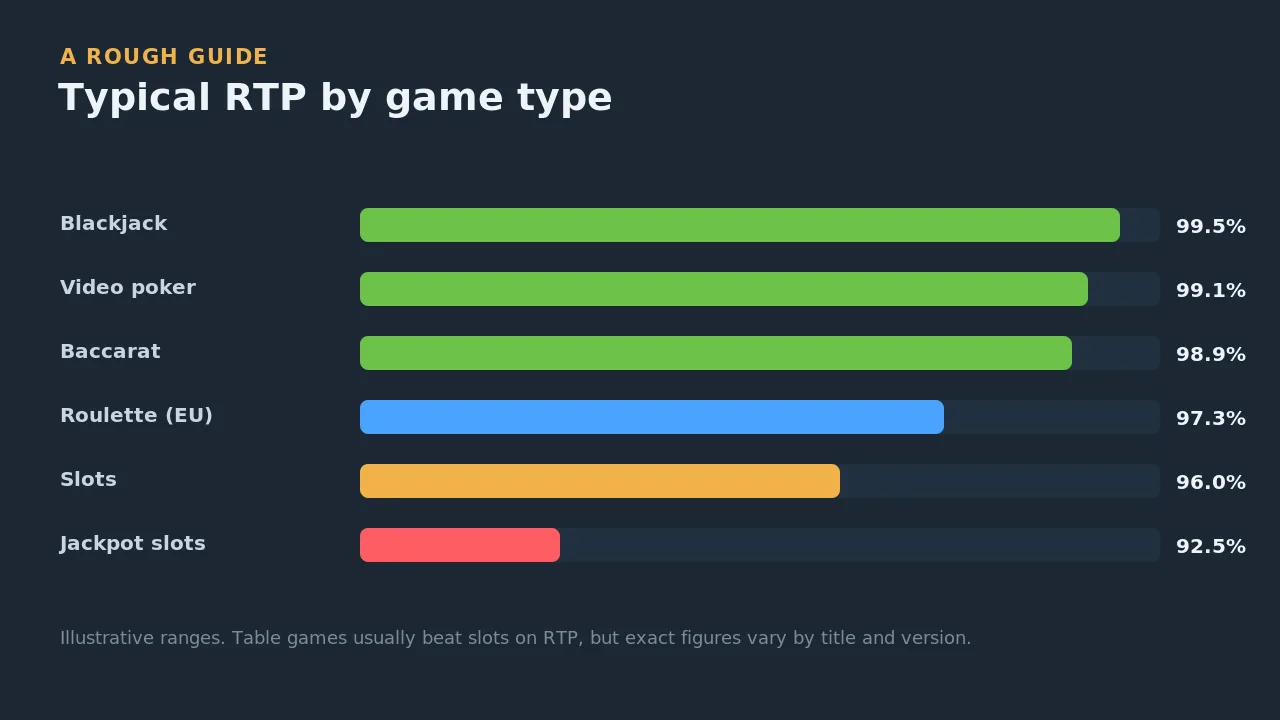
These are broad averages rather than fixed rules, since the exact figure depends on the individual title, the paytable and the version a casino runs. Use them to set expectations by category, then check the specific number inside any game you actually play.
Compare typical RTP by game
If you do not have a specific game's number to hand, the searchable table below gives ballpark RTP and volatility for common game types. Start typing to filter by game, type or provider. Treat these as illustrative ranges: the exact RTP depends on the individual title and the version a casino runs.
| Game | Type | Provider | RTP | Volatility |
|---|
Figures are illustrative samples for demonstration. Always confirm a game's RTP against the provider's published data.
How to find a game's real RTP
The checker is only as good as the number you feed it, so it pays to use the real figure rather than a guess. Almost every game lists its RTP inside the information or paytable panel, usually opened from a menu or an "i" icon in the corner. Providers also publish RTP on their own websites, and well-run casinos display it too, because independent labs verify that games pay at their stated rate.
Watch out for one wrinkle: many popular titles ship with more than one RTP setting, and a casino can choose which version to run. That means the same slot might show 96% at one site and 94% at another. If you play a game across different casinos, check the figure in each, and once you have it, our bonus calculator can turn it into the real cost of clearing a bonus.
How a game's RTP is tested
The RTP a game shows is not simply the developer's word for it. Before a title reaches a licensed casino, independent test houses such as eCOGRA, GLI and iTech Labs run its random number generator through millions of simulated rounds and confirm that real results match the declared mathematical model. Only certified games are allowed on regulated sites, and the operator cannot quietly alter them afterwards.
That certification is what makes the number on the paytable trustworthy, and it is the same fairness layer we describe in our guide to how online casinos work. When you feed a published RTP into the checker, you are working from a figure that has been independently verified rather than a marketing claim.
Remember: RTP is a long-run average
It is worth repeating because it is so often misunderstood. RTP describes the average across millions of rounds played by everyone, not what will happen in your next hour. Most spins return nothing, some return a little, a few return a lot, and only across an enormous sample does the average settle near the stated percentage. A low-RTP game can pay you handsomely tonight, and a high-RTP game can leave you cold, without either contradicting the maths, which is exactly how the house edge is designed to behave over the long run.
Tips to get more play from your bankroll
Using the checker well is about stretching your entertainment, not beating the house. A few habits make a real difference:
- Favour higher RTP when two games appeal equally; the lower edge means a slower average loss.
- Match stake to spins. Size your bet so your balance covers a few hundred rounds, especially on high-volatility games.
- Set a budget first and treat the expected loss as the price of the fun, not an investment.
- Use limits. Deposit and loss limits keep the plan on track; our responsible gambling guide covers them.
Common mistakes when reading RTP
A few misreadings come up again and again, and each one costs players money or peace of mind. The first is treating RTP as a per-session guarantee rather than a long-run average: a 96 percent game does not hand back 96 pence of every pound you stake tonight, it settles near that figure only across millions of rounds, so a single session can land far above or below it. The second is confusing RTP with volatility. Two games can share the same RTP yet feel utterly different, one paying small and often, the other going cold for long stretches before a big hit, because volatility, not RTP, governs the ride. A third common slip is assuming the RTP shown for one title is the same everywhere, when many games ship in several RTP versions and a casino can run a lower one; always check the figure inside the game you are actually playing. Finally, players often forget that RTP applies to total turnover rather than to their deposit, so re-wagering winnings pushes far more money through the edge than the starting balance suggests, which is why a night's play can cost more than the first deposit implies.