
Spinny Casino
- Daily/Weekly Cashback
- Quick Account Verification
- Instant Play (No Download Required)
Welcome Bonus
300% up to £5,000 + 5,000 Free Spins

Where UK slot players should be spinning in 2026, the best-rated casinos for high-RTP titles, Megaways engines and progressive jackpots, plus free spins offers whose terms actually stand up to scrutiny.














Nothing else at a UK online casino gets played as much as the slots, and never has the shelf been this full. At one end sit three-reel machines you can learn in ten seconds; at the other, Megaways engines spawning 117,649 win routes, cascading cluster grids, and progressive networks holding jackpots worth millions of pounds. Between the two extremes, 2026 offers virtually every mechanic a designer has ever shipped.
Each casino ranked above pairs a deep, studio-verified slot catalogue with welcome-package free spins whose terms we checked rather than assumed; for the wider picture, our best UK casinos hub covers every category we rate. The guide that follows gives you the working knowledge to choose well: the mechanics behind the reels, the two numbers that determine value, which formats fit which temperaments, and how to price up a free spins offer before you claim it.
Behind every legitimate slot sits a Random Number Generator, software that churns out thousands of random sequences a second, around the clock, with or without a player attached. The instant you hit spin, whatever the RNG is producing at that moment fixes the outcome. The reels you then watch tumble are theatre; the result was settled before the animation started.
This has a consequence many players resist: spins have no memory. The machine that has gone a week without a jackpot is not building towards one, and the machine that just paid out is not "spent". Every spin carries precisely the same odds as the one before it, because a continuously running random process cannot be due for anything.
How do you know the randomness is real? Certification. UKGC licensees must run RNG systems verified by independent labs (eCOGRA, Gaming Laboratories International and iTech Labs are the principal names) that test outputs across millions of spins to confirm both genuine randomness and that the advertised RTP matches what the game actually returns.
Measured across an enormous sample, usually hundreds of millions of spins, RTP tells you what share of all money staked a game gives back. At 96% RTP, £100 of total wagering returns £96 on average over that whole sample. Your Tuesday evening session will not look like the average: fifty dead spins followed by a 300x hit is perfectly normal behaviour for a volatile game. Treat RTP as the game's long-run economics, never as a forecast for tonight.
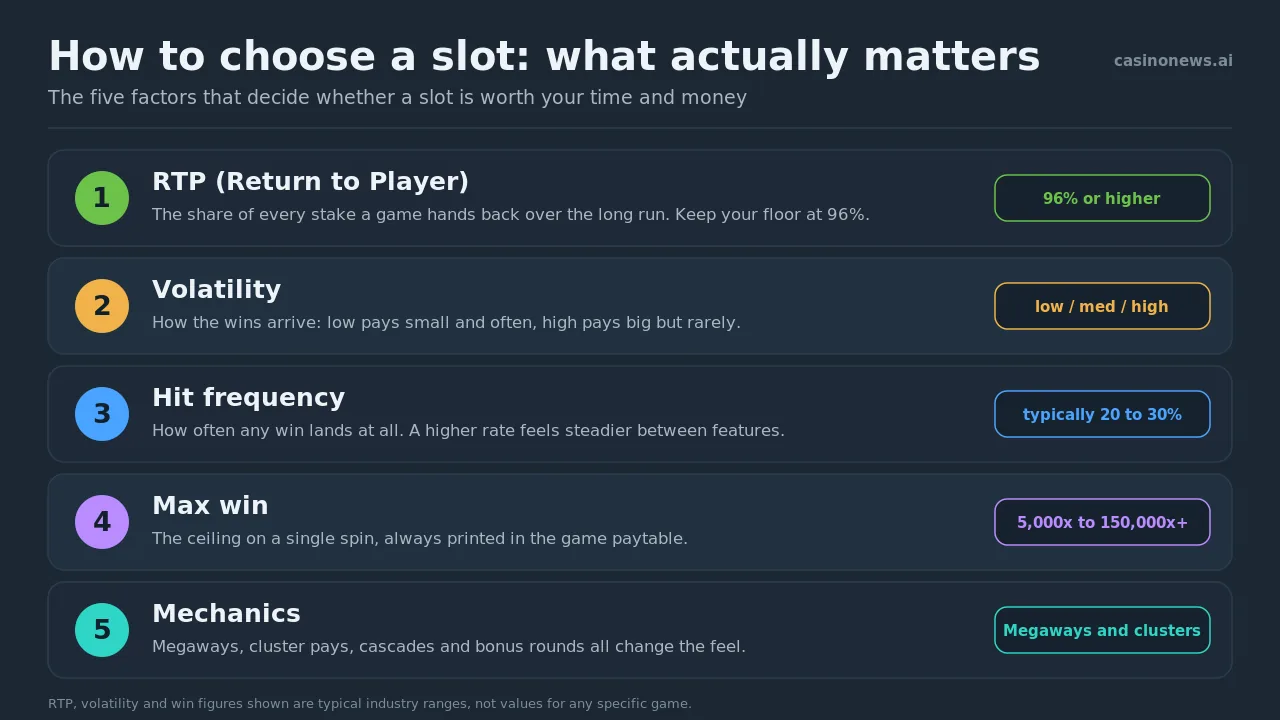
Our advice is to hold the line at 96% and refuse to play below it. Four percentage points, the gap between a 92% and a 96% title, means £4 lost per £100 staked, which compounds brutally for anyone who plays regularly. Every game publishes its RTP in the help screen or paytable, and any casino that makes that figure hard to find has told you something important about itself.
Where RTP describes how much comes back, volatility, also called variance or risk, describes the shape it comes back in. At the high end, wins arrive rarely but land heavily; the format rewards players hunting a serious payout who can sit through barren stretches without flinching. At the low end, small wins drip in constantly, stretching a fixed budget across a much longer session. Most UK players settle in the middle band, which trades a little of each extreme for a balanced ride. Our dedicated guide to RTP and volatility works through both numbers in more depth.
| Volatility level | Win frequency | Typical win size | Best suited to |
|---|---|---|---|
| Low | High, frequent small wins | Small, often sub-stake | Budget players, extended sessions |
| Medium | Moderate | Moderate, 5x to 50x stake common | Most UK players |
| High | Low, long gaps between wins | Large, 100x to 10,000x+ stake | Players chasing big wins with adequate bankroll |
The fruits, bars, bells and sevens of the traditional format, arranged on three reels with payline structures anyone can read at a glance. Modern releases in this category quietly upgrade the formula (nudges, hold buttons, better paytables) without sacrificing the speed and simplicity that make it appealing. If elaborate bonus mechanics leave you cold, this is your corner of the lobby.
The mainstream of the UK market: five or more reels, paylines or ways-to-win, and a toolbox of features (scatter-triggered free spins, wilds that expand or stick in place, cascades that clear winning symbols and drop replacements, pick-me bonus rounds and more). No other category offers anything like this breadth of experience, which is why it dominates every casino's catalogue.
Big Time Gaming's signature idea: let the symbol count on each reel change randomly every spin, so the number of ways to win fluctuates, peaking at 117,649 on a standard six-reel setup. Licensing deals have spread the engine across the industry, and Megaways editions of familiar names such as Book of Dead, Monopoly and Bonanza now rank among Britain's most-played slots. Expect high volatility, with the bonus rounds carrying most of the win potential.
Here a slice of every bet feeds a communal jackpot that keeps climbing until somebody lands it. The wide-area networks (Mega Moolah, Mega Fortune, Age of the Gods) pool stakes from players across many casinos at once, which is how their prizes reach seven figures; standalone versions confine the pool to one game or operator. The price of the dream is maths: because the jackpot contribution comes out of every spin, base-game RTP runs below comparable non-progressive titles.
Abandon paylines entirely and you get the grid format, where wins come from clumps of matching symbols touching each other. Winning clusters usually vanish and let new symbols cascade in, so one hit can chain into several. Reactoonz and Aloha! Cluster Pays defined the genre. The feel is distinctive: a steady, almost meditative rhythm of small chain reactions rather than long waits for one big bonus-round moment.
For an upfront price, usually 50 to 100 times your base stake, these games sell you the bonus round directly instead of making you wait for scatters. The feature is common on 2026 releases, but UK players should know the regulatory split: UKGC rules restrict bonus-buying at UK-licensed sites, while the internationally licensed casinos in our rankings can offer it freely.
Learn to read the studio name before the game name. No single piece of information predicts quality better. Every casino in our rankings stocks certified content from several of the developers below, the ones that matter most to UK players this year.
| Provider | Known for | Signature titles and mechanics |
|---|---|---|
| Pragmatic Play | High-energy video slots and tumbling reels | Gates of Olympus, Sweet Bonanza |
| NetEnt | Polished design and dependable bonus maths | Starburst, Gonzo's Quest |
| Play'n GO | High-volatility adventures and grid games | Book of Dead, Reactoonz |
| Hacksaw Gaming | Ferocious volatility and huge maximum wins | Wanted Dead or a Wild, Stick'em |
| Nolimit City | Inventive high-risk mechanics | San Quentin, Mental (xWays and xNudge) |
| Big Time Gaming | Creator of the Megaways engine | Bonanza Megaways (up to 117,649 ways) |
Nobody ships at Pragmatic's pace (several new slots a month), and remarkably little of it is filler. Gates of Olympus, Sweet Bonanza, The Dog House Megaways and Wanted Dead or a Wild all sit near the top of UK play charts, and the company's live casino arm is simultaneously one of the two giants of that separate market. Very few studios cover both RNG and live products at this level.
Modern online slots owe much of their visual grammar to NetEnt. Titles like Starburst, Gonzo's Quest and Dead or Alive 2 set templates the industry still copies. The house style is unmistakable: clean design, dependable bonus mechanics, rigorous certification. When a casino carries NetEnt, it has paid for pedigree, which is why we treat the partnership as a quality marker in itself.
Ask a British slot player to name one game and the answer is frequently Book of Dead, the title that made the high-volatility Egyptian adventure a genre of its own. Around it, Play'n GO has built genuine range: Reactoonz on the grid side, Gemix, Fire Joker for the classic crowd, all backed by eCOGRA certification and openly published RTP figures.
Three years ago a challenger, today a fixture. Hacksaw's rise has been powered by titles like Wanted Dead or a Wild and Stick'em, games built around ferocious volatility and maximum wins that dwarf the stake. For UK players who measure a slot by its ceiling rather than its hit frequency, Hacksaw has become the default studio.
Nolimit City designs for the deep end. The xWays and xNudge mechanics behind San Quentin and Mental are genuinely inventive engineering, and the max-win figures attached to them rank among the largest in the industry. The audience is self-selecting: players happy to endure long droughts for the possibility of an enormous strike, and few studios serve them better.
Almost every UK welcome package includes free spins, and the biggest batches often surface at new UK casino sites competing for sign-ups. Almost no two batches are worth the same, though. Four questions determine what a spins offer is really worth, so ask them all before you claim.
Spins never float free; they are locked to a named title, and that title's maths sets their value. A batch on Book of Dead (96.21% RTP, high volatility) carries meaningfully more expected value than the identical number on a weak, low-RTP game. Be aware that some casinos deliberately park their spins on obscure titles for exactly that reason: the offer looks the same and pays less.
Look up the stake each spin is fixed at, because it is usually small: £0.10 is typical. Do the multiplication and a headline like "5,000 free spins" resolves to £500 of staking value, and less than that in realistic winnings. Still worth having, but the arithmetic keeps expectations where they belong.
Whatever the spins win is rarely yours immediately: a separate wagering requirement of 20x to 40x usually applies to those winnings. Concretely: thirty £0.10 spins that return £5, under 30x wagering, commit you to £150 of qualifying bets before a withdrawal is possible. Judge every spins offer by that total commitment, never by the spin count on the banner.
Check the clock, too. Spins commonly lapse 7 to 14 days after they are credited, and tight deadlines, especially combined with spins drip-fed in daily instalments, push you into playing on the casino's schedule instead of yours. The player-friendly structure is all spins credited upfront with a fortnight or more to use them.
Start with the honest premise: no staking plan beats the house edge, because the edge is baked into every spin of a chance-based game. What sensible bankroll habits actually buy you is time: longer sessions, protection from wiping out your budget in twenty minutes, and the ability to keep treating slots as the entertainment you intended.
The workable rule of thumb is to stake 1 to 2% of your session budget per spin. Fund a session with £100 and that means £1 to £2 spins, giving you at least a hundred spins for variance to even out and bonus features a realistic chance to land. Push the stake to £5 on the same £100 and the entire session can be over inside 20 spins, win or lose.
Volatile Megaways titles demand an even bigger cushion relative to stake. Fifty consecutive spins without a meaningful base-game win is routine for these games: the value lives in the bonus rounds, and you need enough budget left to still be playing when one finally triggers.
Slots are engineered for pace and engagement. That is their appeal and their risk in one. The single most protective habit is setting your deposit and loss limits before the first spin, when you are deciding with a clear head, rather than mid-session when you are not. Every casino we list offers these controls as standard; the timing of when you use them is up to you.
GamCare provides free, confidential support at any hour on 0808 8020 133. For self-assessment tools and specialist referrals, visit gambleaware.org.
Aim for 96% or higher and treat that figure as your floor. Most quality UK slots return between 95% and 97%, and every game publishes its RTP in the paytable or help screen. The difference sounds small but it compounds: a 92% game costs you £4 more per £100 staked than a 96% one, so it is always worth checking before you spin.
Volatility describes how wins arrive rather than how much comes back overall. Low volatility slots pay small amounts often and stretch a budget across a long session, while high volatility slots pay rarely but can land very large wins. Most UK players settle on a medium setting, which balances regular action against the chance of a bigger hit.
Considerably. A physical machine in a pub or arcade typically runs at 70 to 85% RTP, while the leading online studios publish figures of 95 to 97%. The gap is structural, with no cabinets to maintain and no floor space to rent, and that saved overhead flows back to players as better game maths.
It depends entirely on the game. Ordinary video slots tend to cap between 5,000x and 10,000x your stake, while the extreme end of the market, Nolimit City and Hacksaw Gaming territory, reaches 150,000x and beyond. Fixed maximums are always printed in the paytable. Progressive jackpots are the exception, since they carry no ceiling and have paid out in the millions of pounds.
Effectively yes. Current slots are built in HTML5, which reshapes itself to whatever screen it meets, whether phone, tablet or desktop, and the old Flash titles that could not do this have left circulation entirely. At every casino we recommend, the mobile browser gets the complete slot library with no app installation required.

Leads the review desk and edits every review. Over a decade testing real-money casinos end to end.

Runs the data team behind our Safety Index and fact-checks every review against primary sources.

Certified responsible-gambling professional who keeps our content fair, honest and player-first.