
Bonus Value Calculator



A casino bonus is only worth taking if its likely value beats the cost of clearing the wagering requirement. Enter the figures below to see an instant estimate. Everything is calculated in your browser.
How to use this calculator
Fill in the six fields and the results update as you type, so there is no button to press. Each field maps to a term you will find in a casino's bonus terms and conditions, and if any of them are unfamiliar, our casino glossary defines them in plain English.
- Bonus amount: the bonus credited to your account. For a offer of 100 percent up to 200 pounds on a 200 pound deposit, that is 200 pounds.
- Deposit amount: the cash you pay in to claim the offer.
- Wagering requirement: the multiplier you must bet. A figure of 35x means you must stake 35 times the wagering base before you can withdraw.
- Wagering applies to: whether the requirement is based on the bonus only, or the bonus plus your deposit. The second option is roughly twice as hard to clear.
- Game contribution: the percentage of each bet that counts toward wagering. Slots are usually 100 percent, while table games are often weighted far lower, and a lower percentage means more turnover.
- Average game RTP: the return to player of the games you will play. A typical online slot sits around 96 percent, meaning the house keeps about 4 percent of turnover on average.
How the calculation works
The calculator uses a standard expected-value model in three short steps, and understanding it makes the result far more useful than a single number on its own.
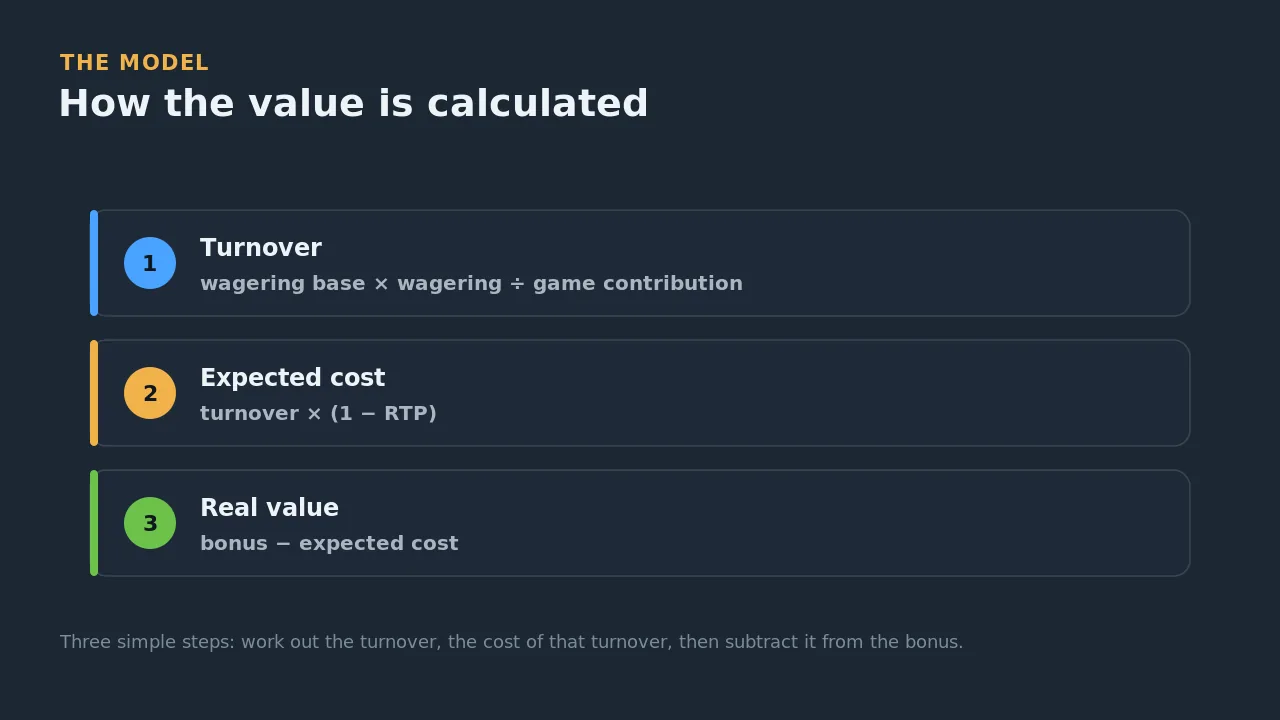
First it works out the turnover, the total you must bet, by multiplying the wagering base by the requirement and dividing by the game contribution. Then it estimates the expected cost of that turnover by applying the house edge, which is simply one minus the RTP. Finally it subtracts that cost from the bonus to give the real value. If the cost of clearing the wagering is greater than the bonus, the real value is negative, a clear sign the offer is likely to cost you money on average rather than reward you.
A worked example
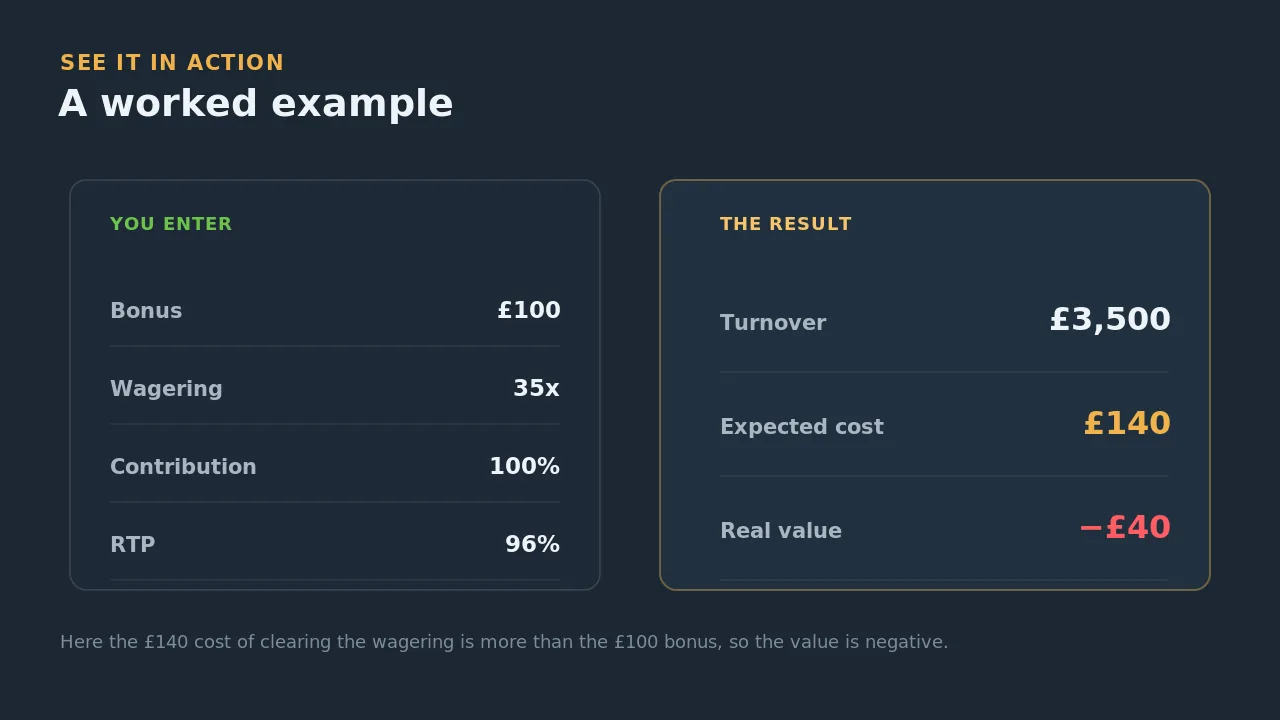
Numbers make it concrete. Take a common offer: a 100 pound bonus with 35x wagering on the bonus only, played on slots that contribute 100 percent and return 96 percent. The calculator runs it through in an instant.
| Field | Value |
|---|---|
| Bonus amount | 100 pounds |
| Wagering | 35x, bonus only |
| Game contribution | 100 percent |
| Average RTP | 96 percent |
| Turnover to clear | 3,500 pounds |
| Expected cost | 140 pounds |
| Real value | minus 40 pounds |
The lesson is striking: a headline 100 pound bonus can carry a negative real value, because the 140 pound expected cost of betting 3,500 pounds through a 4 percent house edge outweighs it. Drop the wagering to 20x and the turnover falls to 2,000 pounds and the cost to 80 pounds, turning the same bonus positive. That single change is why the wagering figure matters more than the size of the bonus.
What your result means
The headline number is the estimated real value, and its sign is what matters most.
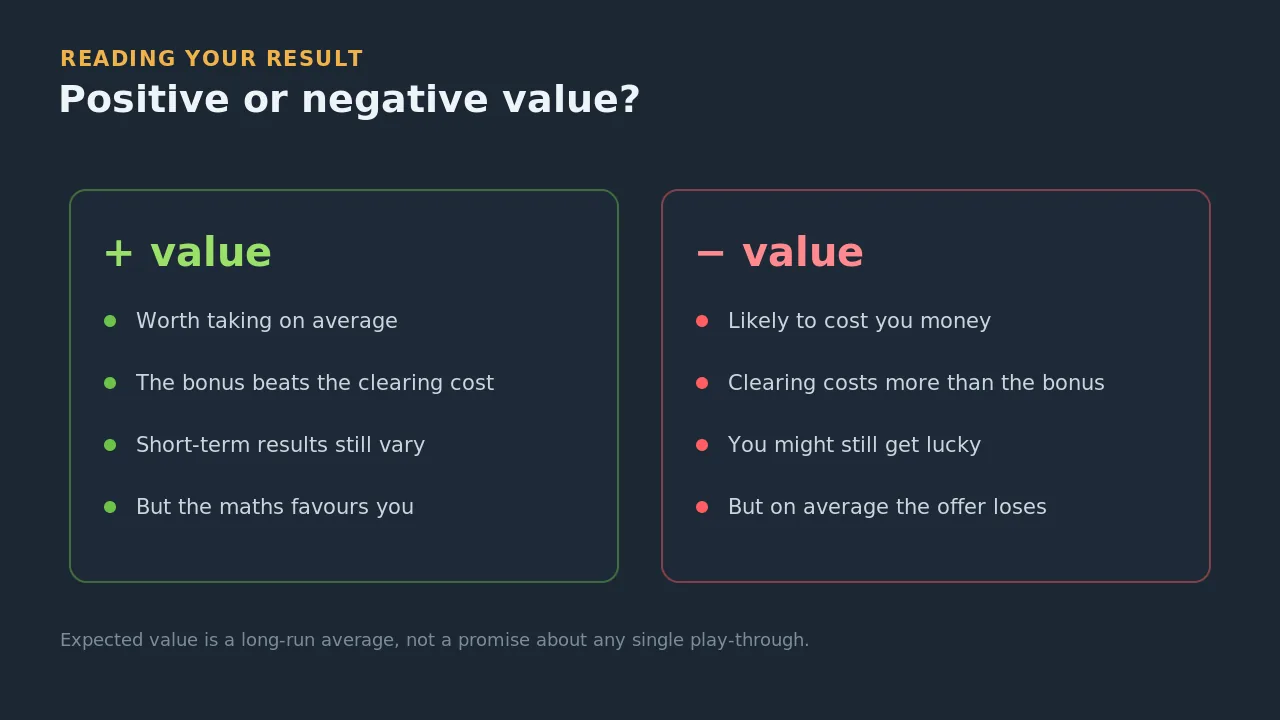
A positive value means that, on average and over the long run, the bonus is worth more than it costs to clear, so it is a reasonable offer to take if you were going to play anyway. A negative value means the expected cost of the wagering is greater than the bonus, so on average the offer is likely to lose you money. Neither figure predicts a single session, because short-term results swing widely, but expected value is the fairest way to compare one offer against another.
Why the wagering requirement matters most
If you take one thing from this tool, let it be that the wagering requirement, not the bonus amount, usually decides whether an offer is any good. Because you must bet the requirement in full and each bet is exposed to the house edge, a high multiplier quietly turns a generous-looking bonus into a probable loss. Halving the wagering does far more for the real value than doubling the bonus.
Encouragingly, the market has been moving in players' favour on exactly this point, with newer brands competing on lower and even wager-free terms. We cover that shift in our report on wagering requirements trending lower, and this calculator is the quickest way to see the difference a lower figure makes to any specific offer.
Tips for getting real value from a bonus
A few habits turn the calculator's insight into better decisions. Favour offers with low wagering and, ideally, a requirement on the bonus only rather than deposit plus bonus. Play the highest-contributing games you enjoy, usually slots at 100 percent, so your turnover clears efficiently, and choose games with a solid RTP to keep the expected cost down. Above all, compare the real value rather than the headline: a modest bonus with fair terms routinely beats a huge one you are unlikely to clear.
The limits of this estimate
The result is a model, not a crystal ball, and it is honest to say so. RTP is a long-run average, so any single play-through can land far above or below the expected cost because of variance. The calculator also cannot see terms it is not given, such as a maximum cashout, a maximum bet while wagering, a time limit or excluded games, all of which affect a bonus's true worth. Use the estimate to compare offers and set expectations, then always read the casino's full terms before you claim.
Frequently asked questions
What does this bonus calculator do?
It estimates the real value of a casino bonus by comparing the bonus with the expected cost of clearing its wagering requirement. Enter the figures and it shows the turnover you must bet, the likely cost, and whether the offer is worth taking on average.
How do I calculate a wagering requirement?
Multiply the wagering base by the requirement. A 100 pound bonus at 35x means 3,500 pounds of turnover. If the wagering applies to your deposit plus the bonus, use that combined figure as the base, which roughly doubles the work.
What counts as wagering contribution?
Contribution is the share of each bet that counts toward the requirement. Slots usually count 100 percent, so every pound staked clears a pound of wagering, while table and live games often count 10 percent or less. A lower contribution means you must bet far more to clear the same requirement, which raises both your turnover and your expected cost.
Is a bigger bonus always better?
No. The wagering requirement usually matters more than the headline figure. A large bonus with a high multiplier can carry a negative real value, while a smaller bonus on fair terms can be worth taking. Compare the estimated real value rather than the bonus amount, and remember that halving the wagering does more for you than doubling the bonus.
Does this include free spins?
Not directly. This calculator is built for cash bonuses expressed as an amount with a wagering multiplier. Free spins usually credit their winnings as a bonus with its own wagering, so once you know the value and terms of those winnings you can enter them here to estimate the real value.