
Responsible Gambling & Staying in Control
Gambling should stay a bit of fun you can afford. This guide shows you the tools, the warning signs and the support that keep it that way.



For the overwhelming majority of people, gambling is a bit of entertainment: a few spins, a bet on the match, a flutter that adds a spark to the evening. It only becomes a problem when it stops being a choice, when the spending creeps up, the losses get chased, and the fun quietly turns into a habit that is hard to control. Responsible gambling is simply the set of habits and tools that keep you on the right side of that line, and this guide lays them out plainly.
There is no judgement here, and nothing to be ashamed of. Gambling companies are designed to be engaging, the maths always favours the house, and anyone can drift from a bit of fun into spending more than they meant to. What matters is knowing how to set your own boundaries, how to spot when things are slipping, and where to turn for free, confidential help if you need it. If any part of this feels close to home, you are not alone and support is always available.
Key takeaways
- Set your limits first. Deposit, loss and time limits are free at every licensed casino and work best set before you play.
- It is entertainment, not income. The odds favour the house, so treat any spend as the cost of the fun.
- Know the warning signs. Chasing losses, hiding it or borrowing to play are cues to pause.
- Self-exclusion is always available, for a single site or, through GamStop, for many at once.
- Help is free and confidential. Every market we cover has its own national helpline, listed near the end of this guide.
What responsible gambling really means
Responsible gambling is not about never playing, and it is certainly not about willpower or being strong enough to stop. It is about setting up your play so that staying in control is the default, not something you have to fight for in the heat of the moment. That means deciding what you can comfortably afford to lose before you start, keeping gambling as one hobby among many, and being honest with yourself about how it makes you feel.
A big part of it is understanding what you are actually playing. Because every game keeps a built-in mathematical edge, gambling is a form of paid entertainment rather than a way to make money, no matter how a hot streak feels in the moment. Seeing it clearly, as explained in our guide to how online casinos work, takes the pressure off: you are buying entertainment, and the sensible question is simply how much you want to spend on it.
It also helps to separate the game from the outcome. A good session is one where you stayed within the limits you set and enjoyed yourself, whether you finished a little up or a little down. Judging your play by whether you won leaves you at the mercy of variance; judging it by whether you stayed in control puts you back in charge.
The tools that keep you in control
Every licensed casino is required to give you a toolkit for managing your play, and all of it is free. The trick is to treat these as seatbelts, not handbrakes: set them up when you are calm and clear-headed, and they quietly do their job in the background so you never have to rely on in-the-moment discipline.
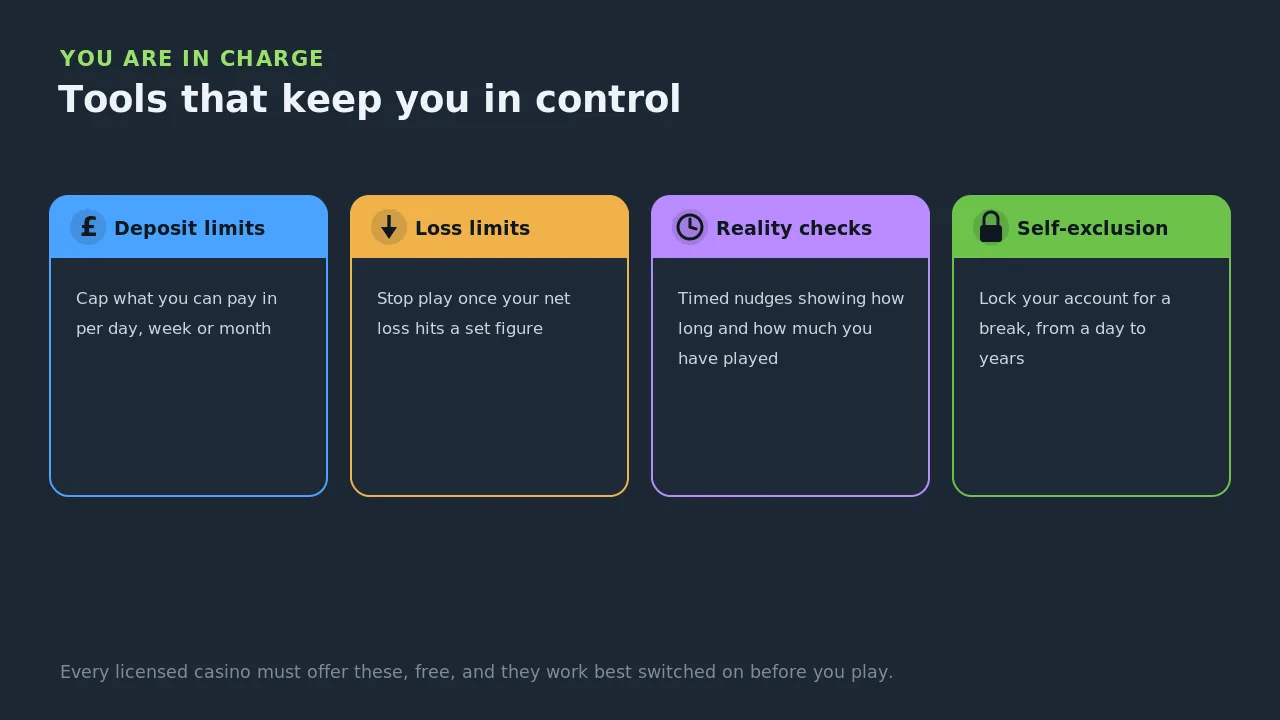
You will usually find all of these under a "responsible gambling" or "limits" section in your account. The table below sums up what each one does and where to set it.
| Tool | What it does | Where to set it |
|---|---|---|
| Deposit limit | Caps how much you can pay in per day, week or month | Account settings |
| Loss limit | Stops play once your net loss hits a set figure | Account settings |
| Time-out | Locks your account for a short cooling-off period | Account settings |
| Reality check | Pops up to show how long and how much you have played | Account settings |
| Self-exclusion | Blocks access for months or years when you need a break | Account, or GamStop |
A quick word on how these fit together: limits stop the money and the time getting away from you, reality checks keep you aware in the moment, and self-exclusion is the circuit breaker for when you need real distance. You do not have to use all of them, but pairing a deposit limit with a reality check covers most people, most of the time.
Setting limits that actually work
A limit only helps if it reflects a number you genuinely will not miss. The simplest approach is to decide on an entertainment budget the same way you would for a night out: an amount that, if it were gone by the end, would not affect your rent, your bills or your peace of mind. Set your deposit limit to that figure, and let it reset weekly or monthly rather than daily so you are not tempted to nudge it up.
Time matters as much as money. It is easy to lose an hour without noticing, so a reality check every 30 or 60 minutes is a gentle, effective nudge. Pair your money limit with a rough time budget, and avoid playing when you are tired, bored or upset, because that is exactly when limits get stretched. If you want to size your budget sensibly against how volatile your games are, our RTP and volatility guide explains how quickly different games can move a balance.
One more trick makes limits stick: set them to renew automatically and resist raising them mid-session. Any increase should wait until the next day, when the urge has passed and you can think clearly. Most casinos build in that delay for exactly this reason, and it is one of the most useful safeguards they offer.
Taking a break: time-outs and self-exclusion
Sometimes the healthiest move is simply to step away, and there are two levels of doing that. A time-out is a short cooling-off period, from 24 hours up to six weeks, that locks your account and then quietly restores it. It is perfect for breaking a run of impulsive sessions without any long-term commitment.
Self-exclusion is the stronger option, blocking your access for six months, a year, or longer. You can self-exclude from a single casino, but most markets also run a free national scheme that blocks every licensed operator in one step: GamStop in the UK, Spelpaus in Sweden, ROFUS in Denmark, Cruks in the Netherlands and BetStop in Australia. Because a licence obliges casinos to honour these schemes, sticking to properly licensed sites is what makes self-exclusion actually work. Crucially, self-exclusion cannot be quietly reversed the moment you change your mind. Once it is in place, there is a mandatory cooling-off period before it can be lifted, and the block does not simply switch off when the term ends; you have to take a deliberate step to reactivate your account. That built-in friction is the whole point, because it protects your future self from a spur-of-the-moment decision made in a difficult hour.
Because these schemes differ from country to country, it helps to know which one applies where you play. The table below lists the main national self-exclusion registers across the markets we cover, each of which blocks every locally licensed operator in a single step.
| Country | National scheme | What it blocks |
|---|---|---|
| United Kingdom | GamStop | All UK-licensed online operators |
| Sweden | Spelpaus | All Swedish-licensed gambling |
| Denmark | ROFUS | All Danish-licensed operators |
| Netherlands | Cruks | All Dutch-licensed operators |
| Australia | BetStop | All licensed Australian online operators |
Signing up takes only a few minutes and, once active, the block cannot be undone on a whim, which is exactly what makes it work. If your market is not listed here, your individual casino's own self-exclusion still applies, and a device-level blocking app such as Gamban can cover your phone and computer as well.
Warning signs to watch for
Gambling harm rarely arrives all at once. It usually creeps in one small habit at a time, which is exactly why catching it early matters so much. None of the signs below means you have a problem on its own, but noticing several together is a clear cue to pause and take stock.
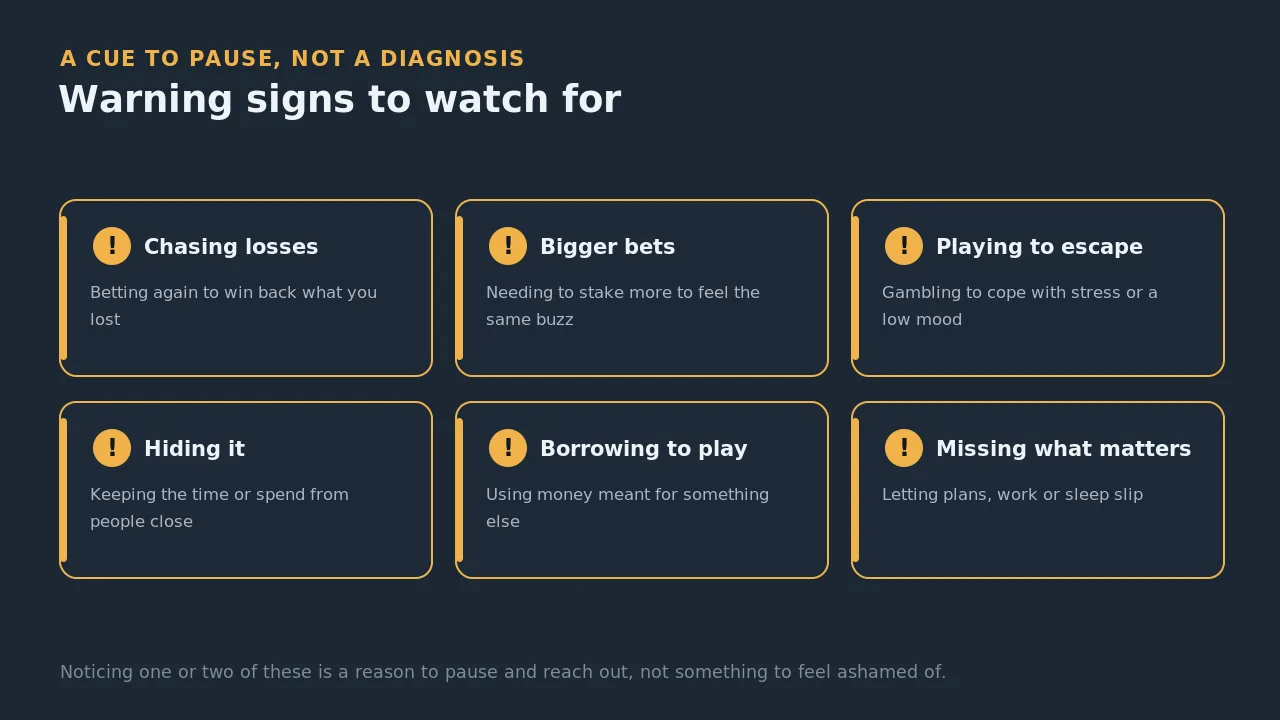
The most common sign is chasing losses: betting again, often bigger, to win back what has gone, which tends only to dig the hole deeper. Close behind are needing larger stakes to feel the same excitement, and gambling to escape stress, boredom or a low mood rather than for fun. Others are more practical, such as hiding the time or money from people close to you, borrowing or dipping into cash set aside for something else, and letting work, sleep or plans slip. If a few of these feel familiar, treat it as useful information rather than a verdict, and use the quick self-check below to gauge where you stand.
A two-minute self-check
If you are not sure where you stand, a few honest questions can help. This is not a diagnosis, and only a professional can give you that, but these are the kinds of things support services ask, and they are a gentle way to decide whether it is worth reaching out.
Ask yourself
- Have you bet more than you could really afford to lose?
- Have you needed to gamble with larger amounts to get the same feeling?
- Have you gone back another day to try to win back losses?
- Have you borrowed money or sold anything to fund gambling?
- Have you felt guilty, anxious, or that gambling might be a problem?
There is no score to add up and no pass or fail. If you answered yes to even one or two and it has been nagging at you, that is reason enough to set firmer limits, take a break, or talk to one of the free, confidential services listed further down. Reaching out early makes everything that follows easier.
How to cut back
If you want to rein things in, you do not have to do it all at once. A handful of small, practical steps stacked over time works far better than a single grand resolution you cannot keep.
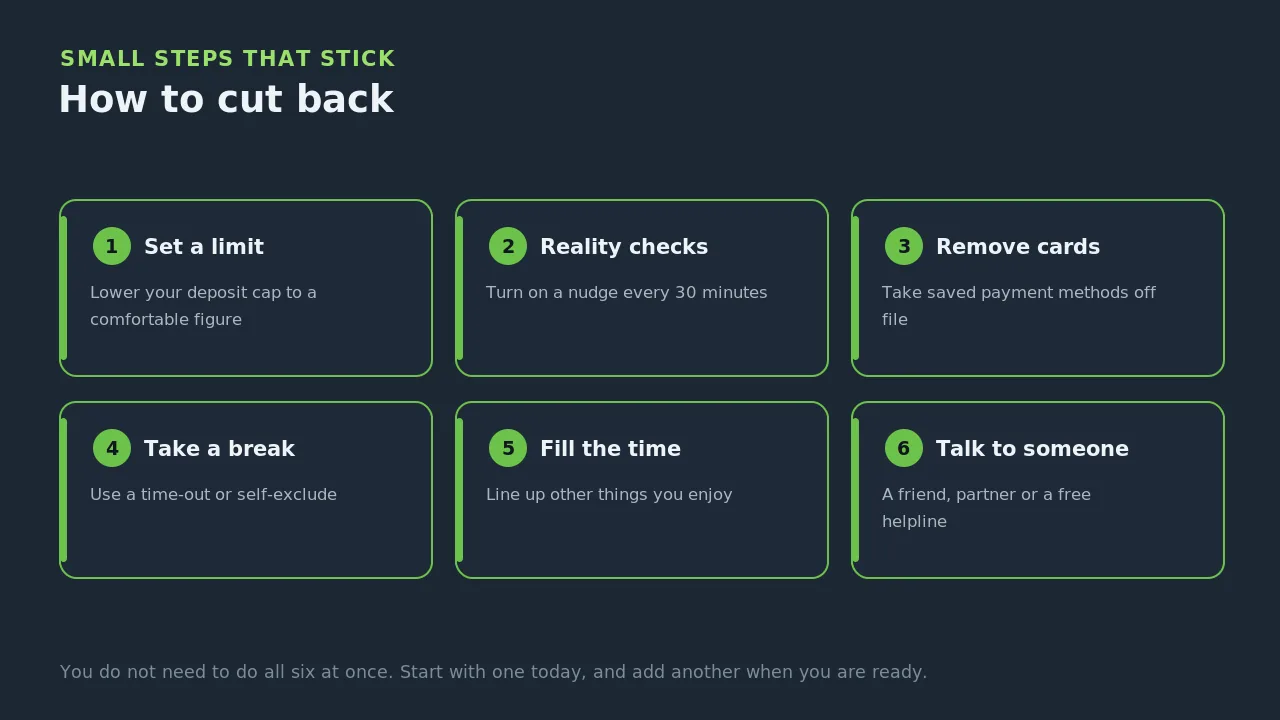
Start with the money: lower your deposit limit to a figure that feels comfortable, and switch on a reality check so time does not quietly slip away. Removing saved cards from the cashier adds a helpful moment of friction before any deposit. When you need more distance, a time-out or self-exclusion takes the decision out of your hands for a while. Then fill the space that gambling leaves with something else you enjoy, because a gap with nothing in it is hard to hold. Finally, tell someone: a friend, a partner, or a free helpline. Saying it out loud makes it real and turns a private struggle into something you have support with.
Common myths that keep people playing
A few persistent beliefs make staying in control harder, because each one quietly nudges you to keep going. Seeing through them is part of playing safely.
"I am due a win"
Every spin and every hand is independent. A long losing run does not make a win any likelier next time, and the game keeps no memory of what you are owed. This is the gambler's fallacy, and it is one of the most expensive ideas in the casino.
"I can win it back"
Chasing a loss feels logical in the moment but works against you, because the house edge applies to every new bet exactly as it did to the last. The most likely result of trying to win back a loss is a bigger one.
"A system beats the game"
No staking pattern, hot streak or betting system overcomes a built-in mathematical edge on a game of chance. A system can change the shape of your losses, but not whether they come.
"It is fine as long as I can afford it"
Affordability matters, but harm is not only financial. Time, stress, sleep and relationships can all suffer even when the money can be spared, so it is worth watching how gambling makes you feel, not just what it costs.
Gambling and your wellbeing
Gambling and how you feel are closely linked, and the connection runs both ways. Reaching for a flutter to escape stress, anxiety or a low mood is one of the clearest signs that play has stopped being simple entertainment, and it usually leaves the underlying feeling worse once the session ends.
Harm also spreads well beyond the balance. Worry about money can disturb sleep, strain relationships and feed a cycle of guilt and secrecy that weighs on your mental health. If gambling has become tangled up with how you are coping, it helps to look after both at once, the habit and the feelings underneath it. Speaking to your doctor or a mental-health service, alongside a gambling helpline, is a sensible step, and there is no need to sort it out alone. If you are going through a genuinely hard time, please reach out to someone you trust, or a professional, today.
Helping someone else
Watching a friend or family member struggle with gambling is hard, and it is natural to feel you have to fix it. You cannot make the decision for them, but the way you respond can still make a real difference.
Choose a calm moment and talk without blame, focusing on what you have noticed and how much you care rather than on the money. Avoid lending cash or clearing debts, however tempting, because it usually removes the very pressure that prompts change. Point them gently towards the free services below, and let them move at their own pace. Just as importantly, look after yourself, since the same organisations that help players also support friends and family. Setting your own boundaries is not giving up on someone; it is staying well enough to keep helping.
Where to get help
If gambling has stopped feeling like fun, reaching out is a sign of strength, not weakness, and every service below is free and confidential. In the UK, GamCare runs the National Gambling Helpline on 0808 8020 133, offering round-the-clock advice, live chat and treatment referrals. Gamblers Anonymous holds free peer-support meetings, in person and online, in most countries for anyone who wants to stop gambling. Gambling Therapy offers free online support, forums and multilingual help to people anywhere in the world, which makes it a good first port of call wherever you live.
Alongside support services, the national self-exclusion schemes let you block yourself across every licensed operator in your market in a single step: GamStop in the UK, Spelpaus in Sweden, ROFUS in Denmark, Cruks in the Netherlands and BetStop in Australia. In Britain, BeGambleAware is also a useful hub, with plain-English information, a symptom checker and links to local treatment. If you are worried about someone else, these same organisations offer advice for friends and family, so you do not have to work out what to do on your own. Whatever your situation, help is always available, and the sooner you ask, the easier things become.