
Wagering Requirements Trend Lower at Newer Brands



The headline offer used to be everything, but the fine print is where bonuses are quietly getting better. Across newer casino brands, the wagering requirement, the number of times you must bet a bonus before you can withdraw from it, has been drifting steadily downward, and a growing band of sites now offer bonuses with no wagering at all.
For years the industry standard sat around 35 times the bonus, and often higher, which turned a tempting offer into a long grind before any winnings became real cash. Newer brands, fighting to win players from established names, have made a lower requirement a headline feature in its own right, and the most aggressive have gone all the way to zero. It is one of the clearest examples of competition working in the player's favour.
This piece explains what a wagering requirement actually is, why the newer brands are cutting it, how far the trend has gone, and, most importantly, how to judge a bonus properly, because the wagering number alone never tells the whole story.
What a wagering requirement is
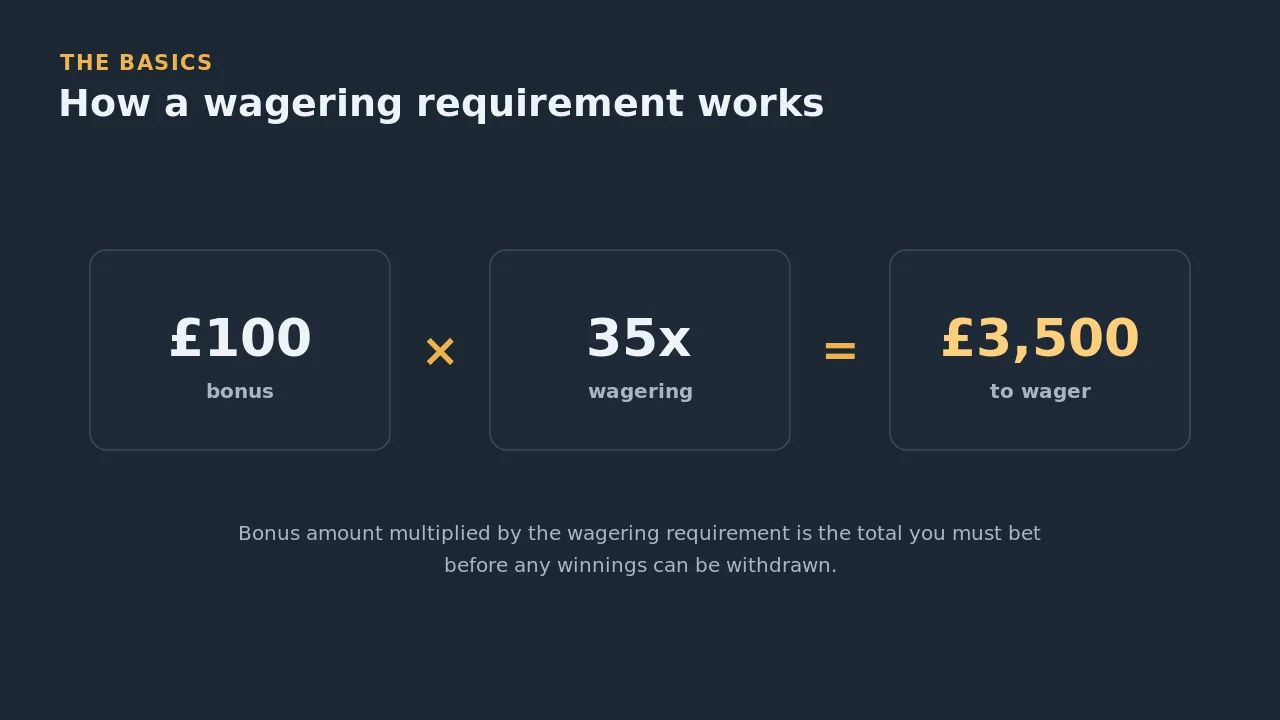
A wagering requirement, sometimes called a playthrough or rollover, is the condition attached to almost every bonus. It sets how many times you must bet the bonus amount, and at some sites your deposit too, before any winnings tied to it can be withdrawn. Until you meet it, those winnings are locked bonus funds rather than real, cashable money.
The maths is simple once you see it. Take a 100 pound bonus with a 35x requirement: multiply the two and you must place 3,500 pounds in bets before you can withdraw. That figure surprises people, because the wagering applies to the bonus repeatedly, not just once, which is exactly why the size of the multiplier matters so much. A drop from 35x to 20x on that same bonus cuts the amount you must wager from 3,500 pounds to 2,000, a meaningful difference in both time and risk.
Why newer brands are cutting them
The shift is driven by competition more than generosity. A new casino launching into a crowded market needs a reason for players to try it over a familiar name, and a strikingly low or wager-free bonus is an instant, easy-to-grasp advantage. Where established brands built their offers in an era of 40x-plus norms, newcomers can design around fairer terms from day one and use them as a marketing hook.
Player expectations have moved too. Bonus terms are more visible and better understood than they once were, comparison sites highlight the wagering number, and a generation of players has learned to treat a huge headline bonus with a punishing requirement as a warning sign rather than a gift. In that climate, a lower requirement signals confidence and transparency, and brands that offer it are rewarded with the trust, and the sign-ups, that follow.
A short history of the shrinking requirement
Wagering requirements were not always the norm. In the earliest days of online casinos, bonuses were often handed out with few strings attached, and operators quickly learned this was unsustainable, as players simply claimed, cashed out and left. The wagering requirement was the industry's fix, a way to keep bonus money in play long enough to benefit the house.
By the 2010s the pendulum had swung hard the other way. Requirements of 40x, 50x and occasionally higher became common, sometimes applied to deposit and bonus together, turning many offers into something close to impossible to clear. Huge headline percentages masked terms that quietly ensured most players would never see withdrawable winnings.
The correction came from transparency. As comparison sites, forums and reviewers began publishing wagering figures prominently and calling out the worst offenders, a punishing requirement became a reputational liability rather than a clever tactic. Newer brands, unburdened by legacy offers, seized the chance to compete on fairness, and the wager-free bonus emerged as the logical endpoint of that pressure. Today's falling requirements are the result of that long shift from hidden catches toward terms a player can actually read and trust.
The trend in numbers
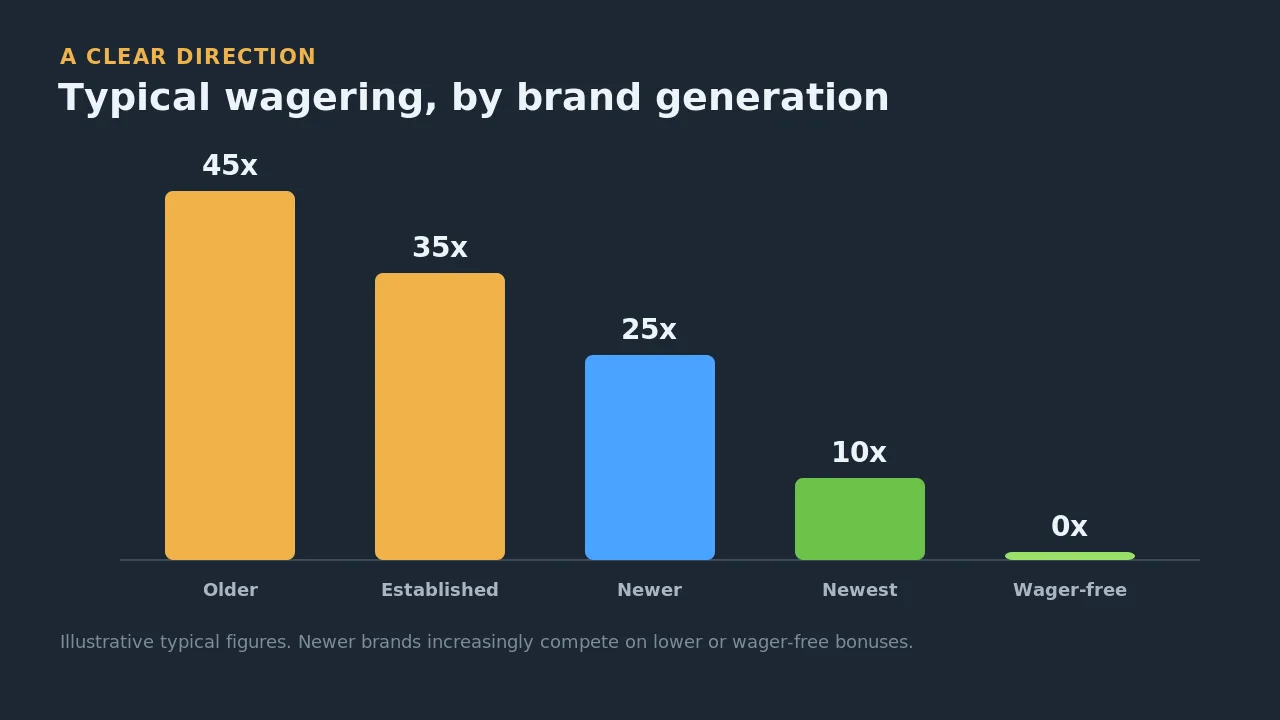
The direction of travel is easiest to see laid out by brand generation. Older casinos, built when high requirements were normal, still tend to carry the steepest terms, while the newest arrivals cluster at the bottom of the scale or skip wagering entirely.
| Brand generation | Typical wagering | What it feels like |
|---|---|---|
| Older brands | 40x to 50x | A long grind before winnings unlock |
| Established | Around 35x | The old industry standard |
| Newer brands | 20x to 30x | Noticeably fairer and quicker |
| Newest and low-wager | 1x to 15x | Fast to clear, close to real value |
| Wager-free | 0x | Winnings are cash you can withdraw |
These are typical ranges rather than fixed rules, and plenty of exceptions exist in both directions. But the pattern is real and consistent: as a brand's launch date gets more recent, its default wagering tends to fall, and the wager-free tier that barely existed a few years ago is now a genuine category of its own.
The number is not the whole story
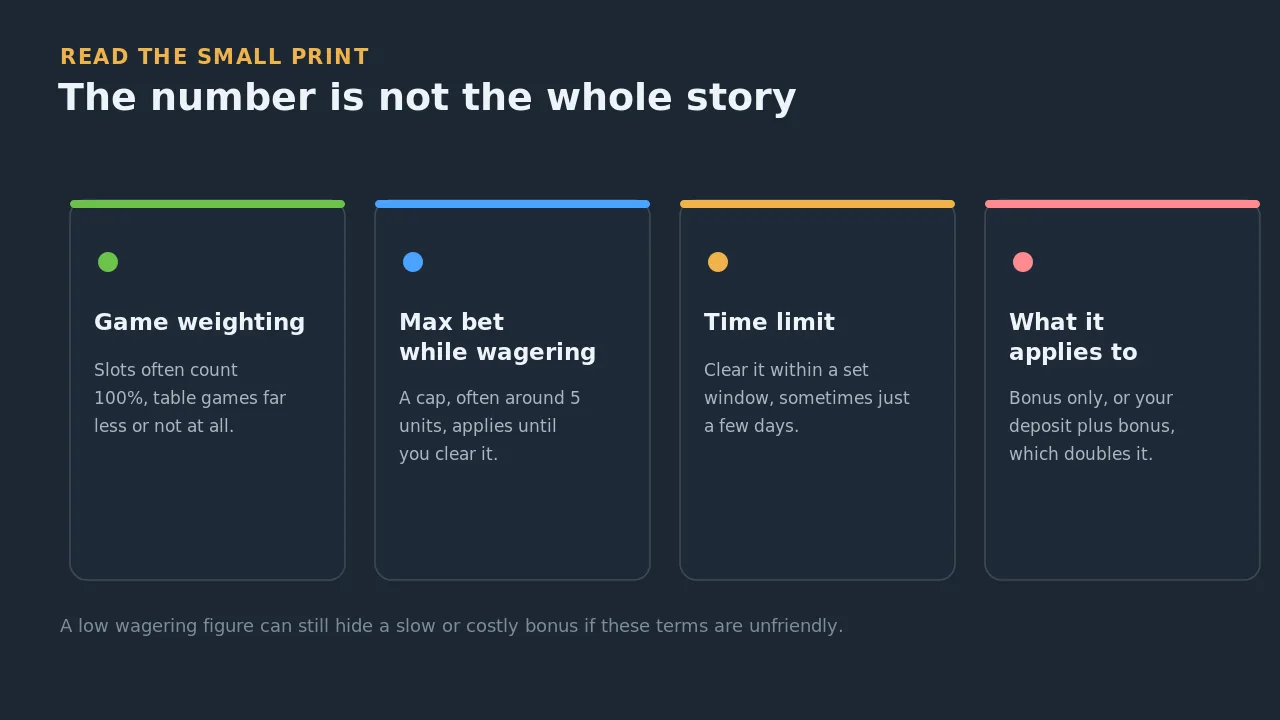
Here is the crucial caveat, and the reason a low requirement should never be the only thing you check. The wagering multiplier is one term among several, and an unfriendly version of any of the others can quietly undo the benefit of a low number. Four factors matter almost as much as the headline figure.
Game weighting
Not every game contributes equally to clearing a bonus. Slots usually count 100 percent, so a pound wagered on a slot removes a pound from your requirement, but table games such as blackjack and roulette often count only 10 percent or nothing at all. A tempting 20x requirement is far less generous if the games you actually want to play barely count toward it.
Max bet while wagering
Most bonuses cap the amount you can stake per bet while a wagering requirement is active, commonly around five units of currency. Breach it, even accidentally, and you can void the bonus and any winnings. It is a sensible rule that stops players clearing a bonus in one huge bet, but it is also one of the most common reasons bonuses are forfeited, so it pays to know the cap.
Time limits
A requirement you cannot realistically meet in the time allowed is worse than a higher one with a generous window. Bonuses expire, sometimes within a few days, and any unmet wagering, along with the winnings attached, disappears when they do. A low multiplier paired with a tight deadline can be harder to clear than a higher one you have a month to work through.
What the requirement applies to
Finally, check whether the wagering applies to the bonus alone or to your deposit plus the bonus, because the difference doubles the work. A 20x requirement on a 50 pound bonus is 1,000 pounds to wager; the same 20x on deposit plus bonus, on a 50 pound deposit matched with 50 pounds, is 2,000. If a term is unfamiliar, our casino glossary defines the bonus vocabulary in plain English.
Worked example: what lower wagering saves you
To see why the trend matters in practice, hold the bonus steady at 100 pounds and change only the requirement. The amount you must bet before withdrawing moves dramatically, and with it the time you spend and the risk you take on along the way.
| Requirement | Total you must wager | How it feels |
|---|---|---|
| 40x | 4,000 pounds | A heavy grind, high chance of losing the lot first |
| 35x | 3,500 pounds | The old standard, still demanding |
| 20x | 2,000 pounds | Half the work, far more realistic |
| 10x | 1,000 pounds | Quick to clear on most budgets |
| 0x (wager-free) | 0 pounds | Winnings are cash from the first spin |
The key insight is that wagering is not just an inconvenience; it is risk. Every pound you are required to bet is a pound exposed to the house edge, so the more you must wager, the more likely you are to lose the bonus and any winnings before you ever clear it. Lower wagering does not just save time, it genuinely improves the odds that a bonus turns into withdrawable cash, which is why the shift is more than a marketing gimmick.
Wager-free and low-wager bonuses
The clearest expression of the trend is the wager-free bonus, which carries a 0x, or occasionally 1x, requirement. With true wager-free winnings, anything you win from the bonus is real money you can withdraw immediately, with no playthrough at all. A 1x version asks only that you play the amount through once, which is close enough to feel similarly fair.
These offers are usually smaller in headline size than the giant matched deposits of old, and that is the honest trade: a modest bonus you can actually keep beats a huge one you almost certainly cannot clear. For many players, especially casual ones, a small wager-free offer is the most genuinely valuable promotion on the market, precisely because there is no catch buried in the multiplier.
Low wagering or a bigger bonus?
Faced with a choice between a large bonus with high wagering and a small one with low or no wagering, many players instinctively reach for the bigger number. The maths usually says otherwise. What matters is not the size of the bonus but its value after the requirement, and a huge bonus you are unlikely to clear is worth far less in practice than a modest one you will.
Consider a 300 pound bonus at 45x against a 50 pound wager-free bonus. The first demands 13,500 pounds in wagers, exposing a large sum to the house edge and making it statistically likely you lose the balance before clearing it. The second is 50 pounds of winnings you can withdraw the moment you make them. For most players, and especially casual ones, the smaller offer is simply better money.
That does not mean bigger is never right. A disciplined, higher-stakes player who intends to wager a lot anyway may extract more from a large matched deposit. But the default assumption should be the opposite of the industry's old marketing: treat the wagering requirement, not the bonus size, as the number that decides whether an offer is worth your time.
How to compare bonuses properly
Comparing offers well means looking past the two biggest numbers, the bonus size and the wagering figure, to the full shape of the deal. A reliable habit is to work out the real cost first: multiply the bonus by the requirement to see the true amount you must wager, then sanity-check the game weighting, the max bet, the time limit and the maximum you are allowed to withdraw from the bonus.
Doing that maths by hand every time is tedious, which is why we built a tool for it. Our bonus calculator turns a bonus and its wagering requirement into the total you must bet in seconds, so you can compare offers on a like-for-like basis rather than being dazzled by the headline number. The best offer is rarely the biggest; it is the one whose terms you can actually meet.
The catch to watch for
Lower wagering is a genuine improvement, but it would be naive to assume every low-wager offer is pure generosity. Some brands recover the cost elsewhere in the terms, and a sharp eye spots the trade-offs. The most common is a low maximum cashout, a cap on how much of your winnings from the bonus you can actually keep, which can quietly limit the upside of an otherwise attractive deal.
Others pair a low requirement with a smaller bonus, tighter game weighting or a shorter time window, so the effective value lands closer to a traditional offer than the headline suggests. None of this makes low-wager bonuses a trick; it simply means the same rule applies as ever: read the full terms and judge the offer as a whole. A fair low-wager bonus is excellent value, but low wagering is a feature to verify, not a guarantee to assume.
What it means for players
For players, the trend is straightforwardly good news, and it rewards a little knowledge. Bonuses are becoming easier to clear, closer to real value and less likely to end in the frustration of winnings you could never withdraw. The rise of wager-free offers in particular has given casual players a type of promotion that is genuinely worth claiming without a maths degree to decode it.
The one behaviour worth keeping is scepticism of the giant headline. A 200 percent bonus with 45x wagering is almost always worse value than a modest wager-free offer, however impressive the big number looks. As brands compete on fairer terms, the smart player rewards the ones being transparent, and treats the size of a bonus as the least important part of the deal.
Claiming a bonus sensibly
Whatever the wagering, a bonus is still a reason to gamble, so it deserves the same care as any other play. Only claim offers on games you would enjoy anyway, since chasing a bonus into games you dislike is a fast route to a joyless session. Set a budget before you start and remember that a deposit needed to unlock a bonus is real money at real risk, regardless of how low the wagering is.
It also helps to see a bonus as an occasional extra rather than a reason to deposit more or more often than you planned. If a promotion is nudging you to play beyond your budget, that is the moment to skip it. Our guide to responsible gambling and staying in control covers the limits and habits that keep bonuses fun, and our guide to casino payments and payouts explains how winnings actually reach you once a bonus is cleared.
Before you claim: a quick checklist
When an offer catches your eye, a few seconds of checks will tell you whether it is as good as it looks. Start with the wagering requirement and what it applies to, bonus only or deposit plus bonus, then multiply it out to see the real amount you must bet. Check the game weighting to confirm the games you enjoy actually count, and note the maximum bet allowed while wagering so you do not void the bonus by accident.
Then look at the clock and the ceiling: how many days you have to clear it, and the maximum you are allowed to withdraw from any winnings. If all of those line up in your favour, and the offer is on games you would happily play anyway, it is worth claiming. If any one of them looks hostile, a smaller headline bonus elsewhere with cleaner terms will almost always serve you better.
The bottom line
Falling wagering requirements are one of the clearest ways the online casino market has shifted in the player's favour. Driven by competition among newer brands, the old 35x-plus norm is giving way to lower multipliers and a growing wager-free tier, and that means bonuses that are quicker to clear, closer to real value and less likely to disappoint.
The catch is that the wagering number is still only one term among several, so the skill is in reading the whole deal: the weighting, the max bet, the time limit, the scope and the cashout cap. Do that, lean on tools like a bonus calculator to compare offers honestly, and treat any bonus as entertainment rather than income, and the trend toward lower wagering becomes exactly what it looks like, a real and welcome win for players.
Frequently asked questions
What is a wagering requirement?
A wagering requirement is how many times you must bet a bonus, and sometimes your deposit too, before you can withdraw any winnings from it. A 35x requirement on a 100 pound bonus means you must wager 3,500 pounds first.
Why are wagering requirements lower at newer casinos?
Competition. Newer brands use low and wager-free bonuses to stand out and win players from established sites, and players increasingly expect fairer, clearer terms, so a low requirement has become a selling point.
Is a low wagering requirement always better?
Not on its own. A low number can still sit alongside unfriendly terms such as heavy game weighting, a low maximum bet, a short time limit or a small maximum cashout, so it is the whole set of terms that decides a bonus's value.
What is a wager-free bonus?
A wager-free bonus has 0x, or sometimes 1x, wagering, so your winnings are cash you can withdraw straight away or after playing through just once. These have become increasingly common at newer brands.
How do I calculate how much I need to wager?
Multiply the bonus by the requirement, and include your deposit if the terms say so. A 50 pound bonus at 30x means 1,500 pounds to wager. Our bonus calculator works it out for you in seconds.
Does every game count toward wagering?
No. Game weighting means slots usually count 100 percent while table games such as blackjack or roulette count only a little or nothing at all, so always check the weighting before deciding what to play.
Are low-wagering bonuses worth claiming?
Often yes, because they are easier to clear and closer to real value, but only when the rest of the terms are fair. Judge the whole offer rather than the headline number, and skip anything you would not enjoy playing anyway.
Go deeper

Bonus wagering calculator
Turn any bonus and its wagering requirement into the real amount you must bet.
Read more →
Casino glossary
Playthrough, weighting, max cashout and the rest of the bonus vocabulary, explained.
Read guide →
Responsible gambling and staying in control
How to enjoy bonuses without letting them nudge you past your budget.
Read guide →Editorial note
This article is independent editorial coverage of casino bonus terms, not sponsored content, and no brand has paid for inclusion. The wagering figures and examples are illustrative and typical rather than offers from any specific casino; real terms vary widely, so always read a bonus's full terms and conditions before claiming. Nothing here is betting advice. Play only at licensed casinos, 18+, and within limits you set in advance.