
Identity and Source-of-Funds Checks Expand



Signing up to a casino used to take a minute; proving you belong there now takes rather more. Across regulated markets, the checks that confirm who you are, and increasingly where your money comes from, are being pushed earlier, wider and deeper. What was once a light-touch formality has become a serious, auditable part of how licensed gambling works.
Two things are happening at once. Identity verification, the process of confirming your name, age and address, is now standard before you can play or withdraw a penny. And source-of-funds checks, which ask you to show that the money you are gambling is legitimately yours, are reaching further down the spending scale than before. Both are driven by anti-money-laundering law and a wider push to keep gambling clean and affordable.
This article explains the difference between the two, walks through the verification journey step by step, sets out when a source-of-funds request is likely, and shows what it all means for everyday players. It is a practical, plain-English guide, not legal advice.
The story in brief
- Two checks, two questions: who you are, and where your money came from.
- Identity checks are universal, required at every licensed casino before you play.
- Source-of-funds checks are risk-based, aimed at higher spenders rather than everyone.
- Thresholds are falling, so the checks now reach more players than they used to.
- Anti-money-laundering law is the engine, reinforced by digital ID and new regulators.
What is actually changing
Verification itself is not new. Licensed casinos have long had to confirm a customer's age and identity, and to watch for money laundering. What is changing is the intensity. Identity checks now happen up front, before a first deposit rather than before a first withdrawal, and they lean on digital ID and biometric liveness rather than a scanned document emailed in days later.
Source-of-funds checks are where the real expansion is happening. Regulators have made clear that the thresholds triggering these checks were often set too high to be genuinely risk-based, and enforcement has pushed them down. The result is that a request to evidence your funds, once reserved for a small group of very heavy spenders, now reaches a wider band of players. Alongside this, the rules increasingly treat identity and money as a single compliance picture rather than two separate boxes to tick.
Identity and source of funds: two different questions
The single most useful thing to understand is that these are two distinct checks answering two different questions. Confusing them causes a lot of needless worry, so it is worth separating them clearly.
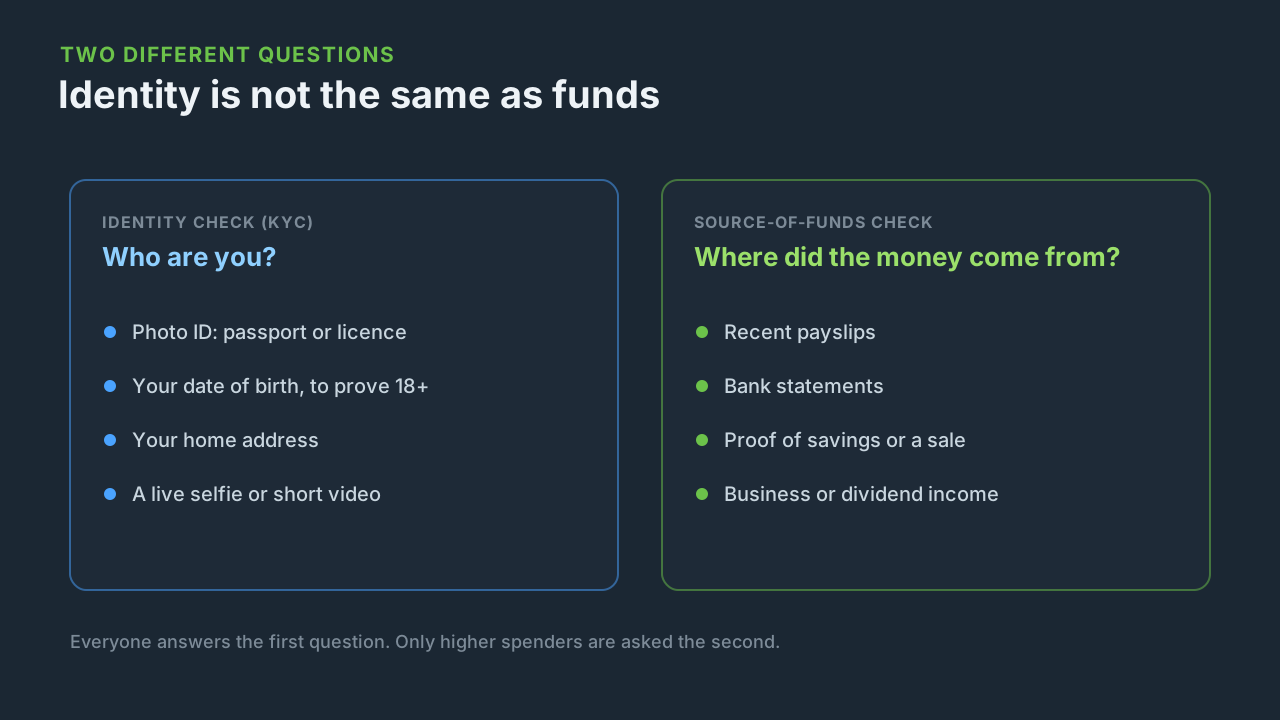
An identity check, often called KYC or know your customer, simply confirms that you are a real, adult person living where you say you do. It typically uses a photo ID, your date of birth and address, and increasingly a quick selfie or video to prove you are a live human rather than a stolen document. A source-of-funds check is a different and deeper request: it asks you to show, with evidence such as payslips or bank statements, that the money funding your play is legitimately yours. Everyone answers the first question; only higher spenders are asked the second.
The verification journey
For a new player, verification unfolds as a sequence rather than a single event. Knowing the order helps you see what is routine and what is exceptional, and why a later request is not a red flag against you personally.
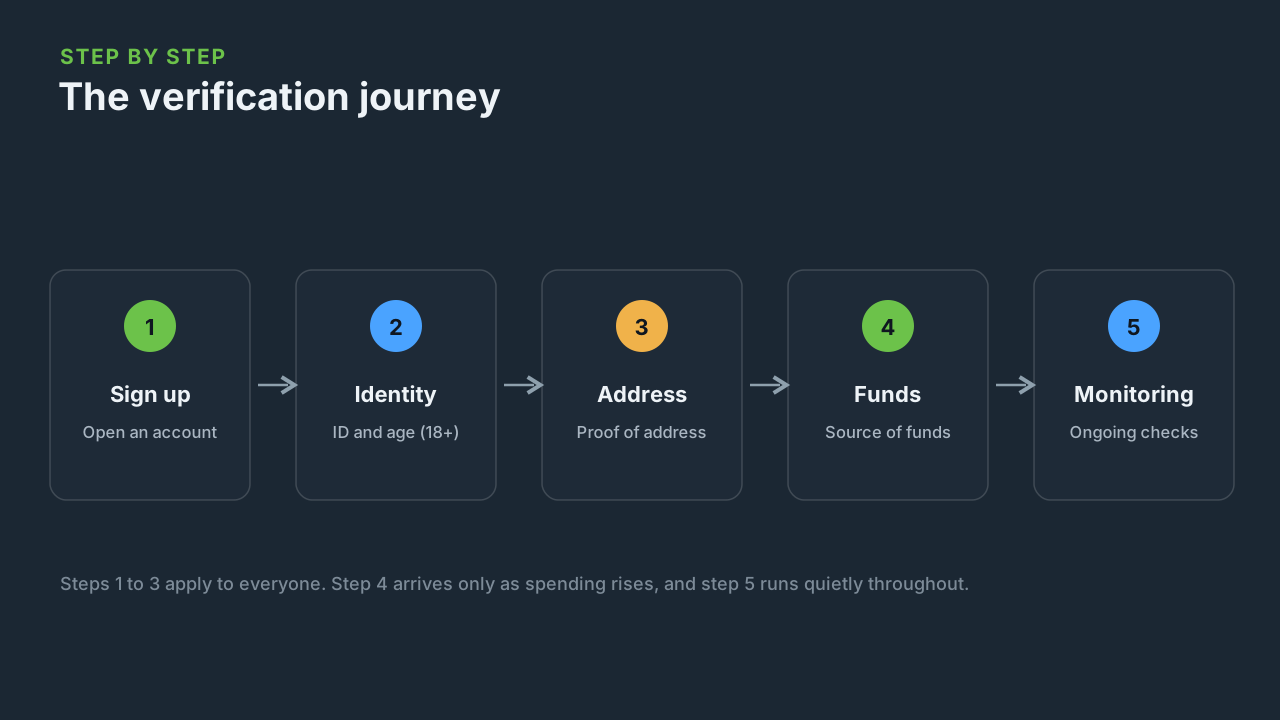
At sign-up: identity and age
The journey starts the moment you register. Before you can deposit, a licensed casino must confirm your identity and that you are of legal age, and in most markets this now happens instantly using digital ID or a document scan paired with a selfie. In the Nordic countries this is seamless, because national electronic identities such as Sweden's BankID and Denmark's MitID verify both age and identity in a single, trusted step.
Proving your address
Alongside identity, operators confirm where you live, both to apply the right rules for your market and to complete the anti-money-laundering picture. This is often handled automatically through the same digital ID or an electronic database check, so many players never notice it. If automated checks cannot confirm your address, you may be asked for a recent utility bill or bank letter.
Source-of-funds checks
Further along, and only for some players, comes the source-of-funds check. This is triggered by how much you deposit or lose rather than by anything suspicious in itself, and it asks for evidence that your funds are legitimately yours. Because it involves financial documents, it feels more intrusive than the earlier steps, but it follows the same logic of matching the depth of the check to the level of risk. Our guide to casino payments and payouts explains how these checks sit alongside deposits and withdrawals.
Ongoing monitoring
Verification is not a one-off gate you pass and forget. Licensed operators monitor accounts on an ongoing basis, and a change in behaviour, such as a sharp jump in spending, can prompt a fresh check even for a long-standing customer. This is why someone who verified years ago may suddenly be asked for up-to-date documents; the account, not just the sign-up, is what is being checked.
When a source-of-funds check kicks in
The question players most want answered is simple: will this happen to me? For the great majority, the honest answer is no, or not beyond the routine identity step. Source-of-funds checks are deliberately risk-based, scaling with how much money is in play.
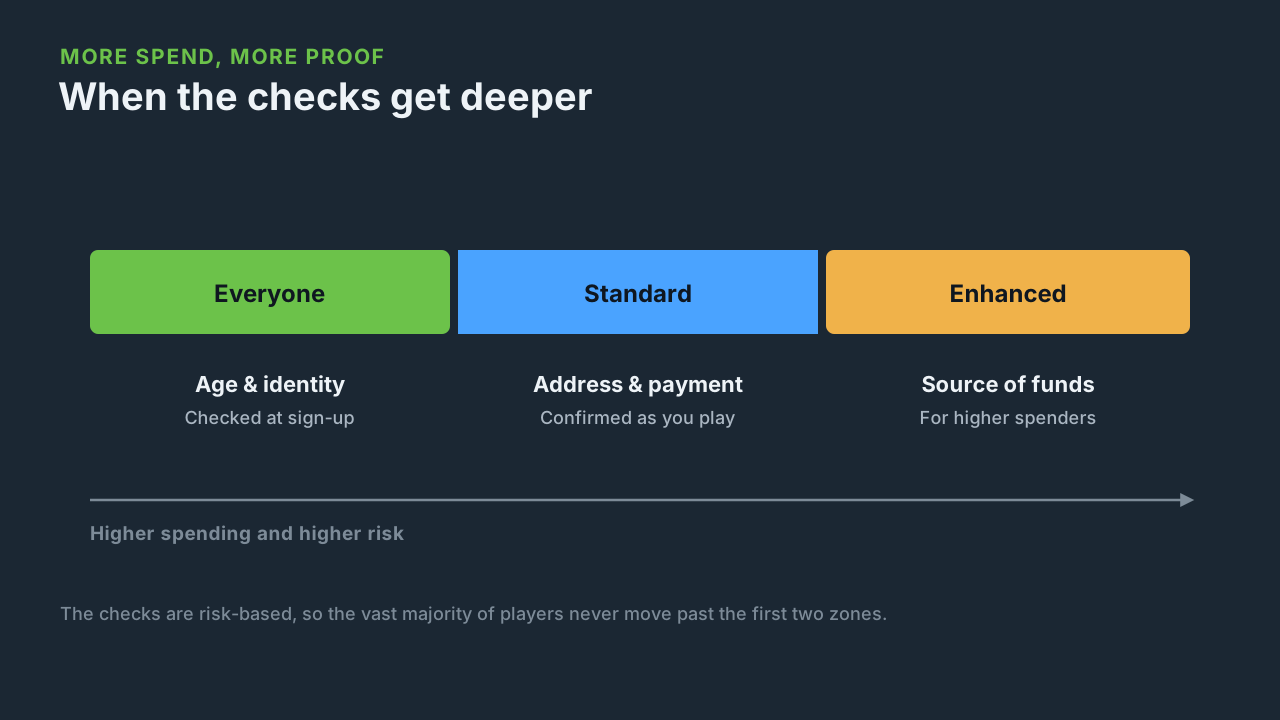
What has changed is where the line sits. Regulators have criticised operators for setting source-of-funds thresholds so high that only a tiny handful of customers ever crossed them, arguing that a genuinely risk-based approach must catch harm and money laundering earlier. Enforcement has pushed those thresholds down, and several markets have lowered the level at which deeper due diligence is required. The practical effect is that a moderately heavy but perfectly ordinary player is now a little more likely to see a request than they were a couple of years ago, even though most people still never will.
What you might be asked for
The documents involved are ordinary ones, and knowing the list in advance takes the sting out of any request. The table below shows the most common items and what each is meant to prove.
| Document | What it proves |
|---|---|
| Photo ID (passport or licence) | Your identity and that you are of legal age |
| Proof of address | Where you live, from a recent bill or bank letter |
| Selfie or short video | That you are a live, real person, not a stolen document |
| Payslips | Your regular, recurring income |
| Bank statements | How money moves through your account |
| Proof of a windfall | A one-off source such as a sale or inheritance |
The first three are the routine identity items almost everyone provides. The last three belong to a source-of-funds check and appear only if your spending calls for it. In every case, a licensed casino should ask you to upload these through a secure tool, never by plain email.
Market by market
The detail differs across our markets, shaped by local ID systems and by how each has implemented anti-money-laundering law, but the direction is shared. The table gives the headline approach in each.
| Market | Verification approach |
|---|---|
| United Kingdom | ID before first deposit, with source-of-funds thresholds pushed lower |
| Ireland | Duty-of-care and anti-money-laundering duties under a new regulator |
| Netherlands | Due diligence tied to income-tested deposit limits |
| Sweden | Instant identity through BankID, with ongoing monitoring |
| Denmark | An account cannot be opened without verifying via MitID |
| Australia | Reforms lowering the casino due-diligence threshold from 2026 |
Across the European markets, a further layer is arriving from the top down: a single anti-money-laundering rulebook and a dedicated European authority are harmonising how due diligence and source-of-funds checks must be carried out, which will push standards in the same direction regardless of local habits.
Why the checks are expanding
Four forces are driving the expansion, and they reinforce one another. The first and biggest is anti-money-laundering law. Gambling handles large volumes of cash-like transactions, which makes it attractive for laundering, so lawmakers treat robust identity and source-of-funds checks as essential. New and tougher rules, including a harmonised European framework and a fresh wave of reforms in Australia, have raised the baseline everywhere.
The second is the link to affordability and harm. Source-of-funds checks overlap heavily with the affordability agenda, because money someone cannot evidence is often money they cannot afford to lose, a connection we explore in our report on affordability and deposit-limit rules. The third is technology: digital ID and instant electronic checks make verification fast enough to do up front without driving players away. The fourth is new risk: the rise of crypto deposits and increasingly sophisticated identity fraud has pushed regulators to demand deeper, smarter checks than a simple document scan.
Crypto and the extra scrutiny it brings
Cryptocurrency deposits deserve a special mention, because they are where verification is tightening fastest. Crypto can obscure where money originates, which is exactly the problem anti-money-laundering rules exist to solve, so casinos that accept it carry heavier obligations. Regulators have singled out crypto deposits and synthetic identity fraud as emerging risks, and operators are responding with deeper, smarter checks.
In practice, a player funding an account with crypto may be asked not only the usual identity questions but also for evidence of how they obtained the coins, such as exchange records or transaction history. The aim is to trace the money back to a legitimate origin rather than an anonymous wallet. If you use crypto, expect more questions rather than fewer, and keep clear records of your purchases and transfers so you can answer them without fuss.
What it means for players
For most people, the practical effect is a slightly slower sign-up in exchange for a faster, safer account afterwards. Verifying up front means that when you come to withdraw, the money can leave quickly because the checks are already done, rather than being held up at the worst possible moment. The days of a big win vanishing into a verification queue are, at good operators, largely over.
The trade-off is that a minority of players, mostly higher spenders, will face a source-of-funds request that can feel intrusive. It is worth knowing that this is a legal obligation on the operator, not a personal accusation, and that declining simply means you stop playing rather than facing any penalty. The bigger risk to watch for is the opposite: a site that never asks for anything is not being generous, it is very likely unlicensed. Our guide to casino licensing and safety explains why a site that verifies you is a sign of safety, not suspicion.
How to prepare
A little preparation turns verification from a hassle into a formality. The goal is to make any check quick to pass, so your play and your withdrawals are never held up.
Register with your real, accurate details, exactly as they appear on your ID, because mismatches are the most common cause of delays. Complete identity verification when you first join rather than waiting until you want to withdraw. Keep the everyday documents handy, such as a clear photo of your ID and a recent bank statement or payslip, so a source-of-funds request is a five-minute task rather than a scramble. Always upload through the casino's secure tool, and if any wording is unfamiliar, our casino glossary translates the compliance jargon into plain English.
Protecting your documents
Only ever share identity or financial documents with a licensed operator, and only through its official secure upload, never by email or chat. A legitimate casino will explain why it needs each item and how your data is protected. Treat any request to send documents to a personal address, or any site that skips verification entirely, as a serious warning sign. This article is general information, not legal or financial advice.
How long verification takes
For the routine identity step, verification is usually instant or close to it, especially where a digital ID or an automated database check does the work in the background. You may barely notice it beyond a short pause at sign-up. When problems do occur, they almost always come from mismatched details, a blurry document photo, or a name that does not match your payment method.
A source-of-funds check takes longer, because a person often reviews the documents you provide. Responding promptly, with clear and complete files, is the single biggest thing within your control, and it is why preparing documents in advance matters so much. At a well-run licensed operator, a straightforward check is typically resolved within a few days.
The debate
As with other safer-gambling rules, there is a real balance being struck. Supporters argue that strong checks keep criminal money out of gambling, stop underage and fraudulent accounts, and catch unaffordable play before it does lasting damage. They point out that verification also protects players themselves, by making accounts harder to hijack and withdrawals faster to clear.
Critics raise friction and privacy. They warn that asking ordinary players for bank statements feels invasive and paternalistic, that it can drive privacy-conscious or higher-spending customers toward unlicensed sites that ask nothing, and that holding sensitive financial documents creates a data-security burden of its own. There is also a fairness question about where thresholds sit, since set them too low and the checks catch people who pose no real risk. The honest position is that the balance is genuinely contested, and that regulators are trying to weigh crime prevention and player protection against real costs in convenience and privacy.
What comes next
Expect verification to grow more automated and more continuous. Digital ID will spread further, making the identity step almost invisible, while behind the scenes operators will lean on data and analytics to run source-of-funds and affordability checks together rather than as separate events. Thresholds are likely to keep drifting downward as regulators refine what counts as risk-based, and crypto deposits will draw particular scrutiny as rules catch up with the technology.
The tension to watch is the same one that runs through all of this: making checks thorough enough to work without making them so heavy that players leave the regulated market. The markets that manage frictionless but effective verification, much of what the Nordic digital-ID model already achieves, will point the way for everyone else.
The bottom line
Identity and source-of-funds checks are becoming deeper, earlier and more widespread, driven by anti-money-laundering law and the same concern for harm that shapes the rest of gambling policy. For most players the change is modest: verify once, up front, and enjoy faster withdrawals afterwards. For higher spenders, the prospect of a source-of-funds request is now a realistic part of playing at a licensed site.
The reassuring way to read the trend is that these checks are a feature of a safe, regulated market rather than a bug. A casino that confirms who you are and, when it matters, where your money comes from is one doing its job. The smartest response is to keep your details accurate, verify early, choose licensed operators, and treat any site that asks for nothing as the real risk.
Frequently asked questions
What is a KYC check?
KYC, or know your customer, is how a licensed casino confirms who you are. It verifies your identity, age and address when you sign up, usually with a photo ID and often a selfie or liveness check. It is a legal requirement, not optional.
What is a source-of-funds check?
A source-of-funds check asks where the money you are gambling with came from. If your spending is high, a casino may ask for evidence such as payslips or bank statements to confirm the money is legitimate and within your means.
Why is a casino asking for my ID and documents?
Licensed casinos are legally required to verify identity to prevent underage gambling and fraud, and to check source of funds for higher spenders to prevent money laundering. A request is routine compliance, not a sign you have done anything wrong.
When do source-of-funds checks apply?
They are risk-based, usually triggered when spending crosses certain thresholds or a pattern looks unusual. Most players never reach that point, because the checks are aimed at the highest spenders rather than everyone.
Is it safe to send my documents to a casino?
At a licensed operator, yes. Documents are handled under strict data-protection rules and used only to verify you. Always upload them through the casino's secure tool rather than email, and never send documents to an unlicensed site.
Can I gamble without ID or anonymously?
No. At a licensed casino you must verify your identity and age before you can play or withdraw. Any site that lets you skip this is almost certainly unlicensed, which means none of the usual protections apply.
Why are these checks expanding?
Tougher anti-money-laundering laws, new bodies such as the EU's dedicated authority, lower thresholds, widespread digital ID, and fresh risks from crypto and identity fraud have all pushed the checks wider and earlier.
Go deeper
Markets tighten affordability and deposit limits
The companion trend: checks on what you can afford, and caps on how much you can deposit.
Read article →
Casino payments and payouts
How deposits and withdrawals work, and why verification speeds up your cashouts.
Read guide →
Casino licensing and safety
Why a site that verifies you is safer than one that asks for nothing at all.
Read guide →Editorial note
This article is independent journalism about gambling regulation. It explains fast-changing identity and anti-money-laundering rules in plain English and is not legal, financial or compliance advice. Specific thresholds and requirements vary by market and are reviewed regularly, so always check the current position with the relevant regulator or a licensed operator. If you choose to play, do so only at licensed casinos and within limits you set in advance.