
What to look for before joining a casino
Signing up to an online casino takes two minutes, but choosing the right one is what protects your money and your peace of mind. This guide is the checklist we run on every casino we review: what to verify, in what order, and the red flags that tell you to close the tab.



Every online casino wants you to sign up in seconds. The button is big, the welcome bonus is bright, and the friction is deliberately low. What none of them put front and centre is the information that actually matters: who licenses them, how their bonus terms really work, and how quickly, or whether, they pay winners. That gap between how easy it is to join and how hard it is to judge a casino is exactly where players get caught out.
The good news is that vetting a casino is not complicated once you know what to look at and in what order. A handful of checks, most of which take only a few minutes, will tell you whether a site is a safe place for your money or one to avoid. This guide walks through each of them, from the licence that underpins everything to the support you will lean on if something goes wrong, and ends with the red flags that should stop you before you deposit a cent.
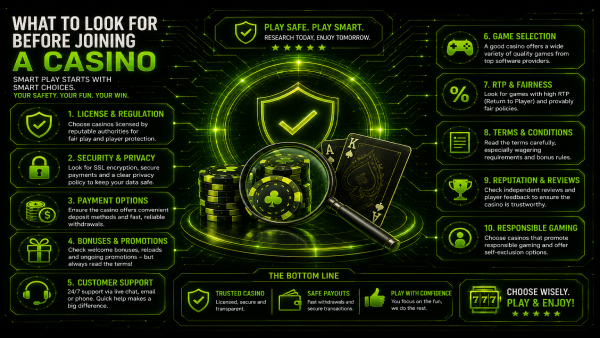
Key takeaways
- Licensing comes first. A verifiable regulator underpins fair games, fund protection and a complaints route.
- Read past the bonus. Wagering, time limits and cashout caps decide a bonus's real value, not the headline percentage.
- Payouts reveal the truth. Clear withdrawal methods, times and limits, and a clean payment record, matter more than deposits.
- Security is non-negotiable. SSL, certified games and sensible KYC show a casino takes protection seriously.
- Trust the red flags. No licence, hidden terms, vague payouts or absent support are reasons to walk away.
Why These Checks Matter
An online casino holds your money, your identity documents and your payment details, and it decides whether and how quickly you get paid when you win. That is a lot of trust to hand over to a site you found through an advert. Unlike a shop, where a bad experience costs you one purchase, a bad casino can lock your funds, bury your winnings under impossible terms, or simply vanish.
Running a few checks before you join is how you shift the odds of a good experience in your favour. None of this is about being able to win, the house edge in our how casinos make money guide makes clear the casino is built to profit over time. It is about making sure that when you do win, you actually get paid, that the terms are honest, and that your data is safe. Five minutes of checking is cheap insurance against a problem that can cost you far more.
The Core Checklist
Before going through each area in detail, it helps to see the whole checklist at once. Almost everything that separates a trustworthy casino from a risky one falls into six areas, and a good site gets all six right rather than dazzling you on one and hoping you ignore the rest.
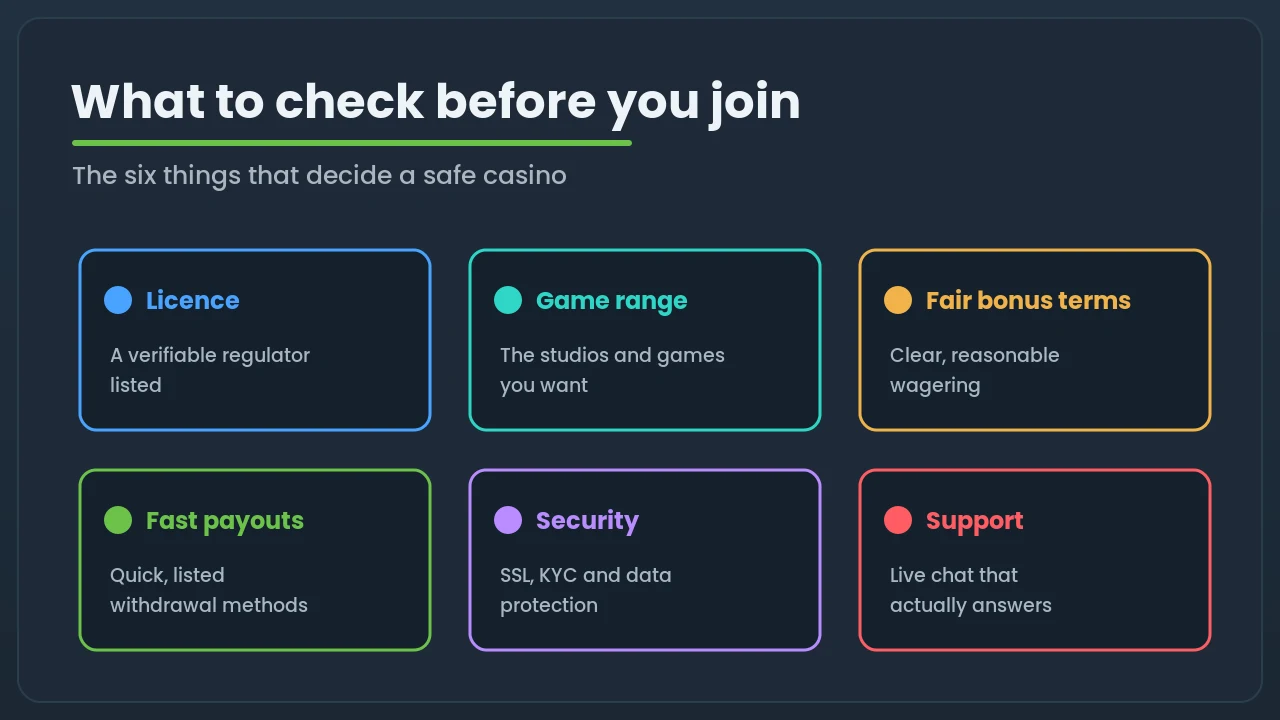
The order matters as much as the list. Licensing sits at the top because it validates everything beneath it; there is little point admiring a bonus or a game library on a site with no accountability. Once the licence checks out, the other five, the games, the bonus terms, the payouts, the security and the support, tell you whether the casino is not just legitimate but actually good to use. The rest of this guide takes them in that order.
| Check | What good looks like |
|---|---|
| Licence | A named regulator and number you can verify |
| Games | Titles from known studios, tested and certified |
| Bonus terms | Reasonable wagering, clear limits, easy to find |
| Payouts | Published methods, times and limits, paid reliably |
| Security | SSL encryption, sensible KYC, data protection |
| Support | Reachable, responsive, genuinely helpful |
Licensing Comes First
The single most important thing to check is who regulates the casino, because a licence is what turns promises into obligations. A licensed operator must offer certified, fair games, protect player funds to some standard, follow anti-fraud rules and provide a complaints process you can escalate to the regulator. Without a licence, every other feature rests on nothing but the operator's goodwill.
Finding the licence is straightforward: look in the footer for a named regulator and a licence number. The crucial step, which most players skip, is to verify it. Click through to the regulator's own website and check the number on its public register, because a logo in a footer can be copied by anyone. Our casino licensing guide explains the main regulators and how strict each one is, but the principle is simple. A casino that names and evidences its licence is telling you it can be held accountable; a casino that hides or fakes one is telling you the opposite.
Games and Software
Once a casino is licensed, the game library is what you will actually spend your time on, so it is worth a look before you commit. The two things that matter are range and provenance. Range is simply whether the casino carries the kinds of games you enjoy, slots, live dealer, table games, in enough variety to keep you interested.
Provenance matters more than it sounds. Games from established studios such as the big-name slot and live-casino providers are independently tested and certified, which means the return-to-player figures are honest and the outcomes genuinely random, as our slot games guide explains. A lobby full of recognised studios is a quiet sign of a legitimate operation, because those providers only license their games to properly regulated casinos. A site padded with unknown, untested games deserves more caution, since there is no third party vouching for how they behave.
Bonuses and Their Terms
The welcome bonus is the loudest thing on any casino homepage and the most misread. A big percentage means very little on its own; the value lives entirely in the terms attached to it, and this is where a generous-looking offer can quietly become worthless. Reading them takes a couple of minutes and is one of the highest-value checks you can run.
Focus on three numbers. The wagering requirement is how many times you must bet the bonus before withdrawing, and around 35 times is normal while much higher is a warning. The time limit is how long you have to meet it, and a short deadline can make a large bonus impossible to clear. The maximum cashout caps what you can keep from bonus winnings, and a low cap can gut the value entirely. Our casino bonuses guide breaks all of this down, and you can model an offer with our bonus calculator. The deeper point is that fair terms are stated clearly and easy to find, while terms designed to trap you are buried, extreme, or both, so how a casino presents its bonus tells you almost as much as the numbers.
Payments and Payout Speed
Deposits are easy everywhere; the real test of a casino is getting your money back out. This is the area where the difference between a good and a bad operator shows most clearly, so it deserves close attention before you join rather than the disappointment of discovering it after a win.
Check that the casino supports payment methods you actually use, then look specifically at the withdrawal side. A trustworthy casino publishes its withdrawal methods, processing times and limits clearly, rather than leaving them vague. Reasonable identity verification is normal and protects you, but the rules should be sensible, not a moving target. Our casino payments guide covers the methods and typical speeds in full. Above all, look for a consistent payment record: independent reviews that describe fast, reliable payouts are a strong green flag, while a pattern of delayed or refused withdrawals is one of the most serious warning signs a casino can carry.
Security and Fair Games
Security is the check you cannot see directly but must not skip, because it governs how safe your data and money are behind the scenes. The basics are quick to confirm and non-negotiable for any site you would trust with your identity and card details.
Look for SSL encryption, shown by the padlock and an address beginning with https, which protects your information in transit on every page. Confirm the casino performs KYC, identity verification, because while it adds a step, its presence shows the operator follows anti-fraud and anti-money-laundering rules rather than cutting corners. Fair games are guaranteed by the same licensing and independent testing covered above, so a certified game library doubles as evidence of fairness. A casino that encrypts your data, verifies identity properly and runs tested games is one that treats protection as a requirement, not an afterthought.
Support and Reputation
You may never need customer support, but the day you do, it matters enormously, and its quality is a reliable proxy for how a casino treats its players generally. Before joining, it is worth a quick test rather than an assumption.
Check what support channels exist, live chat, email, ideally around the clock, and if you can, send a simple question before depositing to see how fast and how well they respond. A casino confident in its service answers quickly and clearly; one that is slow, scripted or silent before you have even joined will not improve once your money is in. Pair that with reputation: read independent reviews and player feedback, looking less at the star rating and more at whether complaints describe unresolved payout problems. Our own casino reviews combine this reputation research with hands-on testing, so a strong review there does much of this legwork for you.
Green Flags and Red Flags
Everything above can be distilled into a set of signals. Some tell you a casino is worth trusting; others tell you to close the tab. Learning to read them at a glance turns a long checklist into a quick instinct.
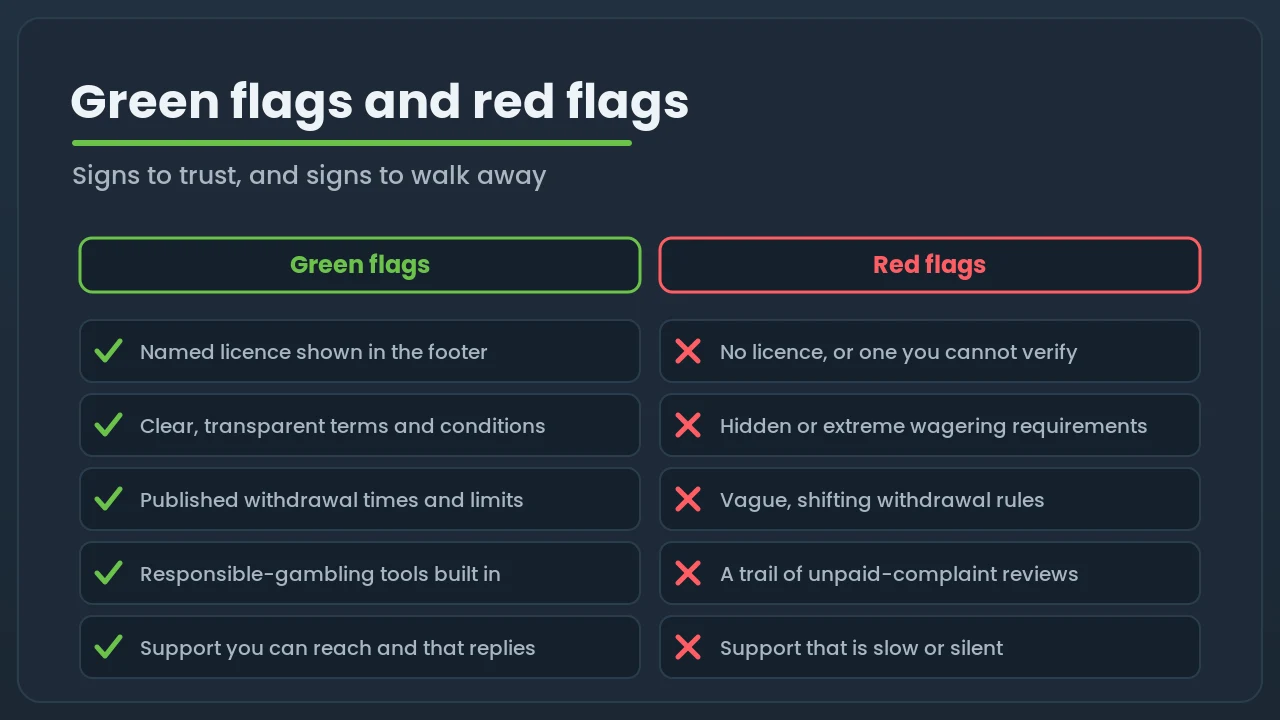
The green flags are consistency and transparency: a named licence in the footer, terms and conditions that are clear and easy to find, published withdrawal times and limits, built-in responsible-gambling tools, and support you can actually reach. The red flags are the mirror image: no licence or one you cannot verify, hidden or extreme wagering requirements, vague or shifting withdrawal rules, a trail of unpaid-complaint reviews, and support that is slow or silent. One red flag is a reason to be cautious; several together are a reason to leave. When a casino is evasive about the things that matter most, that evasiveness is itself the answer.
Vet a Casino in Four Steps
Put together, the whole process becomes a short routine you can run on any casino in about ten minutes. It front-loads the checks that protect you and leaves the fun until you know the site is worth your time.
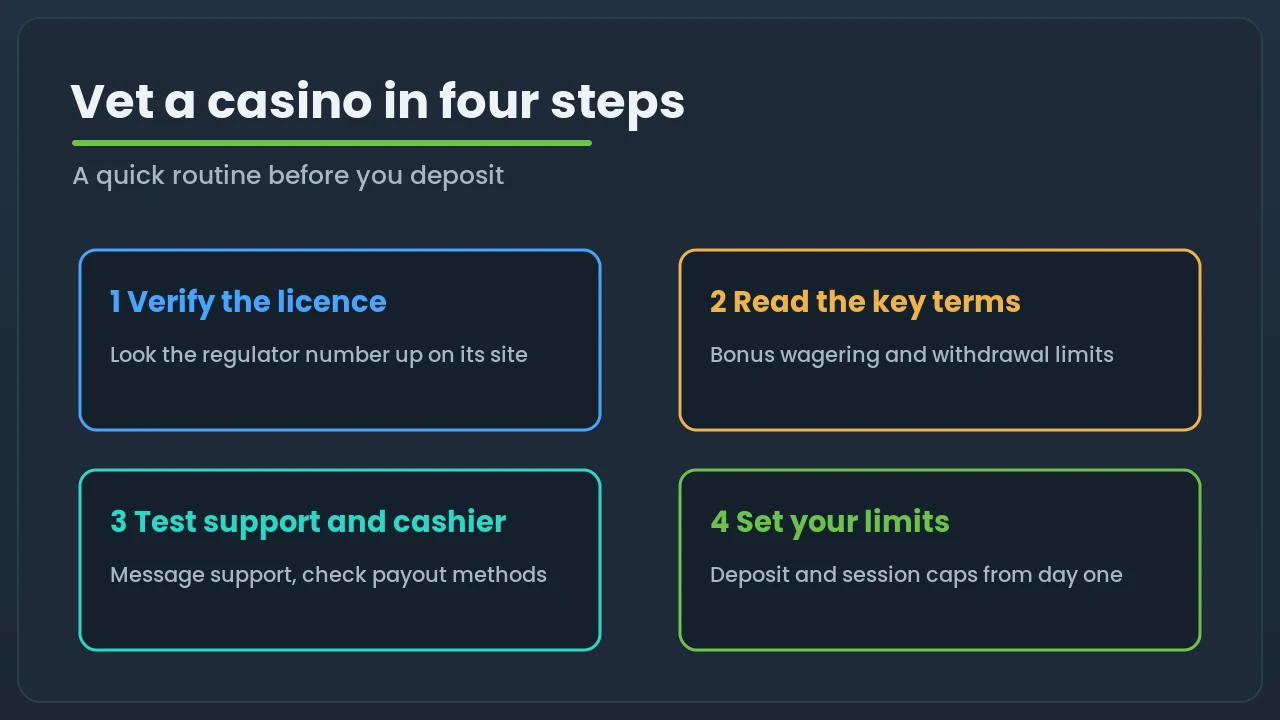
First, verify the licence by finding the number and checking it on the regulator's own register. Second, read the key terms, focusing on bonus wagering and withdrawal limits rather than the marketing. Third, test the support and the cashier by sending a question and confirming your payment methods are available before you deposit. Fourth, once you are satisfied, set your limits, deposit and session caps, from day one, so control is built in from the start rather than added after a problem. Only then is it time to claim a bonus and play. Following the routine in that order is what keeps a quick sign-up from becoming a slow regret.
A Responsible-Gambling Note
Choosing a well-run casino is itself a responsible-gambling step, because the safest sites make it easy to stay in control. Casino play is for adults only, 18+, and the house edge means the operator profits over time however carefully you choose. A good casino supports that reality with tools; a bad one hopes you will not use them.
Build control in from the start
Before you deposit, set a budget you can afford to lose and use the casino's deposit, loss and session limits to enforce it. Treat the checks in this guide as your first responsible-gambling habit, and favour operators that put their limit and self-exclusion tools front and centre rather than hiding them. If play ever stops feeling fun or starts to feel compulsive, step away and use those tools. Our responsible-gambling guide explains every one and where to find free, confidential support.