
How casinos make money (house edge)
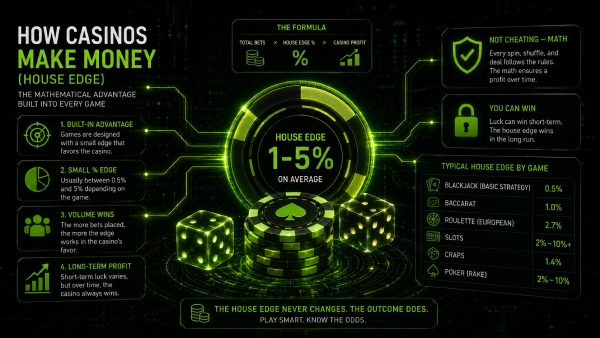
Casinos are not lucky and they do not cheat. They profit from a small, permanent mathematical advantage built into every game. Here is exactly how the house edge works, and what it means for you.



A casino is a business, and like any business it needs a reliable way to make a profit. It does not rely on luck, and in a licensed market it does not need to cheat. Instead it relies on something far more dependable: a small mathematical advantage, called the house edge, that is baked into the rules of every game. The games themselves are genuinely random and independently certified, but the payouts are set slightly below the true odds, and that tiny gap is where all the profit comes from.
Understanding this one idea changes how you see the whole industry. You realise that a casino does not care whether any single player wins or loses on a given night, because it is not betting against you at all. It is simply collecting a predictable slice of everything that gets wagered, over millions of bets, from thousands of players. This guide explains how that works, how the edge differs from game to game, why no system beats it, and how to use the knowledge to play more sensibly.
Key takeaways
- The edge is the business model. Payouts are set just below the true odds, so the casino keeps a small share of every stake over time.
- House edge and RTP are mirrors. House edge = 100% - RTP. A 96% RTP game carries a 4% edge.
- Short term is noise, long term is maths. You can and do win sessions, but the more you play, the closer results track the edge.
- Games differ hugely. Blackjack can be under 0.5%; keno can be 20% or more. The game you choose matters more than any system.
- No staking pattern beats a negative edge. Systems reshape the wins and losses, not the expected value.
What Is the House Edge?
The house edge is the average percentage of every bet that the casino expects to keep over the long run. It is not a fee taken from any particular wager, and it is not a switch the operator can flip during your session. It is a permanent statistical feature of how a game is designed, created by paying out winners at odds that are fractionally worse than the true chance of the event happening.
European roulette is the cleanest example. A single number on the wheel has a true probability of 1 in 37 of landing, so a genuinely fair payout would be 36 to 1. The casino pays 35 to 1 instead. That one missing unit, spread across every possible number, works out to a house edge of 2.70%. Nothing about the spin is rigged; the wheel is perfectly random. The profit lives entirely in the gap between the true odds and the odds actually paid.
Put simply, if a game has a 2.70% house edge, then for every €100 that flows through it in bets, the casino expects to keep €2.70 and return €97.30 to players on average. The word "average" is doing heavy lifting there, and we will come back to it, but the definition itself is that clean: the house edge is the long-run expected cost of playing, stated as a percentage of the amount staked.
House Edge vs RTP vs Volatility
Three terms get used constantly around this topic, and they are easy to muddle. They describe related but distinct things, so it helps to pin each one down.
RTP is the mirror image of the edge
The return to player, or RTP, is the percentage of all wagers a game is designed to pay back over the long run. It is simply the other side of the same coin as the house edge, and the arithmetic is exact:
House edge = 100% - RTP. A slot with a 96% RTP has a 4% house edge. A blackjack game returning 99.5% has a 0.5% edge. If you know one number, you know the other.
Operators and game studios tend to advertise the RTP because a big number sounds friendlier than a small one, but they are describing the identical piece of maths. When you read that a slot "returns 96%", you are reading that its house edge is 4%.
Volatility is the swing around the average
Where RTP and the edge tell you the long-run average, volatility (sometimes called variance) tells you how bumpy the ride is on the way there. A low-volatility game pays small amounts frequently, so your balance drifts down gently. A high-volatility game pays rarely but can land large hits, so your balance can lurch around wildly even though the underlying edge is unchanged. Two slots can share an identical 96% RTP and feel like completely different games because one is calm and the other is feast-or-famine. Our RTP and volatility guide covers this pairing in depth, and the glossary defines each term in a sentence.
One Bet vs the Long Run
This is the part players most often misunderstand, and getting it right is the key to reading everything else honestly. The house edge is a long-run average, and the long run is much longer than a single evening.
On any one bet, the edge tells you almost nothing. Put €10 on red at roulette and you have a 48.6% chance of nearly doubling it. Nothing about the 2.70% edge stops you winning that spin, or the next ten. Over a short session the dominant force is variance, the natural random swing of results, and variance can easily push you well ahead. Winning players exist every single night. That is not a flaw in the casino's model; it is a feature of it, because those wins are what keep the games exciting and keep people playing.
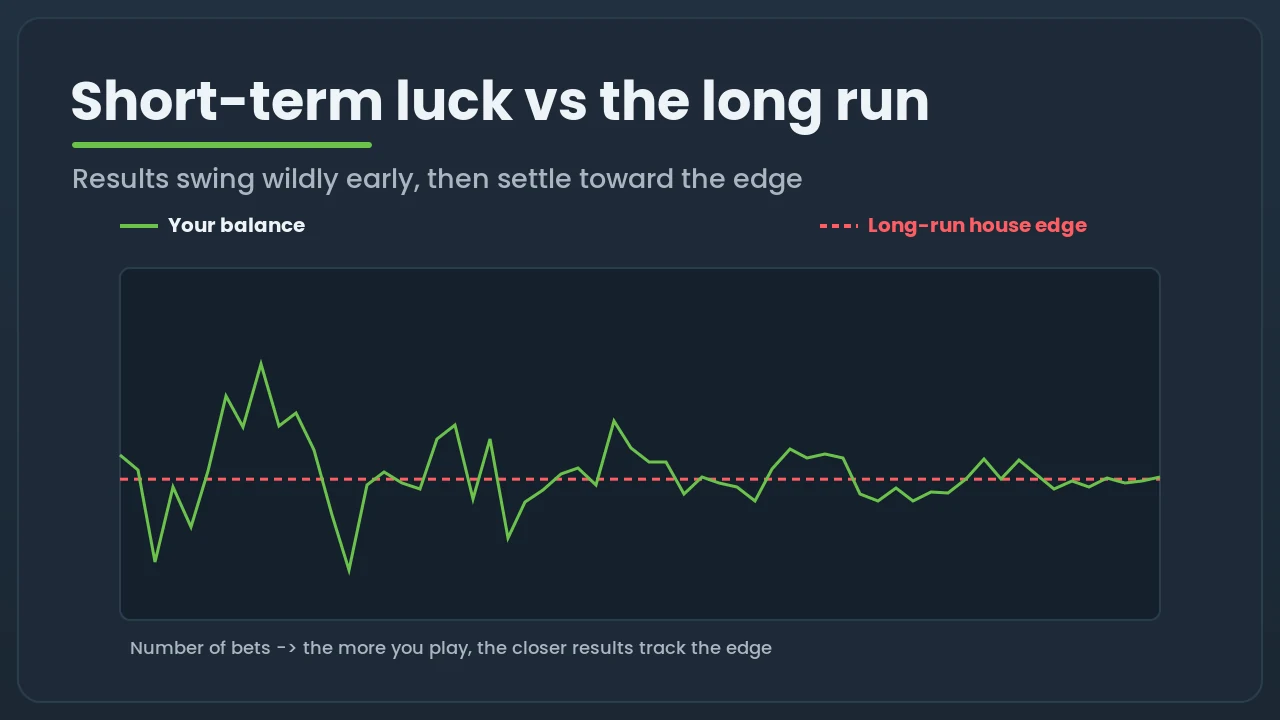
What the edge governs is the long run, through a principle called the law of large numbers. The more bets that are placed, the closer the actual result gets to the mathematical expectation. A single player might beat a game for a weekend, but the casino is not playing a single session; it is aggregating millions of bets across its whole customer base every day. At that scale the swings cancel out and the edge shows through with almost mechanical reliability. The same logic applies to you personally over time: the more you play a game, the more your own results converge on its edge. You can win tonight. You are very unlikely to win across a thousand hours.
The House Edge, Game by Game
The single biggest lever you control is which game you sit down at, because the edge varies enormously across the lobby. Skill-based and low-margin games hand the house almost nothing; slots and side bets hand it far more. The figures below are the standard, widely accepted values for common games. Remember that in every case the edge is simply 100% minus the game's RTP.
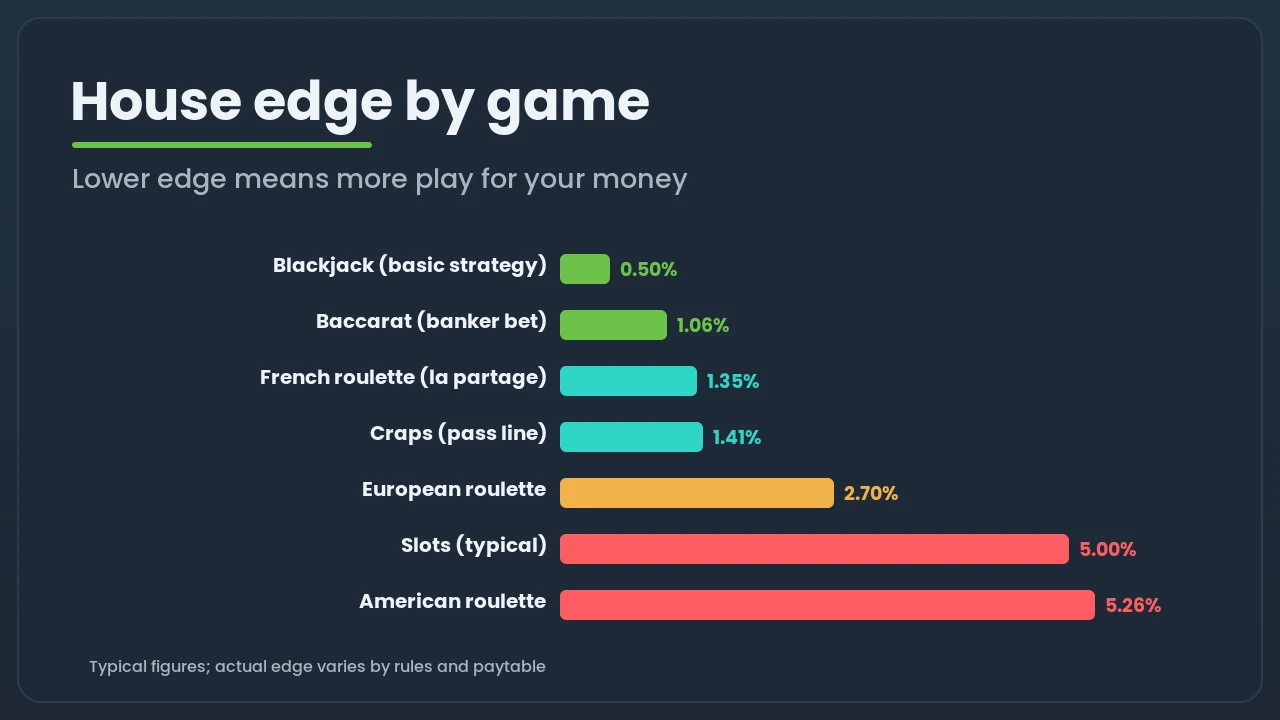
| Game | Typical house edge | Notes |
|---|---|---|
| Video poker (full-pay Jacks or Better) | ~0.46% | Rises toward 5% on poor pay tables; the pay table is everything |
| Blackjack (basic strategy) | ~0.5% | Lowest edge of any common game when you play the correct strategy |
| Baccarat (banker) | 1.06% | The best baccarat bet; a small commission is already priced in |
| Baccarat (player) | 1.24% | Slightly worse than banker, but still low |
| French roulette (la partage) | 1.35% | Half your even-money stake is returned when zero lands |
| Craps (pass / come) | 1.41% | Low-edge line bets; most proposition bets are far worse |
| European roulette (single zero) | 2.70% | One green zero on the wheel |
| Video poker (typical machines) | up to ~5% | Short pay tables quietly raise the edge |
| American roulette (double zero) | 5.26% | The extra 00 nearly doubles the edge versus European |
| Online slots (typical) | ~2% to 10% | Most sit around 4% to 6%; always check the game's RTP |
| Baccarat (tie) | ~14.4% | Tempting payout, one of the worst bets on the table |
| Keno | 20% to 30% | Among the highest edges in the entire casino |
The spread is dramatic. Choosing full-pay video poker or basic-strategy blackjack over keno is the difference between the house expecting to keep half a percent of your stakes and expecting to keep a quarter of them. You can confirm a specific title's figure with our RTP checker before you play.
Theoretical Edge vs Actual "Hold"
There is a subtle but important gap between the edge on paper and the money a casino actually keeps. The theoretical house edge is the percentage of a single wager the casino expects to keep. The hold is the percentage of the money players brought to the table that the casino ends up keeping in reality, and it is usually much higher than the edge.
The reason is re-betting. Imagine you sit down at a European roulette table with €100. On a single spin the house expects to keep only 2.70% of your stake. But you do not bet once and leave. You win some, lose some, and keep re-wagering the same chips over and over. Every time a euro is bet again, the 2.70% edge takes another small bite. After a couple of hours of play, that original €100 may have been wagered many times over, and the casino can end up keeping 15%, 20% or more of what you walked in with, even though the per-bet edge never changed. This is why session length matters so much: the edge is charged on turnover, not on your deposit, and the longer you play, the more turnover you generate.
How RTP and Payouts Are Set and Tested
The edge is not a number the casino invents on the day. It is designed into the game by its studio through the pay tables and the underlying probabilities, and then it is checked by outsiders.
The maths is built in
When a studio designs a slot or a table game, it chooses the symbol weightings, pay tables and rules so that the game returns a target RTP over the long run. That target, and therefore the edge, is fixed in the game's mathematics before it ever reaches a casino. The operator hosts a sealed product; it cannot quietly turn the RTP down on a whim.
Independent labs certify it
Reputable developers submit their games and random number generators to independent test houses such as eCOGRA, GLI and iTech Labs. These labs run millions of simulated rounds and confirm that the real-world results match the declared model, so a game advertised at 96% genuinely returns close to 96% over a large sample. In regulated markets, operators must offer only certified games, and the RTP is the disclosure mechanism: publishing the return to player is how the house edge is made transparent to you. If you want the fuller picture of certification and fairness, our how casinos work guide walks through the whole chain.
Bonuses, Wagering Requirements and the Edge
Bonuses look like free money working against the house edge, and in a narrow sense they do add expected value to your play. The catch is that casinos protect their margin with the terms attached to that bonus, so the real value is almost always far smaller than the headline suggests.
The two levers that protect the house are wagering requirements and game weighting. A wagering requirement is how many times you must bet a bonus before you can withdraw anything from it: a €100 bonus at 35x wagering means €3,500 of bets first. As we saw with hold, forcing that much turnover feeds the house edge over and over, and the edge steadily eats into the bonus. Game weighting then decides how fast each bet counts toward the requirement: slots usually contribute 100%, but low-edge games like blackjack and roulette often count 10% or less, precisely so you cannot clear the bonus cheaply on a game where the house barely profits.
The result is that a "€100 bonus" is not €100 of value. To see what an offer is really worth once wagering, weighting and the game's edge are accounted for, run the numbers through our bonus calculator before you opt in.
Why Betting Systems Cannot Beat the Edge
Every so often someone claims to have cracked the casino with a staking system: the Martingale (double your bet after each loss), the Fibonacci, the Labouchere and dozens of others. None of them work, and it is worth understanding exactly why, because the reasoning is airtight rather than a matter of opinion.
A betting system only changes the shape of your results, never their expected value. The Martingale, for instance, produces a long string of small wins as you recover previous losses, which feels like a winning method. What it is really doing is trading a high probability of a small win for a low probability of a catastrophic loss when a bad streak arrives. Add up every outcome weighted by its probability and you land on exactly the same negative expectation as flat betting, because each individual spin still carries the same house edge. Rearranging the order of bets cannot conjure value out of a game that pays below true odds.
Two hard limits finish the job in the real world. First, table limits cap how far you can keep doubling, so a Martingale eventually hits a bet the table will not accept. Second, your bankroll is finite, and a run of losses long enough to bankrupt you is not just possible but inevitable given enough sessions. The maths and the practicalities point the same way: no system beats a negative edge.
What This Means for You
None of this is a reason not to play. It is a reason to play with your eyes open. If the house edge is the unavoidable price of the entertainment, the smart move is to get the most entertainment for the least cost.
Playing smarter, in five habits
- Pick low-edge games. Basic-strategy blackjack, full-pay video poker, baccarat banker and European over American roulette all keep more of your money in play.
- Treat the edge as the price of fun, not as an investment cost you expect to recoup. If you would not pay it for an evening out, do not stake it.
- Set a budget first. Decide what you are willing to lose before you start, and stop when it is gone.
- Manage session length. Because the edge is charged on turnover, shorter sessions and fewer re-bets mean the maths has less time to grind.
- Check the RTP. Two similar games can differ by several percent; the higher-RTP one is simply better value.
Do all five and you will not beat the casino, because nobody beats the maths over time. But you will lose more slowly, enjoy more playing time for your money, and never be surprised by how the business works.
A Responsible-Gambling Note
Gambling is entertainment with a built-in cost, and it should always feel optional. Play is for adults only, 18+, and it always involves risk: the house edge means a casino is designed to come out ahead over time, so treat every stake as money you are prepared to lose.
Keep it in perspective
If play ever stops feeling fun, or starts to feel like a way to fix money worries, step away and use the casino's deposit limits, time-outs and self-exclusion tools. Support is free and confidential. Our responsible-gambling guide explains every tool and where to find help.