
Slot games guide
Slots are the most played games in any casino, and the least understood. This guide takes you under the reels: how a spin is really decided, what RTP and volatility mean, the symbols and features that create wins, the main types of slot, and how to play them without fooling yourself.



Slots are the beating heart of every casino. They fill the biggest part of the lobby, they power most of the jackpots, and they are usually the first game a new player tries. They are also the most misunderstood. Because a slot is so simple to play, press a button and watch the reels, it is easy to assume there is nothing to understand, or to fall for the opposite trap and imagine hidden patterns, hot streaks and machines that are "due".
The truth sits between those two ideas. A modern slot is a carefully engineered piece of software with a maths model you can actually understand, and understanding it will not help you beat the game, but it will help you enjoy it, choose the right one, and avoid the myths that cost players money. This guide walks through the whole thing in plain English: what is really happening on each spin, the parts of the screen, the features that create wins, the numbers that shape your session, and the types of slot you will meet.
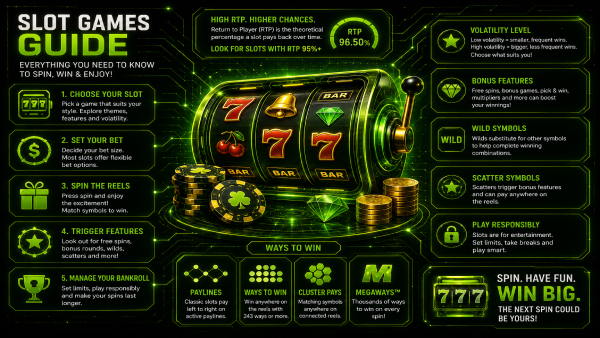
Key takeaways
- Every spin is random. A random number generator decides each result, so there are no patterns, streaks or due payouts.
- RTP is the long-run return. A 96% RTP means the game pays back 96 per 100 staked on average, over millions of spins.
- Volatility is how it pays. Low volatility means frequent small wins; high volatility means rare but bigger ones.
- Features create the wins. Wilds, scatters, free spins and multipliers do most of the heavy lifting.
- Stake for your bankroll. Bet size changes the win amount, never the odds, so play at a level you can sustain.
What a Slot Actually Is
A slot is a game where symbols land on a grid of spinning reels, and matching combinations of those symbols pay out according to a fixed table. That is the whole game at its core. Everything else, the themes, the animations, the bonus rounds, is decoration and packaging built on top of that simple engine. The version on your screen is a digital descendant of the mechanical fruit machines of a century ago, but where those used physical reels and springs, a modern slot is pure software.
That software heritage matters, because it means the reels you watch are not deciding anything. They are an animation played back to show you a result that has already been chosen the instant you pressed spin. Once you understand that a slot is a piece of certified software wrapped in a theme, the myths start to fall away: there is no lever technique, no warm-up, and no machine that owes you a win. What is left is a game of chance with a transparent maths model, which is exactly what this guide unpacks.
The Anatomy of a Slot
Before the maths, it helps to name the parts of the screen, because the terms come up constantly and each one has a precise meaning. Almost every slot is built from the same handful of components, whatever its theme.
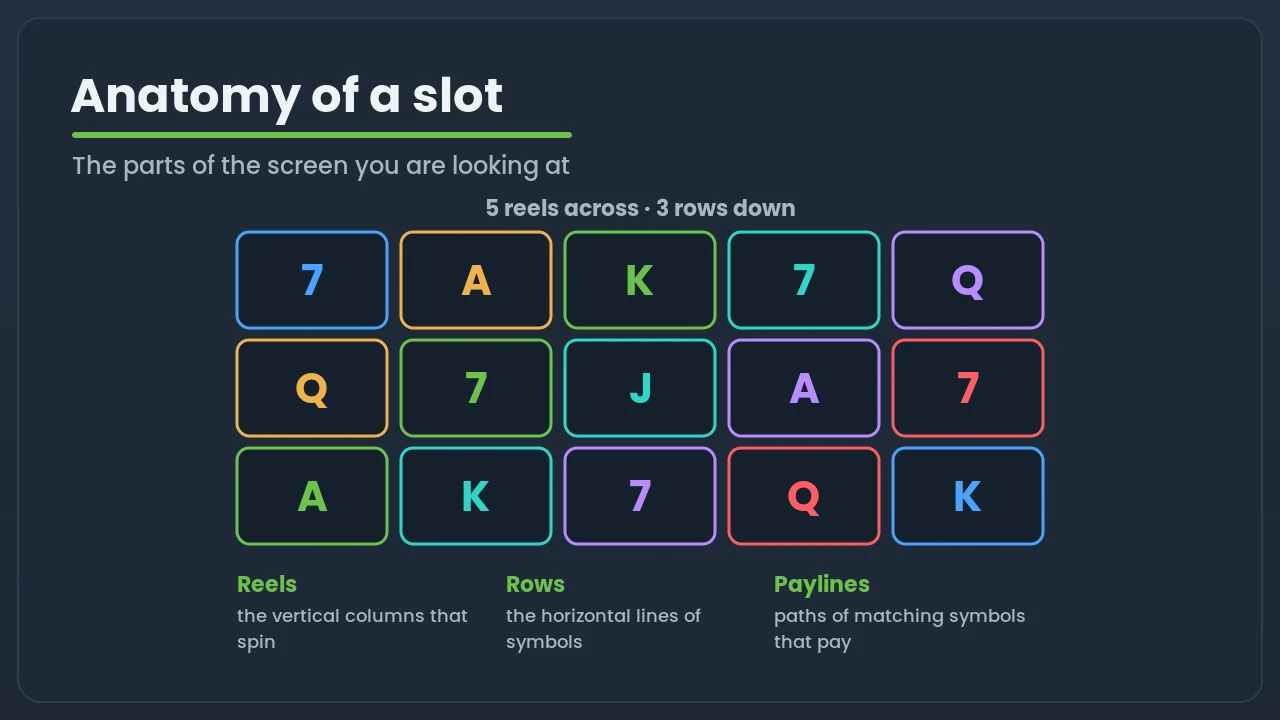
The reels are the vertical columns that spin, and most modern slots have five of them, though classic games use three. The rows are the horizontal lines of symbols, usually three or four, so a common layout is five reels by three rows. The symbols are the images on the reels, split into standard symbols that form ordinary wins and special symbols that trigger features. The paylines are the paths across the reels along which matching symbols must land to pay; a classic slot might have one, while a video slot can have dozens or use a ways-to-win system instead. Finally the paytable lists what every combination is worth, and it is the single most useful screen a player ignores.
How a Spin Really Works
This is the part that dispels the most myths, so it is worth being precise. At the heart of every slot is a random number generator, or RNG, a piece of software that continuously produces unpredictable numbers. The moment you press spin, the RNG's current value is taken and mapped to a set of symbol positions. That result is fixed instantly; the spinning reels are simply an animation revealing it to you with a bit of drama.
Two consequences follow, and both matter. First, each spin is completely independent of the one before. The game has no memory, so a machine that has not paid out is no more "due" than one that just hit a jackpot, and a run of losses does not raise the odds of the next spin. Second, because the RNG is certified by independent testing labs at any licensed casino, the odds are fixed and disclosed rather than manipulated in the moment. The casino's profit comes from the built-in house edge described in our how casinos make money guide, not from tampering with individual spins.
The practical takeaway is freeing: there is no skill, timing or system that changes a slot's outcome, so anything sold as a slot strategy is selling you a story. What you can control is which game you play and how you stake it, which is where RTP, volatility and the paytable come in.
Features and Symbols
If ordinary symbols were all a slot had, it would be a dry game of matching pictures. The special symbols and bonus features are what create the excitement and, more importantly, most of the meaningful wins. Knowing what each one does turns a confusing screen into a readable one.
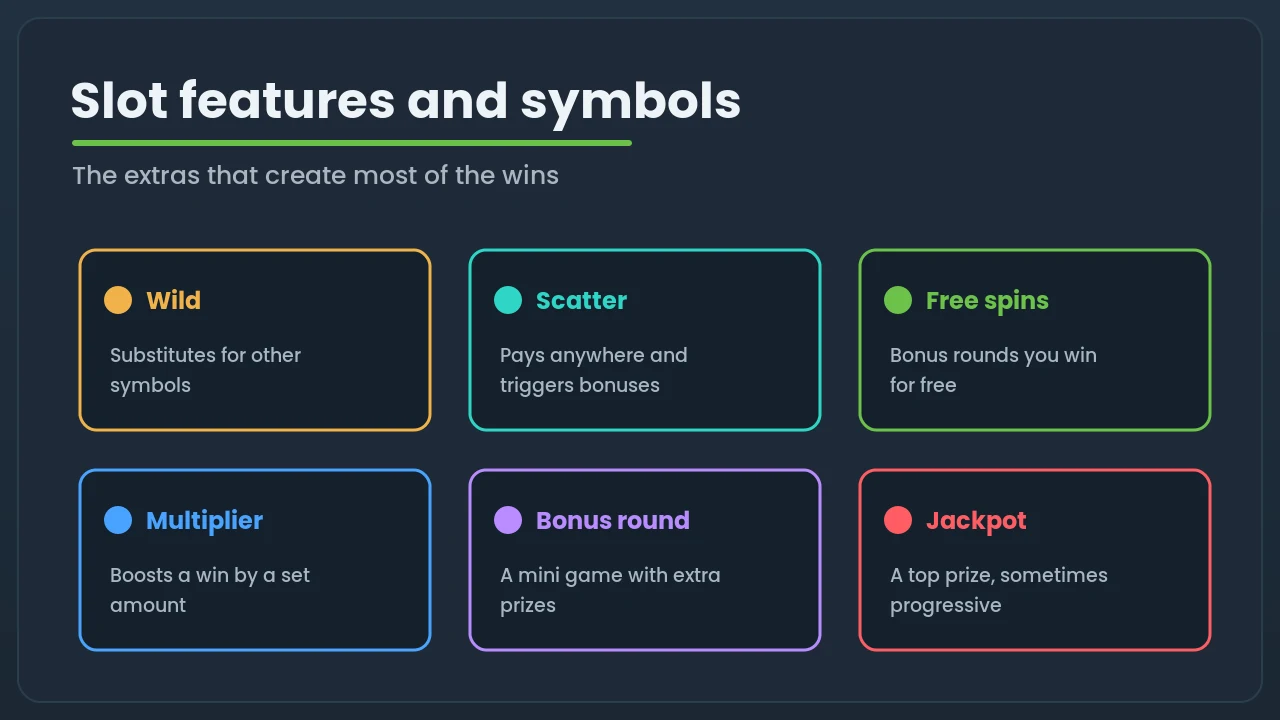
A wild substitutes for other symbols to help complete a winning line, much like a joker in cards. A scatter is special because it usually pays wherever it lands rather than on a payline, and landing a few of them typically triggers a bonus. Free spins are the most common bonus: a set of spins you play without staking, often the best chance of a large win. A multiplier increases a win by a stated factor, and these often stack inside free-spin rounds to create the headline payouts.
Beyond those, a bonus round is a mini game, such as a pick-and-reveal screen, that offers extra prizes, and a jackpot is a top prize that may be fixed or progressive. It is worth remembering that these features are not add-ons to the maths; they are baked into the RTP. A slot with a huge free-spins potential usually pays less often in the base game to fund it, which is simply volatility at work, the subject of a later section.
The Main Types of Slot
Slots come in a few broad families, and knowing which you are looking at sets your expectations for pace, features and risk. The diagram below covers the four you will meet most often.
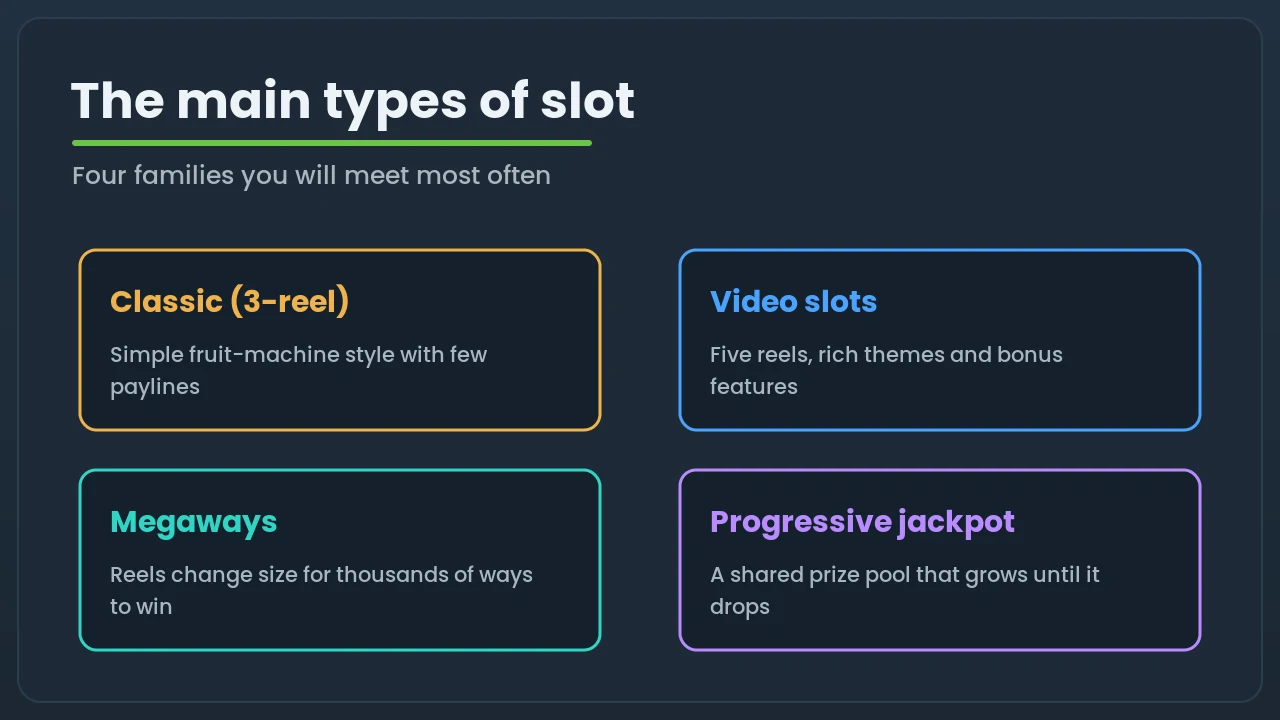
Classic slots keep it simple, usually three reels and a handful of paylines with fruit, bells and sevens, ideal if you want fast, uncomplicated play. Video slots are the modern standard: five reels, detailed themes and a full set of bonus features, and they make up the bulk of any lobby. Megaways slots use a mechanic where the number of symbols on each reel changes every spin, creating up to hundreds of thousands of ways to win and a very different, high-variance rhythm. Progressive jackpot slots pool a slice of every bet across many players into a prize that grows until someone wins it, offering life-changing sums at the cost of a lower base-game return.
| Type | Typical reels | Best for |
|---|---|---|
| Classic (3-reel) | 3 reels, few lines | Simple, fast, low-feature play |
| Video slots | 5 reels, many lines | Themes, features and variety |
| Megaways | 6 reels, shifting | Big ways to win and high variance |
| Progressive jackpot | Varies | Chasing a large shared prize |
Reading the Paytable
The paytable is the instruction manual every slot hides in a menu, and it answers the questions that actually matter before you spin. Opening it takes ten seconds and tells you what the game is really about, yet most players never look. It is usually behind an "i" or menu icon on the game screen.
Inside, you will find what each symbol pays for a matching combination, so you can see at a glance which symbols are valuable and which are filler. You will find how many paylines or ways to win the slot has, and how they are formed. Crucially, you will find how the special features work: how many scatters trigger free spins, what the wilds do, whether multipliers apply, and any rules attached to the jackpot. Many paytables also state the RTP and sometimes the volatility, and some slots lock their top prize or bonus behind a maximum bet, a rule you would only discover here. Reading it is the closest thing to a slot strategy there is, because it stops you being surprised by how a game behaves.
RTP and Volatility: The Two Numbers That Matter
If you take only two concepts from this guide, make them these. Together, RTP and volatility describe almost everything about how a slot will treat you, and they are often confused. Our dedicated RTP and volatility guide goes deeper, but here is what you need.
RTP, return to player, is the percentage of all staked money a slot pays back over the very long run. A 96% RTP means that across millions of spins the game returns 96 units for every 100 wagered, keeping 4 as the house edge. Most online slots sit between 94% and 97%. The vital caveat is that RTP is a long-term average, not a session promise; over a single evening you can win far more or lose far more than the number suggests. A higher RTP tilts the long-run odds slightly in your favour, so it is worth preferring where you have the choice, and you can look one up with our RTP checker.
Volatility, or variance, describes not how much a slot pays but how it pays. A low-volatility slot delivers small wins frequently, which keeps a session ticking along with modest swings, ideal for stretching a budget or clearing a bonus. A high-volatility slot pays rarely but can produce very large wins when it does, which means long dry spells punctuated by big hits. Two slots can share an identical 96% RTP and feel like completely different games because of volatility, so matching it to your bankroll and temperament matters as much as the RTP itself.
| Volatility | Win pattern | Suits |
|---|---|---|
| Low | Small wins, often | Longer sessions and smaller budgets |
| Medium | A balance of both | Most players, most of the time |
| High | Rare wins, larger | Big-win hunters with a bigger buffer |
Playing Slots Smart
Because no strategy changes a slot's outcome, playing well is entirely about managing your money and expectations rather than the game. A few simple habits make the difference between entertainment and frustration.
Sensible slot habits
- Set a budget first. Decide what you can afford to lose before you spin, and treat it as the price of entertainment.
- Size the stake to the budget. A rough guide is a bet no larger than 1% of your session budget, so a bad run does not end it in minutes.
- Match volatility to your bankroll. High-variance slots need a bigger buffer to survive the dry spells.
- Prefer higher RTP. When two slots appeal equally, the one with the better published RTP is the smarter pick.
- Never chase losses. Raising your stake to win back a loss is the fastest way to a bigger one.
Notice that none of these habits claims to improve your odds, because nothing can. What they do is keep you in control of the one thing you actually govern: how much you are willing to spend and for how long. A slot played within a set budget is a fun game of chance; the same slot played by chasing a result is where the trouble starts.
Choosing a Slot
With thousands of titles in a typical lobby, choosing can feel random, but a short checklist narrows it quickly and starts, as always, with the casino rather than the game. A great slot on an untrustworthy site is no bargain.
Confirm first that the casino is licensed, because that is what guarantees the RNG is certified and the RTP honest. Then match the game to what you want: check the RTP, read the volatility to see whether it suits your budget, and open the paytable to understand the features before you commit real money. Most slots offer a demo or play-money mode, which is a risk-free way to feel a game's rhythm before staking anything. Our casino reviews flag the operators with the strongest, fairest slot libraries so you can start from a shortlist rather than the whole internet.
A Responsible-Gambling Note
Slots deserve particular care because of how they are designed to feel. Fast spins, near-misses, sound and animation all make them absorbing, and that immersion is exactly what can blur how much time and money is passing. Slot play is for adults only, 18+, and the house edge means the game is built to win over time, however entertaining a session feels.
Keep slots fun
Set a deposit and time limit before you start, take regular breaks so a session does not run away from you, and treat any money staked as the cost of entertainment rather than an investment. Be wary of the urge to increase your stake after a loss or to keep spinning "just one more" for a bonus. If play stops feeling fun or starts to feel compulsive, step away and use the operator's limit and self-exclusion tools. Our responsible-gambling guide explains every tool and where to find free, confidential support.