
Roulette guide
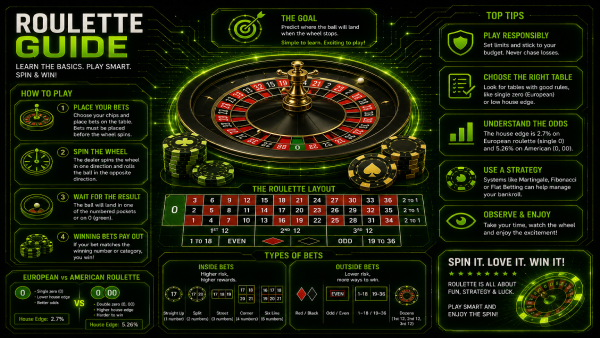
Roulette is the most iconic game on the casino floor and one of the simplest to play, but the bets and odds hide more depth than the spinning wheel suggests. This guide covers the wheel and table, every bet with its payout and real win chance, the crucial European versus American difference, and why no betting system can beat it.



Few sights say casino like a roulette wheel: the spin, the rattle of the ball, the held breath as it drops into a pocket. The game is centuries old, and its appeal has always been the same simple thrill of guessing where a ball will land. You can play it knowing almost nothing, which is part of its charm, but a little understanding of the bets and the odds turns a pretty guessing game into one you play with your eyes open.
This guide gives you exactly that. We start with the wheel and the layout, walk through how a single round is played, then get into the part that really matters: the full range of bets, what each one pays, and how often it actually wins. We look closely at the one decision that changes your odds more than any bet, European versus American, explain why every betting system eventually fails, and finish with how to play sensibly. By the end the wheel will hold no mysteries, only choices.
Key takeaways
- Guess the pocket. You bet on where a ball lands on a numbered wheel, from one number to broad groups.
- Inside vs outside. Inside bets pay big but rarely; outside bets pay small but win close to half the time.
- The zero is the edge. The green zero is what gives the house its advantage on every bet.
- Choose European. A single zero means a 2.7% edge; American's double zero nearly doubles it.
- Systems cannot win. No staking pattern beats a negative-edge game; each spin is independent.
What Roulette Is
Roulette is a game of pure chance built around a spinning wheel of numbered pockets and a small ball. You place bets on where you think the ball will come to rest, the wheel spins one way and the ball the other, and when it settles into a pocket the winning number and colour are decided. Every bet on the table is then paid or lost against that single result.
What makes roulette approachable is that there is no skill in the outcome and no decisions to agonise over once the ball is spinning, unlike a game such as blackjack. What makes it interesting is the sheer range of ways to bet, from staking everything on one number to covering nearly half the wheel at once, each with its own balance of risk and reward. Understanding that balance is the whole game, because the wheel itself does not care what you choose.
The Wheel and the Table
Everything in roulette flows from the wheel, so it is worth a proper look. A European wheel has 37 pockets: the numbers 1 to 36, coloured alternately red and black, plus a single green zero. That green pocket is the quiet source of the casino's edge, as we will see.
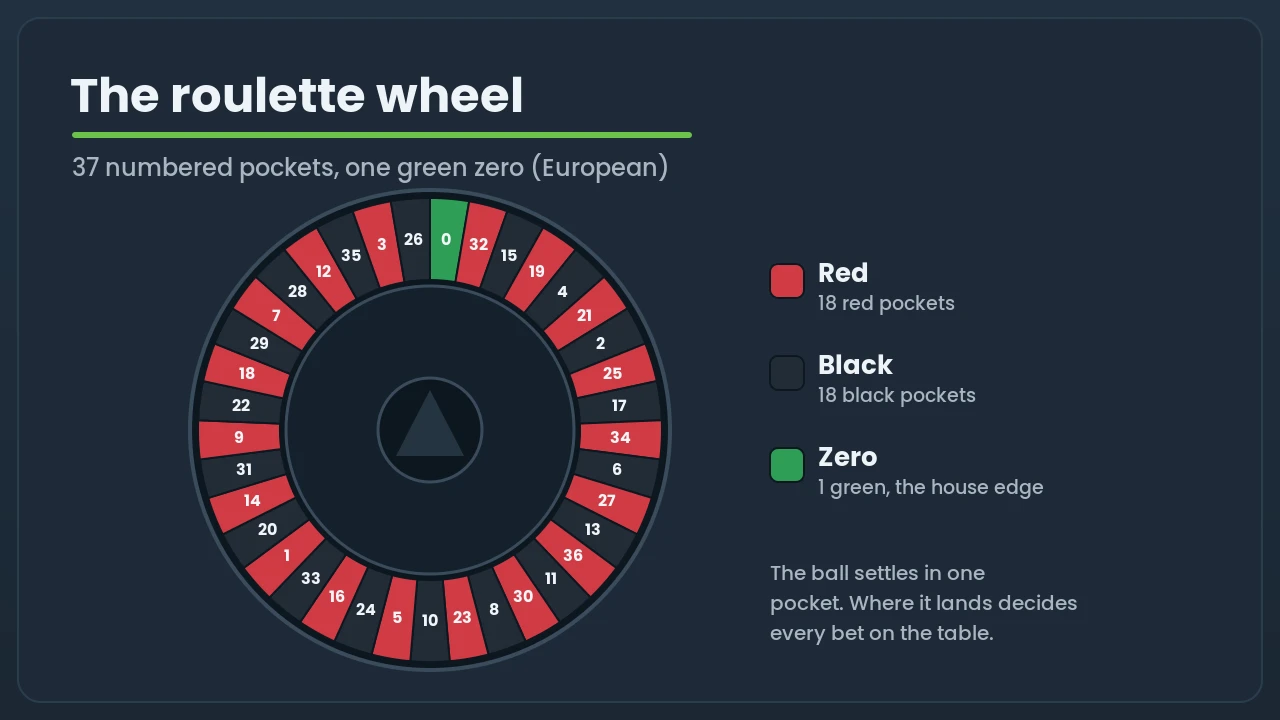
Alongside the wheel sits the betting table, a grid printed with all the numbers plus boxes for the group bets. This is where you place your chips, and the position of a chip defines the bet: directly on a number, on the line between numbers, or in the outside boxes for red, black, odd, even and the rest. Online the table is the same, just rendered on screen, and clicking a spot places your chip there. Once you can read the wheel and the table together, every bet in the game becomes obvious, because each one is simply a way of covering some of those 37 pockets.
How a Round Works
A round of roulette follows an unchanging rhythm, whether you are at a live table or playing software. First, the dealer opens betting and you place your chips anywhere on the table, either on single numbers or on the outside groups. When betting closes, the wheel is set spinning and the ball is released in the opposite direction around the rim.
As the ball loses speed it drops from the rim, bounces across the pockets and finally settles into one, giving the winning number and colour. Losing bets are cleared, winning bets are paid according to the payout table, and the next round opens. That is the entire loop. There is nothing to do once the ball is in motion, which is why roulette is as much about choosing your bets beforehand as anything that happens during the spin.
Inside and Outside Bets
Every roulette bet falls into one of two families, and the split is the most useful idea in the whole game. Where you place a chip decides not just what you are betting on but the entire risk-and-reward profile of that bet.
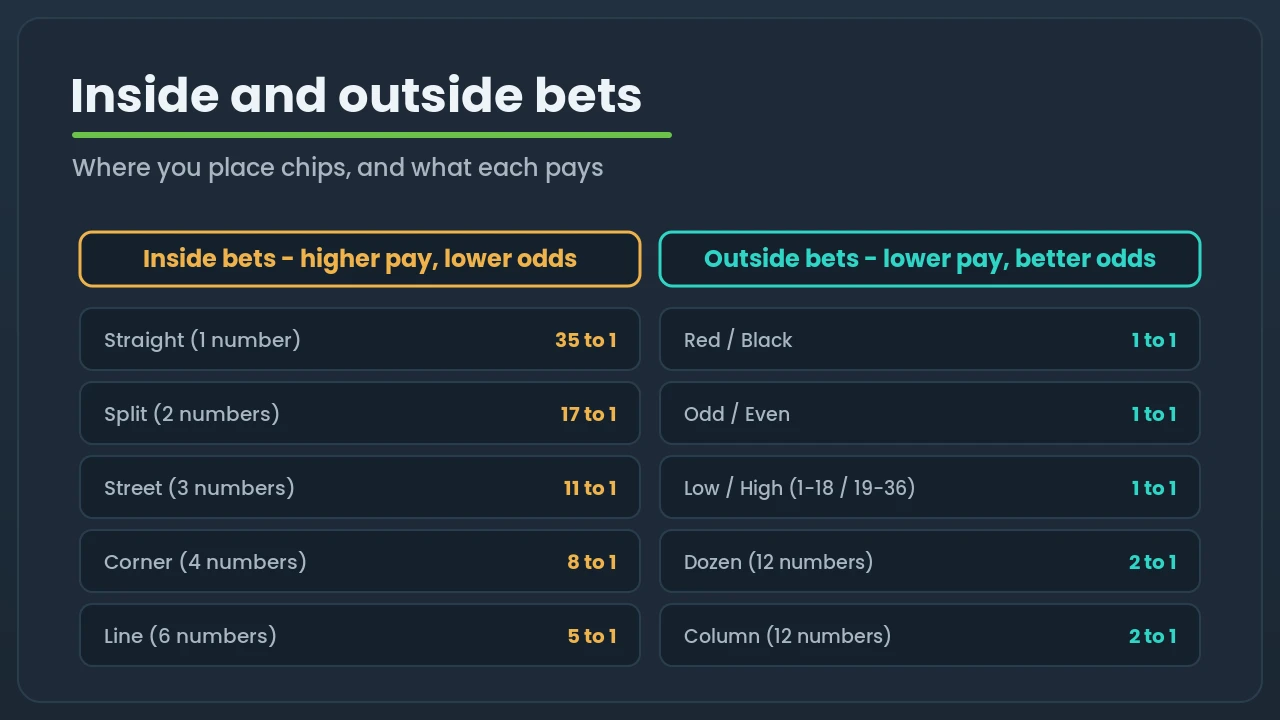
Inside bets are placed on the numbers themselves and cover between one and six of them. They include the straight bet on a single number, the split on two, the street on three, the corner on four and the line on six. Because they cover so little of the wheel they rarely win, but when they do the payouts are large. Outside bets sit in the boxes around the numbers and cover big groups: red or black, odd or even, low or high, the dozens and the columns. They win far more often, close to half the time for the even-money bets, but pay much less. Neither family is better; they simply suit different appetites, the inside for excitement and big hits, the outside for steadier, longer play.
Payouts and Real Odds
This is the table to bookmark. It sets every main bet against two numbers that matter: what it pays and how often it actually wins on a European wheel. Reading them side by side is the clearest way to see that the bigger payouts come with proportionally smaller chances, and that the house edge is woven into every row.
| Bet | Type | Numbers | Payout | Win chance |
|---|---|---|---|---|
| Straight | Inside | 1 | 35 to 1 | 2.7% |
| Split | Inside | 2 | 17 to 1 | 5.4% |
| Street | Inside | 3 | 11 to 1 | 8.1% |
| Corner | Inside | 4 | 8 to 1 | 10.8% |
| Line | Inside | 6 | 5 to 1 | 16.2% |
| Dozen | Outside | 12 | 2 to 1 | 32.4% |
| Column | Outside | 12 | 2 to 1 | 32.4% |
| Red / Black | Outside | 18 | 1 to 1 | 48.6% |
| Odd / Even | Outside | 18 | 1 to 1 | 48.6% |
| Low / High | Outside | 18 | 1 to 1 | 48.6% |
Look closely at the straight bet. It pays 35 to 1, but the true odds of hitting one number out of 37 are 36 to 1, and that missing unit is the house edge in miniature. The same quiet shortfall runs through every bet on the wheel, which is why no single bet is smarter than another in the long run. They all carry the same roughly 2.7% edge on a European wheel; the only real choice is how much risk and reward you want along the way. The wider logic of how that edge funds the casino is in our how casinos make money guide.
European vs American Roulette
If there is one decision that genuinely changes your odds, it is this one, and it has nothing to do with which bet you place. It is which wheel you sit at. The two main versions look almost identical but differ by a single pocket, and that pocket is expensive.
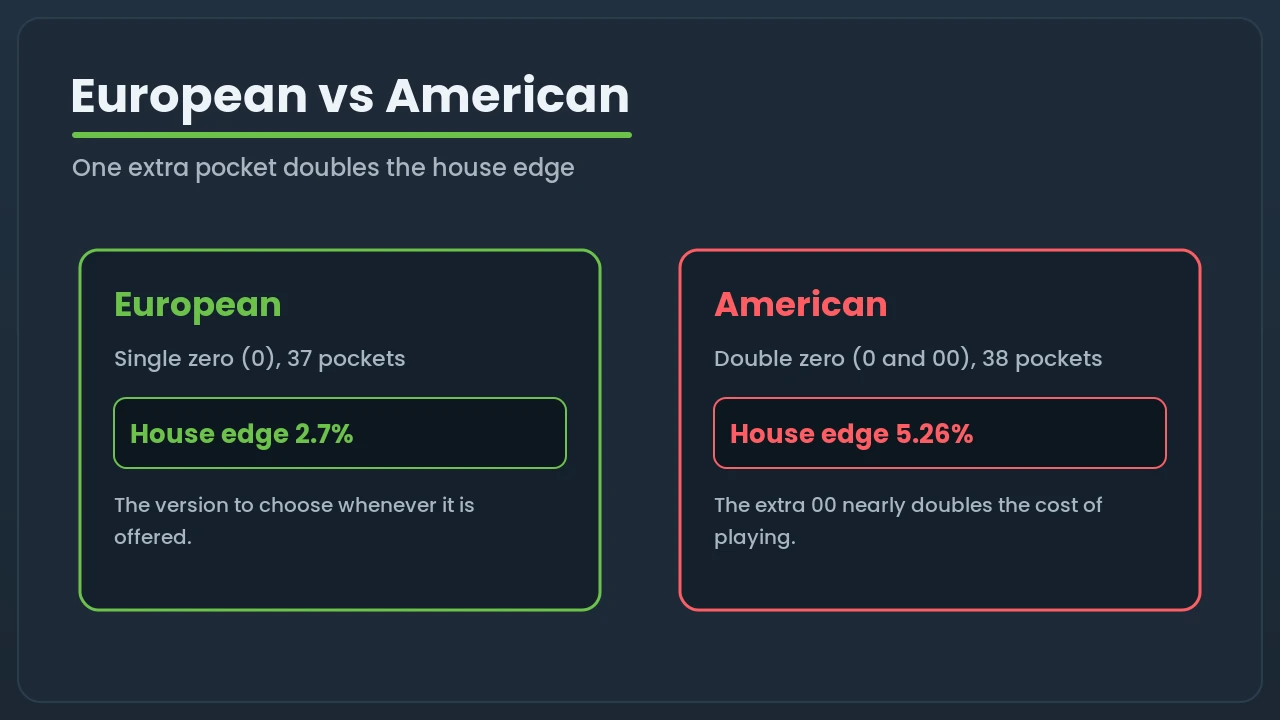
European roulette has a single green zero and 37 pockets, giving a house edge of about 2.7%. American roulette adds a second green pocket, the double zero, for 38 pockets and a house edge of roughly 5.26%, nearly twice as much. The payouts on both are identical, so the extra pocket gives you nothing in return; it simply makes every bet cost more over time. The rule could not be simpler: whenever a casino offers both, choose European, sometimes labelled single-zero. Some European tables also add player-friendly rules on the even-money bets that return part of your stake when the ball hits zero, lowering the edge further still. Given the choice, that is the table to find.
| Version | Green pockets | Total pockets | House edge |
|---|---|---|---|
| European | One (0) | 37 | ~2.7% |
| American | Two (0 and 00) | 38 | ~5.26% |
Why Betting Systems Do Not Work
No topic in roulette attracts more mythology than betting systems, and it is worth being blunt: none of them beats the game. The most famous, the Martingale, tells you to double your bet after every loss so that a single win recovers everything plus a small profit. On paper it looks unbeatable, and in short bursts it delivers a stream of small wins that feels like a method working.
The flaw is fundamental. Each spin is independent, so the wheel has no memory of previous results, and no sequence of bets changes the 2.7% edge on any individual spin. What the Martingale actually does is trade many small wins for the occasional catastrophic loss, because a losing streak, which is entirely normal, forces your stake to double past your bankroll or the table limit. When that happens, all the small wins are wiped out at once. Every other progression, from the Fibonacci to the D'Alembert, runs into the same wall: you cannot turn a negative-edge game positive by rearranging the order of your bets. Systems change how your losses are distributed, never whether they arrive.
Playing Roulette Sensibly
Since nothing you do changes the odds of the wheel, playing well in roulette is entirely about managing your bankroll and expectations. A few simple habits keep the game fun and your session honest.
Sensible roulette habits
- Always pick European. The single-zero wheel halves the house edge for the exact same game.
- Set a budget first. Decide what you can afford to lose and treat it as the price of the entertainment.
- Favour outside bets to last longer. Even-money bets win close to half the time and smooth out the swings.
- Ignore the systems. No staking pattern beats the edge, so bet flat rather than chasing losses upward.
- Skip the previous-numbers board. Past spins are irrelevant; the next spin has the same odds regardless.
Above all, remember that roulette is entertainment with a built-in cost, not a puzzle to solve. Choosing the European wheel and a betting style that fits your budget is the entire skill involved, and it is enough to enjoy the game without handing the casino more than it already takes.
A Responsible-Gambling Note
Roulette's slow, hypnotic rhythm and the near-miss of a ball landing one pocket away can make it easy to keep betting longer than planned. Roulette play is for adults only, 18+, and the house edge means the wheel is built to win over time, however lucky a single spin feels. A run of losing spins is completely normal and no bet is ever due.
Keep the wheel in its place
Set a deposit and time limit before you start, bet flat rather than chasing a loss with a bigger stake, and treat any money wagered as the cost of entertainment rather than an investment you expect to grow. Be especially wary of the urge to recover a losing run in one big bet. If play stops feeling fun or starts to feel compulsive, step away and use the operator's limit and self-exclusion tools. Our responsible-gambling guide explains every tool and where to find free, confidential support.