
Blackjack guide
Blackjack is the rare casino game where your decisions genuinely change the odds. This guide covers the rules and card values, how a hand plays out, your five moves, and a full colour-coded basic strategy chart, the closest thing to a legitimate edge you will find on a casino floor.



Blackjack has a reputation that most casino games cannot claim: it rewards knowing what you are doing. Sit at a slot and the result is decided the instant you press spin, with nothing you can do to change it. Sit at a blackjack table and every hand asks you to make a decision, and those decisions add up. Play well and the house holds one of the smallest edges in the building; play on instinct and you quietly hand that edge back several times over.
That is why blackjack is worth learning properly rather than picking up as you go. This guide gives you the whole game in order: the goal and the card values, how a single hand unfolds, the five moves available to you, and then the centrepiece, a colour-coded basic strategy chart that tells you the mathematically correct play for any hand. We finish with the house edge, the main variants, and the mistakes that cost players the most. By the end you will know not just how to play, but how to play so the game stays as fair as it can be.
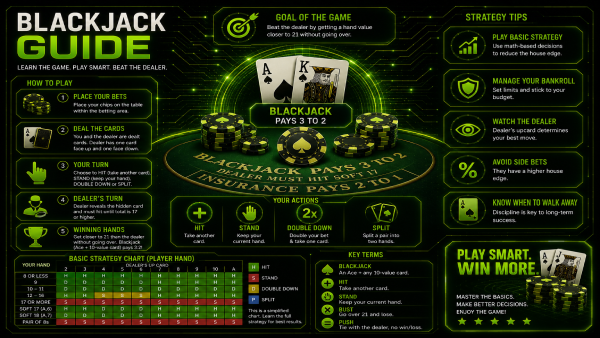
Key takeaways
- Beat the dealer, not 21. The aim is a total closer to 21 than the dealer's, without going over.
- Decisions matter. Hit, stand, double, split and surrender are real choices that change the odds.
- Basic strategy is the edge. Following the chart cuts the house edge to around 0.5% on fair rules.
- Rules change the maths. Look for blackjack that pays 3 to 2 and avoid 6 to 5 tables.
- Skip insurance. It is a losing side bet that basic strategy declines every time.
What Blackjack Is
Blackjack is a card game played between you and the dealer, and that is the first thing to hold onto: the other players at the table are irrelevant to your result. You are not competing with them, and their decisions, good or bad, do not change what you should do. It is a one-on-one contest against the house, repeated hand after hand.
The game is built on a simple target and a simple threat. You want a hand that totals closer to 21 than the dealer's, and the threat is that going over 21, called going bust, loses instantly. Because the dealer plays by fixed rules while you get to choose, blackjack becomes a game of decisions rather than pure luck. That is exactly why it carries one of the lowest house edges in the casino, and why it rewards the small effort of learning it properly.
Card Values and the Goal
Before anything else, you need to know what the cards are worth, and blackjack keeps this refreshingly simple. There is only one piece of arithmetic to learn, and the flexible ace is the one detail that trips up beginners.
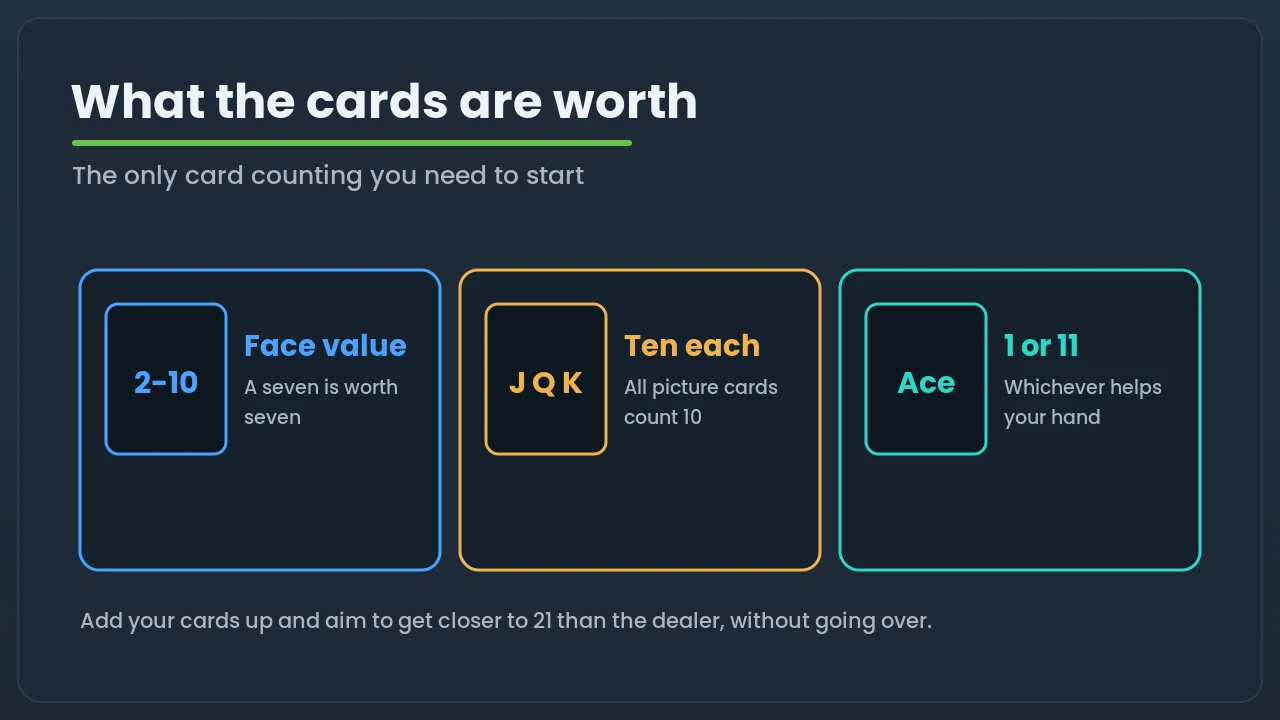
Number cards are worth their face value, so a seven is seven and a four is four. Every picture card, the jack, queen and king, is worth ten. The ace is the clever one: it counts as either one or eleven, whichever is better for your hand at that moment, and it can even switch during a hand. A hand with an ace being counted as eleven is called a soft hand, because it cannot bust on the next card; if that would push you over 21, the ace simply reverts to one. The best possible start is an ace plus any ten-value card, a two-card 21, which is a blackjack and beats any other 21.
How a Hand Plays Out
A round of blackjack follows the same four beats every time, and knowing the rhythm makes the table far less intimidating, whether you are playing software or a live dealer.
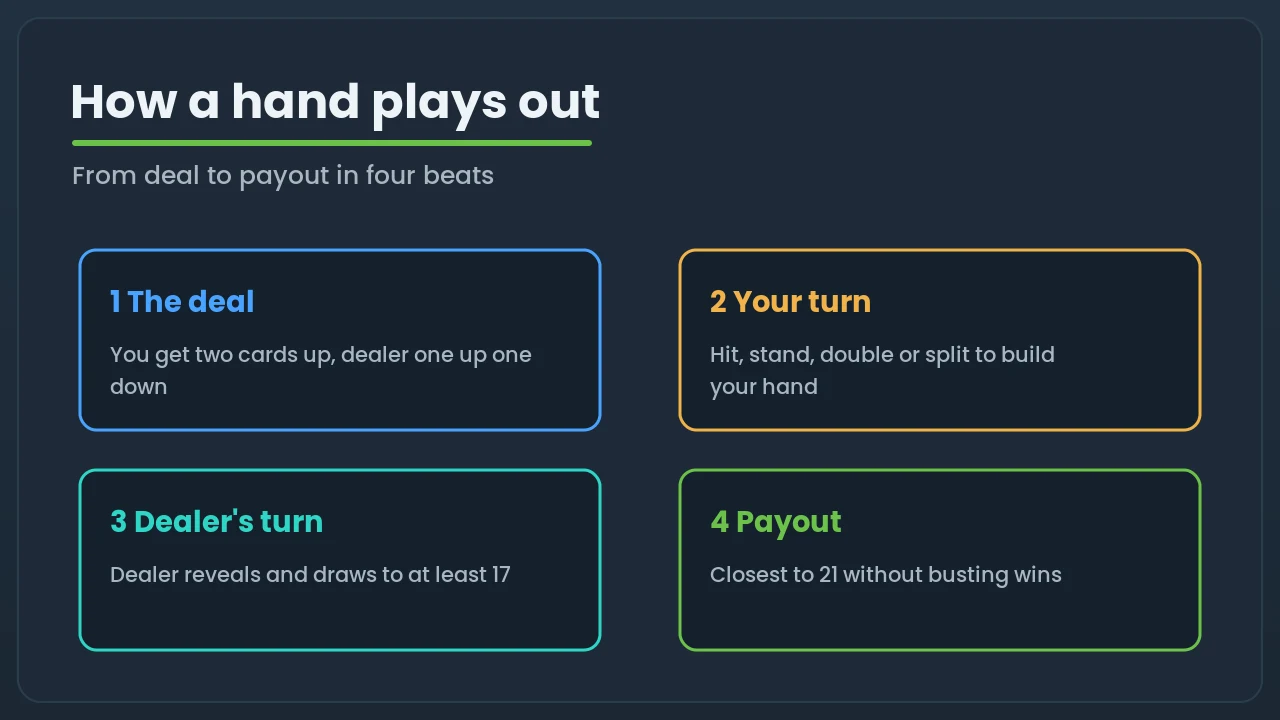
First comes the deal: you receive two cards face up, and the dealer takes two, one face up and one face down, known as the hole card. Next is your turn, where you use the moves in the next section to build your hand, hitting for more cards or standing when you are happy. Then comes the dealer's turn: they reveal the hole card and must draw according to a fixed rule, typically hitting until they reach at least 17 and then stopping. Finally, the payout is settled by comparing totals, closest to 21 without busting wins, a tie returns your stake, and a blackjack pays extra.
Your Five Moves
Everything you actually do in blackjack comes down to five possible actions on your turn. Not all are available on every hand, but knowing what each one does is the foundation for the strategy that follows.
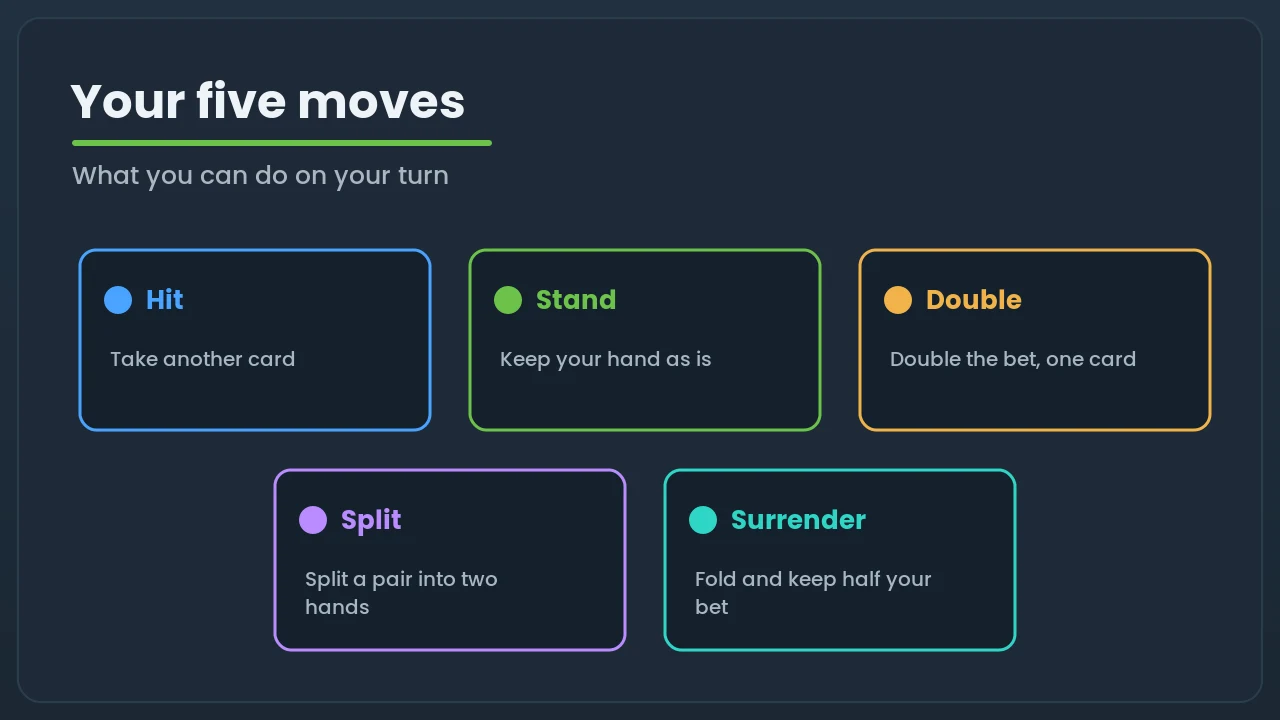
Hit takes another card, used when your total is low enough that you want to improve it. Stand ends your turn and keeps your hand as it is. Double, short for double down, doubles your original bet in exchange for exactly one more card, the aggressive play you make when the odds strongly favour you. Split applies when your first two cards are a pair: you can split them into two separate hands, each with its own bet, and play them independently. Surrender, offered at some tables, lets you fold a bad hand immediately and reclaim half your stake, which is better than playing out a near-hopeless total. Doubling, splitting and surrendering are where much of blackjack's low edge comes from, so ignoring them, as many casual players do, quietly costs money.
Basic Strategy: The Real Edge
Here is the part that separates blackjack from every other casino game. Because your decisions affect the outcome, mathematicians have worked out the single best move for every possible combination of your hand and the dealer's upcard. That set of best moves is called basic strategy, and it is not a betting system or a trick, it is simply the play that, on average, loses the least or wins the most over the long run.
Playing perfect basic strategy pushes the house edge down to roughly half a percent on fair rules, which is dramatically lower than slots or most other games. It will not turn blackjack into a winning game, the edge still favours the house, but it means you never give away more than the rules already take. The good news is you do not have to memorise it: you can keep a chart open while you play online, and with repetition the common decisions become automatic.
The Basic Strategy Chart
The chart below covers hard totals, hands without an ace counted as eleven, which are the most common situations you will face. Find your total down the left, read across to the dealer's upcard along the top, and the coloured cell tells you the correct move. Where doubling is not allowed, hit instead.
| You | 2 | 3 | 4 | 5 | 6 | 7 | 8 | 9 | 10 | A |
|---|---|---|---|---|---|---|---|---|---|---|
| 8 | H | H | H | H | H | H | H | H | H | H |
| 9 | H | D | D | D | D | H | H | H | H | H |
| 10 | D | D | D | D | D | D | D | D | H | H |
| 11 | D | D | D | D | D | D | D | D | D | H |
| 12 | H | H | S | S | S | H | H | H | H | H |
| 13 | S | S | S | S | S | H | H | H | H | H |
| 14 | S | S | S | S | S | H | H | H | H | H |
| 15 | S | S | S | S | S | H | H | H | H | H |
| 16 | S | S | S | S | S | H | H | H | H | H |
| 17+ | S | S | S | S | S | S | S | S | S | S |
Two quick rules cover the hands the chart leaves out. For soft hands, those with an ace as eleven, you play more aggressively, standing on soft 19 and above and often doubling on soft 13 to 18 against a weak dealer card. For pairs, always split aces and eights, never split tens or fives, and split the rest against the dealer's weaker upcards. Memorise the hard-total chart first, since it comes up most, and add the soft and pair rules as you go.
House Edge and Payouts
Blackjack's low house edge is its whole appeal, but it depends entirely on the rules of the specific table, and one number matters more than any other: what a blackjack pays. The traditional and correct payout is 3 to 2, meaning a winning blackjack returns one and a half times your stake. Some tables quietly offer 6 to 5 instead, which sounds close but roughly doubles the house edge and should be avoided outright.
| Outcome | Pays | Note |
|---|---|---|
| Blackjack (3 to 2) | 1.5x your bet | The payout to look for |
| Blackjack (6 to 5) | 1.2x your bet | Worse odds, avoid these tables |
| Ordinary win | 1 to 1 | Even money on a beaten dealer |
| Push (tie) | Stake returned | No win, no loss |
| Insurance | 2 to 1 side bet | High edge, decline it |
Beyond the payout, a few rules nudge the edge up or down: whether the dealer stands or hits on a soft 17, how many decks are in play, and whether you can double after splitting. You do not need to master all of them, but the headline advice is simple. Play a 3-to-2 table, use basic strategy, and decline insurance and most side bets, which carry far higher edges than the main game. The wider picture of how that edge funds the casino is covered in our how casinos make money guide.
Blackjack Variants
Walk through any online casino lobby and you will find blackjack in several flavours. The core game is the same, but small rule changes alter the feel and, importantly, the edge, so it is worth knowing what you are sitting down to.
Classic or European blackjack is the standard version and the one this guide describes. Live dealer blackjack streams a real dealer and real cards to your screen, adding atmosphere and the social side of a real table, as our casino types guide explains. From there, named variants tweak the rules: some change how the dealer plays a soft 17, some restrict doubling or splitting, and novelty versions add side bets and bonus payouts that usually come with a higher edge. The rule of thumb is that the simpler and more classic the variant, the better the odds, and flashy bonus versions tend to cost you in exchange for the extra action.
Common Mistakes to Avoid
Most of the money casual players give away at blackjack comes from a short list of avoidable errors. Steer clear of these and you are already playing better than most of the table.
The habits that cost you
Taking insurance, playing at 6-to-5 tables, ignoring the double and split options, standing on low totals out of fear of busting, and copying the dealer's rule of always hitting to 17 are the classic leaks. Chasing losses by raising your stake after a bad run is the most damaging of all. Each one hands the casino more edge than the rules require, and every one is fixed by simply following basic strategy and a set budget.
A Responsible-Gambling Note
Blackjack's low house edge can create a false sense of safety, as though good play makes losing unlikely. It does not. The edge still favours the casino, the game is for adults only, 18+, and skill reduces the cost of playing rather than removing it. A run of losing hands is entirely normal even with flawless strategy.
Play the long game
Set a budget before you sit down and stake at a level it can absorb, since even good players hit losing streaks. Never raise your bet to recover a loss, and treat basic strategy as a way to enjoy the game longer rather than a route to profit. If play stops feeling fun or starts to feel compulsive, step away and use the operator's limit and self-exclusion tools. Our responsible-gambling guide explains every tool and where to find free, confidential support.