
Provably fair gaming
Most casinos ask you to trust that their games are honest. Provably fair games let you check. This guide unpacks how that works in plain English: the seeds and hashes behind it, the neat commit-and-reveal trick that stops a casino cheating, how to verify any result yourself, and, just as importantly, what provable fairness cannot do for you.



Every casino game rests on a single, uncomfortable question: how do you know it is not rigged? At a licensed casino, the answer is that you trust the system, the independent labs that test the software and the regulator that holds the operator to account. It is a good answer, and for most players it is enough. But it still asks you to take fairness on faith, because you cannot personally inspect the code deciding your spin.
Provably fair gaming was born to remove that leap of faith. It is a clever piece of cryptography, popularised by crypto casinos, that lets you verify a specific result was honestly generated, without trusting the casino, the lab or anyone else. Instead of "trust us, it is fair", it says "here is the maths, check it yourself". That is a genuinely different promise, and this guide explains exactly how it delivers on it, where it falls short, and how you can put it to the test in a couple of minutes.
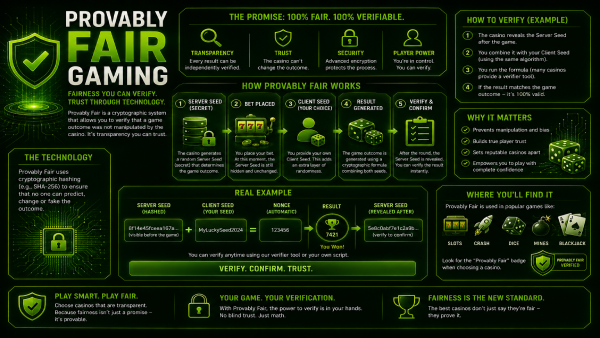
Key takeaways
- It replaces trust with proof. You can verify a single result was generated honestly, without trusting anyone.
- Three ingredients decide each round. A server seed, your client seed and a nonce feed one formula.
- Commit then reveal is the trick. The casino locks in its seed with a hash before you bet, so it cannot change it after.
- You can check it yourself. A verifier re-runs the maths from your bet history in seconds.
- It is not a cure-all. It does not lower the house edge, cover third-party slots, or replace a proper licence.
What Provably Fair Actually Is
Provably fair is a method for generating and confirming random game results so that neither the casino nor the player can secretly influence them, and, crucially, so that either side can prove after the fact that the result was honest. It applies to simple crypto-native games such as dice, crash, plinko and coin flips, where the outcome is a single number that can be reproduced from a few inputs.
The core idea is a cryptographic commitment. Before you bet, the casino locks itself into a secret value it cannot later change, then proves after the round that it stuck to it. That is the whole trick, dressed up in some maths. If you have read our broader guide to how crypto casinos work, you will have met the concept in passing; this guide takes it apart properly, because once you see the mechanism, the cleverness is obvious and the limits become just as clear.
The Trust Problem It Solves
To appreciate why provably fair matters, picture the alternative. On a normal online casino, the result of your spin is decided by a random number generator running on the operator's servers, code you never see. As our slot games guide explains, at a licensed casino that code is tested and certified by independent laboratories, which is exactly why licensing is such a big deal. The fairness is real, but it is guaranteed by third parties you also have to trust.
Provably fair removes the middlemen from that specific question. Rather than relying on a lab's stamp, it gives you the mathematical tools to check a result for yourself. It does not make the games more generous or the odds better; it simply lets you confirm that the number you were dealt is the number the system was always going to deal, given the inputs. For a sceptic, that shift from institutional trust to personal verification is the entire appeal.
The Three Ingredients
Every provably fair result is cooked from the same three ingredients. Understanding what each one is for is most of the battle, because once you have them, the rest is just running a formula.
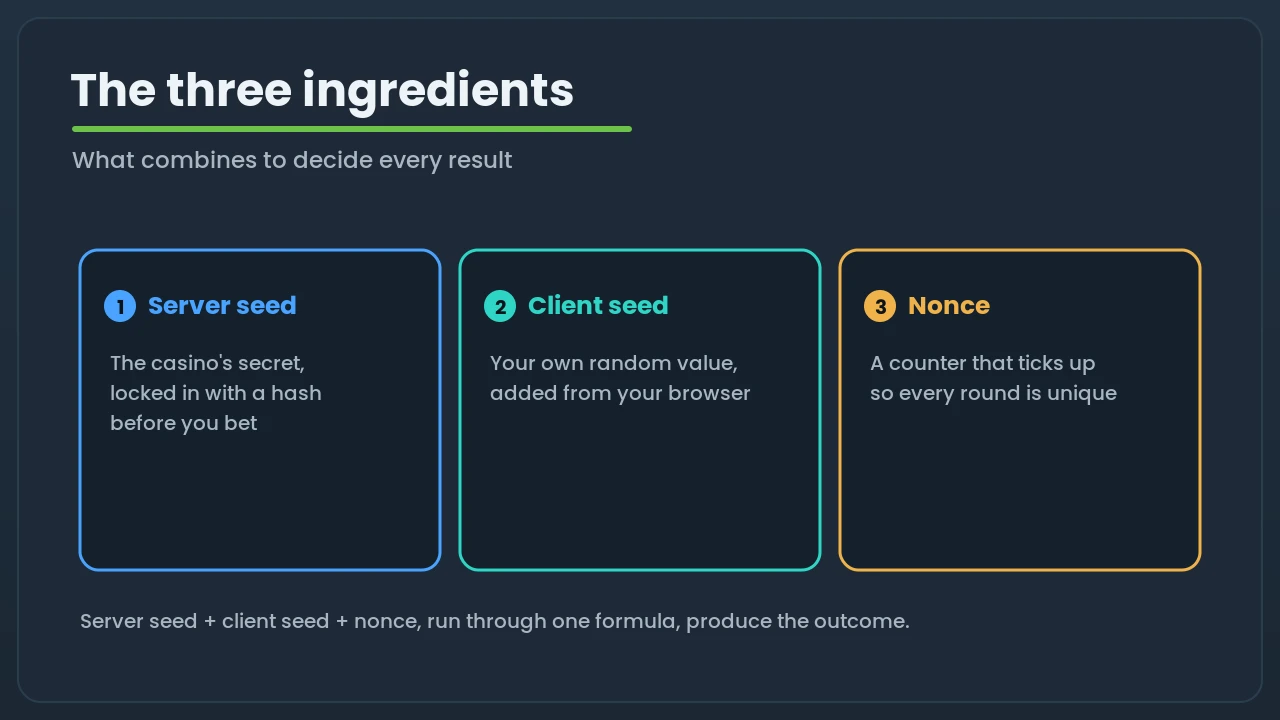
The server seed is the casino's secret, a long random string generated on its servers. It is the casino's commitment: before you play, it is hashed, and you are shown only the hash, never the seed itself. The client seed is your contribution, a value generated by your browser or one you type in yourself. Its job is vital: because the casino commits to its server seed before it knows your client seed, it cannot predict, let alone fix, the outcome. The nonce is the humblest of the three, a simple counter that starts at one and rises by one with every round played under the same pair of seeds. Without it, the same seeds would produce the same result every time; the nonce is what makes round two different from round one.
The Commit-and-Reveal Trick
Now for the part that makes the whole thing tamper-proof. It hinges on one property of a cryptographic hash: it is a one-way scrambler. Feed it any text and it spits out a fixed-length fingerprint, but you cannot work backwards from the fingerprint to the original. Change a single character of the input and the fingerprint changes completely.
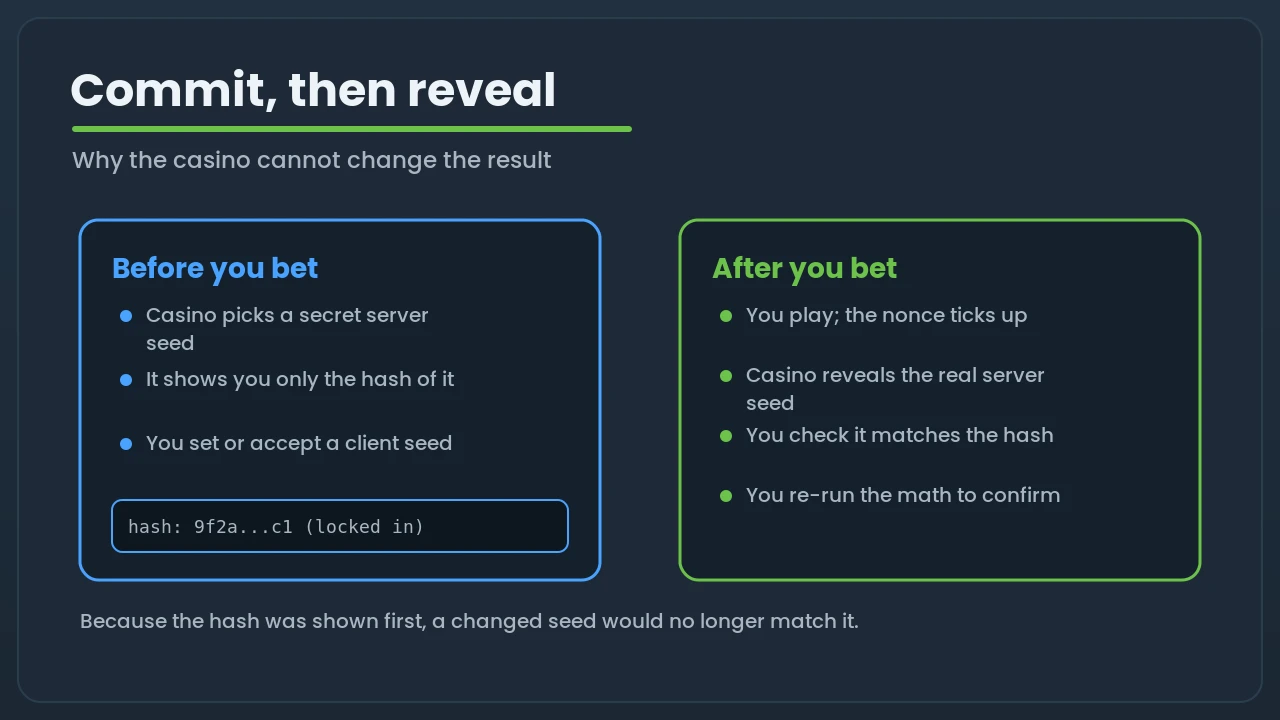
That property is what nails the casino down. Before you bet, it commits by showing you the hash of its server seed. The seed is hidden, but the commitment is public. You then play, with the nonce climbing round by round. After you are done with that seed, the casino reveals the real server seed. Now you do two checks: you hash the revealed seed and confirm it matches the hash you were given at the start, proving the casino did not swap it; and you re-run the game formula with the three ingredients to confirm the outcome was exactly what they dictated. Since the casino committed to its seed before it ever saw your client seed, it had no way to engineer a result in its favour. That is the heart of provable fairness.
A Worked Example
The abstract version can feel slippery, so here is a concrete, if simplified, walk-through of a provably fair dice roll. The exact algorithm varies by casino, but the shape is always the same. Say you want a number from 0 to 99.
Run that yourself and the output number must match the "47" sitting in your bet history. The first check proves the casino did not change its seed after seeing your input; the second proves the result was mechanically derived from the seeds rather than chosen. You do not need to understand the cryptography to trust it, because the tools below do the arithmetic. But seeing the pieces line up, hash matches commitment, formula reproduces the roll, is what makes the guarantee click.
How to Verify a Result Yourself
Here is the reassuring part: you never have to do any of the maths by hand. Verification is a copy-and-paste job, and it takes about two minutes. The steps are the same at almost every provably fair casino.
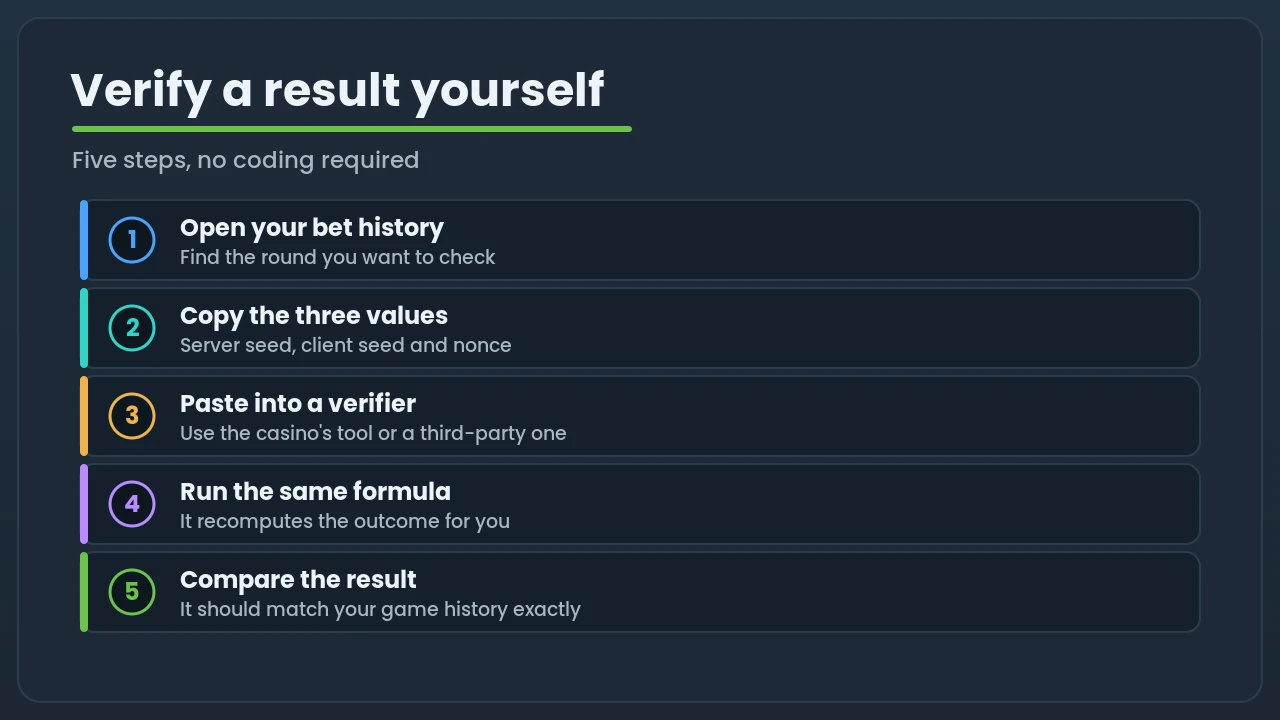
Open your bet history and pick the round you want to check. Copy its three values: the revealed server seed, your client seed and the nonce. Paste them into a verifier, either the tool built into the casino or an independent, third-party one, which many players prefer precisely because it does not belong to the operator. The tool runs the same formula the game used and recomputes the outcome. Finally, compare that output with the result in your history: if they match, the round was provably fair; if they do not, you are holding cryptographic proof that something was altered. To check a full session of past rounds at once, you can also rotate your seed pair first, which reveals the old server seed and lets you verify every round played under it.
A tip worth knowing
Set your own client seed rather than accepting the default, and use an independent verifier rather than only the casino's. Neither is strictly necessary for the maths to hold, but both remove any lingering doubt: a client seed you chose cannot have been anticipated, and a verifier the casino does not control cannot quietly fudge the check.
What Provably Fair Does Not Do
This is the section most guides skip, and it is the most important. Provable fairness is powerful but narrow, and mistaking it for a guarantee of overall safety is a real trap. Being clear about its limits is what lets you use it well.
First, it does not lower the house edge. It proves a result was honestly generated, not that the game is generous; the casino is still built to win over time. Second, it only covers the crypto casino's own in-house games, the dice, crash and similar titles, and not the third-party slots from big studios, which rely on the usual certified random number generators instead. Third, and most importantly, it says nothing about the rest of the operator. A provably fair site can still delay your withdrawal, void a bonus on a technicality, or vanish with your balance, because none of those things are decided by the seeds. Provable fairness verifies a coin flip; it does not verify a company. That is precisely why a recognised licence, checked the way our guide to joining a casino describes, still matters even when provable fairness is on the table.
Provably Fair vs a Standard RNG Casino
It is tempting to frame this as a contest, but the two approaches guarantee fairness in genuinely different ways, and the best casinos increasingly offer both. The table below sets them side by side.
| Aspect | Provably fair | Standard RNG (licensed) |
|---|---|---|
| Who guarantees fairness | You, via the maths | Independent labs and a regulator |
| Can you check a result? | Yes, any single round | No, you trust the certification |
| Covers which games | Crypto-native in-house games | Slots and tables from big studios |
| Protects withdrawals or bonuses | No | Via the licence and its rules |
| Depends on a licence | Ideally, but not always present | Yes, that is the whole basis |
Read that way, the two are complementary rather than rival. Provable fairness gives you a self-check on individual results that no traditional casino can match; a licence gives you protection across everything the maths does not touch, from payouts to complaints. The strongest position for a player is a licensed operator that also offers provably fair games, getting the transparency of one and the safety net of the other.
A Responsible-Gambling Note
There is a subtle risk in provable fairness that is worth naming. Because it proves the game is honest, it can create a false sense of safety, a feeling that a "verified fair" game is somehow a good bet. It is not. Provable fairness confirms the result was not rigged; it says nothing about the odds, which still favour the house. Crypto gaming is for adults only, 18+, and a fair game is still a game you are expected to lose over time.
Fair does not mean favourable
Treat provable fairness as a transparency feature, not a reason to bet more or to believe you can win. Set deposit and session limits before you play, think in your home currency rather than coins, and never let "provably fair" talk you into a stake you would not otherwise make. If play stops feeling fun or starts to feel compulsive, step away and use the operator's limit and self-exclusion tools. Our responsible-gambling guide explains every tool and where to find free, confidential support.