
How crypto casinos work
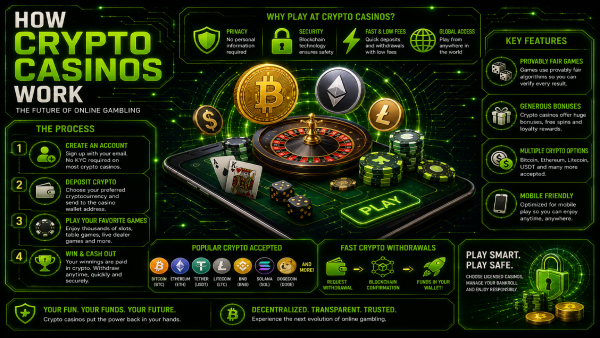
Crypto casinos take deposits and pay out winnings in cryptocurrency instead of, or alongside, ordinary money. This guide explains what that really changes: how wallets and blockchains move your funds, how a deposit works step by step, what provably fair games are, and the genuine trade-offs behind the fast, private payments.



Crypto casinos have gone from a niche curiosity to a mainstream option in just a few years, and the reasons are practical rather than ideological. Players are drawn to withdrawals that land in minutes instead of days, fees that undercut card payments, and a layer of privacy that a bank transfer cannot offer. For a lot of people, the appeal has nothing to do with speculating on coins and everything to do with getting paid faster.
But crypto also changes the rules in ways worth understanding before you deposit. Payments cannot be reversed, coin values can move while you play, and some crypto casinos operate with lighter oversight than their traditional counterparts. This guide walks through the whole picture: what a crypto casino actually is, how the money moves, how a deposit works step by step, what provably fair games add, and how the benefits stack up against the catches, so you can decide with your eyes open.
Key takeaways
- Same games, different money. A crypto casino runs normal games but funds them with cryptocurrency instead of cards or bank transfers.
- Speed is the main draw. Withdrawals often arrive in minutes, with low network fees and more privacy.
- Stablecoins avoid the swings. Coins like USDT hold a steady value, so your balance does not move while you play.
- Provably fair adds proof. Many crypto casinos let you verify a result was not altered after your bet.
- Fewer safety nets. Payments cannot be reversed and oversight can be lighter, so licensing matters more, not less.
What a Crypto Casino Actually Is
A crypto casino is, at heart, an ordinary online casino with a different cashier. The slots, table games and live dealer rooms are usually the same certified titles you would find anywhere, supplied by the same studios. What sets a crypto casino apart is that you deposit and withdraw using cryptocurrency rather than a debit card or bank transfer, and some run entirely on crypto while others simply add it as one option among many.
That distinction matters because it means the game you play and the money you play with are two separate things. Choosing a crypto casino does not change the odds, the house edge or the fairness of the games, all of which work exactly as our how casinos work guide describes. It changes only how value gets into and out of your account. Keeping those two ideas apart, the game engine on one side and the payment rail on the other, is the key to understanding everything that follows.
How the Money Moves
To understand a crypto casino you need three simple pieces: a wallet, a blockchain and an address. A wallet is an app or device that holds your cryptocurrency and lets you send and receive it, a bit like a banking app but one only you control. A blockchain is the shared public ledger that records every transaction for a given coin, maintained across thousands of computers so no single party can quietly alter it. An address is a long string of characters, effectively an account number, that funds are sent to.
When you deposit, you send coins from your wallet to the casino's address, and the blockchain records the transfer. After a set number of network confirmations, the casino credits your balance. Withdrawing reverses the flow: the casino sends coins to your wallet address, and once the network confirms, the money is yours to keep or convert. There is no bank in the middle approving or delaying the transfer, which is why crypto moves faster, but it is also why a mistake, like sending to the wrong address, cannot simply be undone.
Making a Deposit, Step by Step
The first crypto deposit feels unfamiliar, but it is only four steps and gets routine quickly. The diagram below lays out the flow from buying coins to seeing your balance update.
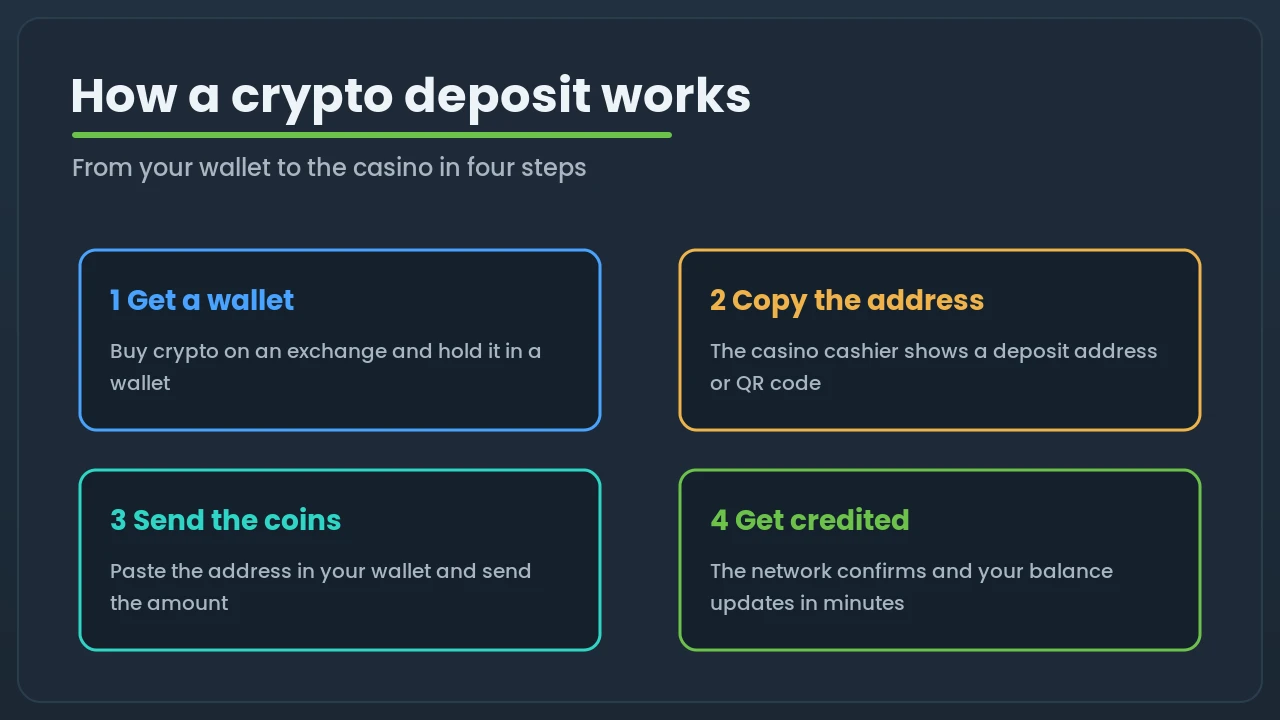
First, you get a wallet and buy cryptocurrency, usually on an exchange, then move it to a wallet you control. Second, in the casino cashier you choose crypto and it shows a deposit address, often as text and a QR code. Third, you send the coins by pasting that address into your wallet and confirming the amount; double-checking the address here is essential, since the transfer cannot be reversed. Fourth, after the network confirms the transaction, your balance is credited, typically within minutes. From then on, repeat deposits are just a couple of taps, and withdrawals follow the same path in reverse.
Which Coins Are Used
Not all cryptocurrencies behave the same way at a casino, and the biggest practical difference is between volatile coins and stablecoins. A handful of coins cover almost all crypto casino play, and knowing what each is for saves confusion at the cashier.
| Coin | Type | Good to know |
|---|---|---|
| Bitcoin (BTC) | Volatile | The most widely accepted, but value can move and fees vary |
| Ethereum (ETH) | Volatile | Very common, fast, with fees that depend on network load |
| Litecoin (LTC) | Volatile | Popular for casinos thanks to quick, cheap transfers |
| Tether (USDT) | Stablecoin | Pegged near one US dollar, so your balance stays steady |
| USD Coin (USDC) | Stablecoin | Another dollar-pegged option favoured for stable value |
The one idea worth taking from this table is the value of stablecoins. Coins like Bitcoin can rise or fall in value between your deposit and your withdrawal, which adds a second layer of risk on top of the gambling itself: you can win at the tables and still end up with less if the coin drops. A stablecoin is engineered to stay worth about one dollar, so it removes that swing entirely while keeping the speed and low fees of crypto. For casino play specifically, many players treat a dollar-pegged stablecoin as the sensible default.
Benefits and Trade-Offs
Crypto genuinely improves some parts of the casino experience and genuinely worsens others. Seeing both honestly is the point, because the same features that make crypto attractive are the ones that carry the risks.
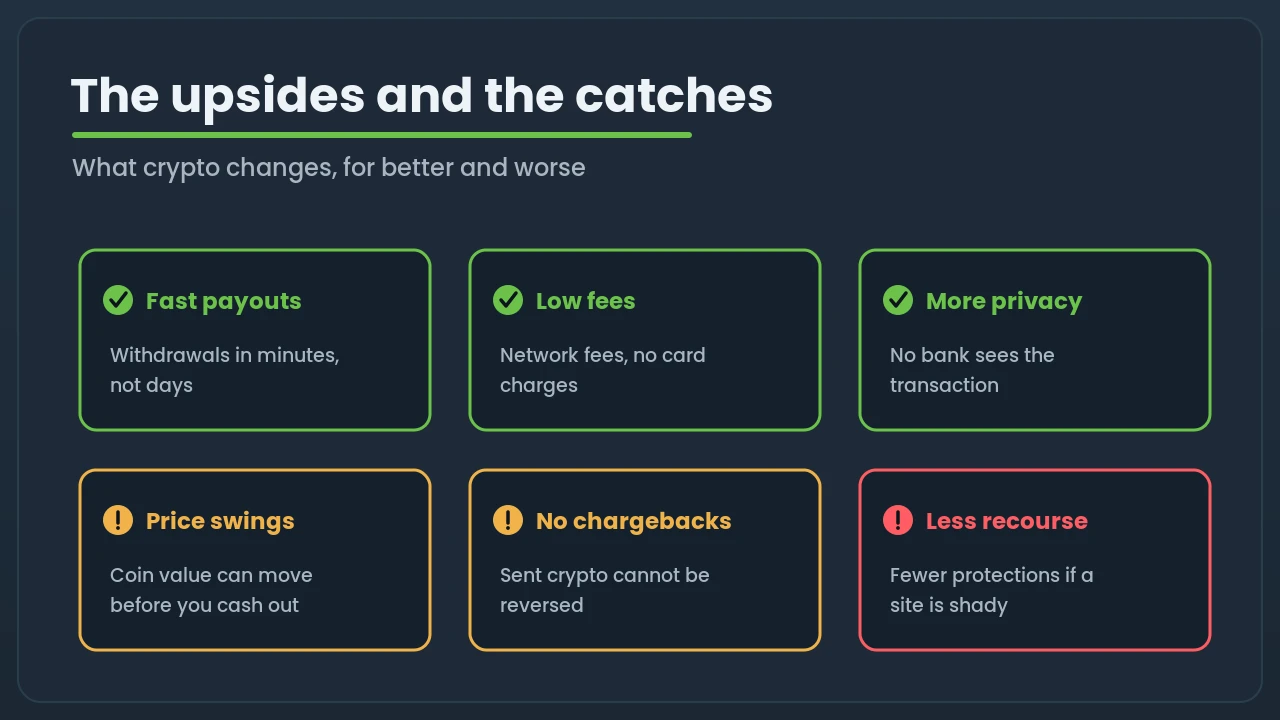
On the upside, payouts are fast, often minutes rather than days, fees are low because you pay a network fee rather than card charges, and there is more privacy since no bank sits in the middle of the transaction. On the downside, coin values can swing unless you use a stablecoin, payments have no chargebacks so an error or a dispute cannot be reversed the way a card payment can, and there can be less recourse if a poorly regulated site treats you unfairly. None of these cancel each other out; they simply mean crypto rewards players who understand what they are giving up in exchange for the speed.
Provably Fair Games
One thing crypto casinos brought to the table is genuinely clever: provably fair games. On a normal casino you trust that the random number generator is honest because a regulator and testing lab say so. A provably fair system lets you check a specific result yourself, without trusting anyone's word.
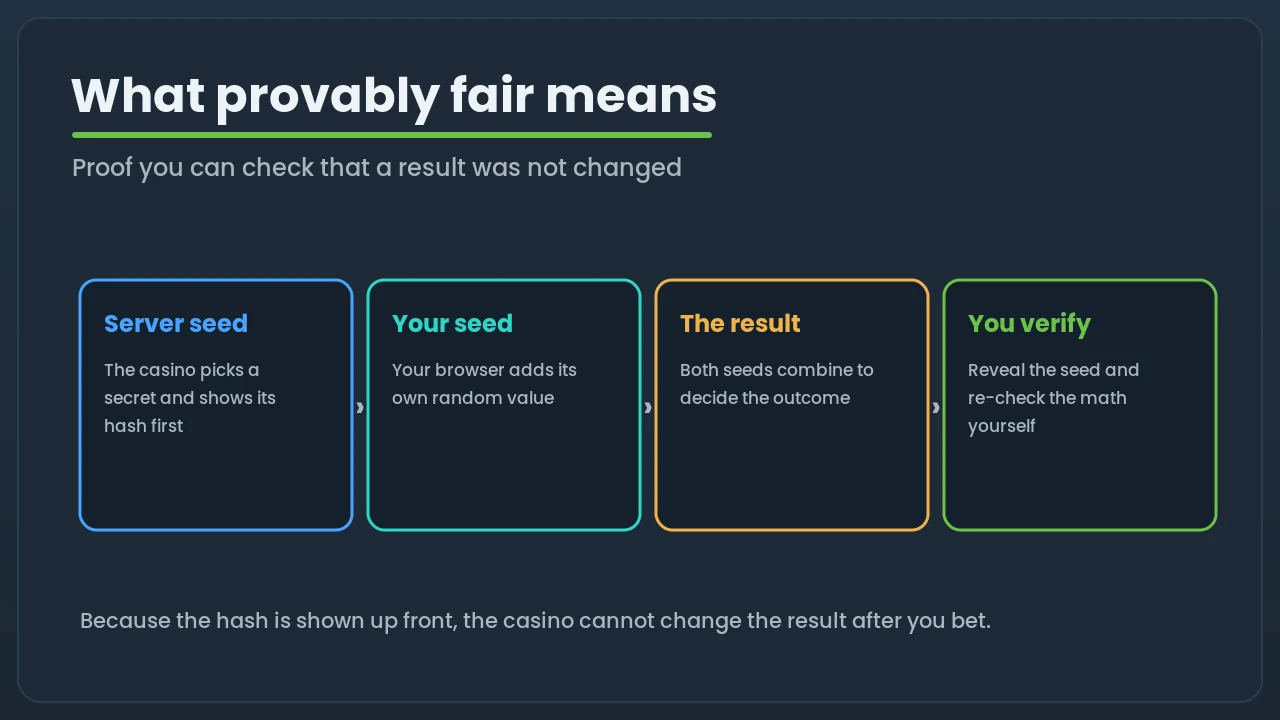
The trick is a cryptographic commitment. Before you bet, the casino generates a secret value, the server seed, and shows you a scrambled fingerprint of it, called a hash, which cannot be reversed to reveal the seed. Your browser contributes its own client seed. When you play, the two seeds combine to produce the result. Afterwards, the casino reveals the original server seed, and you, or a tool, can confirm it matches the hash shown earlier and re-run the calculation to check the outcome was exactly what the seeds dictated. Because the casino committed to its seed before you bet, it could not have changed the result to suit itself. Provably fair does not lower the house edge, and it applies mainly to the crypto casino's own in-house games rather than third-party slots, but where offered it is a real, checkable form of transparency.
Crypto vs Traditional Payments
Set side by side, the difference between paying with crypto and paying by card or bank comes down to a familiar trade-off: speed and privacy against protection and simplicity. Neither is universally better; the right choice depends on what you value.
| Feature | Crypto | Card / bank |
|---|---|---|
| Withdrawal speed | Minutes to an hour | 1 to 5 days |
| Fees | Low network fee | Sometimes card or bank charges |
| Privacy | High, no bank involved | Lower, tied to your bank |
| Reversible | No, transfers are final | Yes, chargebacks possible |
| Value stability | Varies (steady with stablecoins) | Stable, in your currency |
| Ease for beginners | A learning curve | Familiar and simple |
For a fuller look at every deposit and withdrawal method, including the traditional ones, see our casino payments guide. The short version is that crypto wins on speed, fees and privacy, while cards and bank transfers win on protection, stability and simplicity. Many players end up using both: a stablecoin for fast withdrawals and a card for the convenience of a quick deposit.
Safety, Licensing and the Law
The most important thing to understand about crypto casinos is that the coin does not change the fundamentals of safety. A crypto casino still needs a proper licence to be trustworthy, and the checks in our what to look for before joining guide apply just as much here. If anything, they matter more, because crypto payments cannot be clawed back and some crypto-first sites operate under lighter regulation.
Two points deserve particular care. First, legality depends on where you live: online casinos are regulated market by market, and some jurisdictions restrict or ban crypto gambling specifically, so paying in crypto never makes an otherwise unlawful casino legal for you. Our licensing guide covers how to check a regulator. Second, the no-KYC pitch some crypto casinos use is a genuine trade-off, not a free win: skipping identity checks can mean faster sign-up but usually comes with weaker oversight and less protection if a dispute arises. Treat a licensed crypto casino that still does sensible verification as the safer choice, and always confirm what is legal for you before depositing.
A Responsible-Gambling Note
Crypto can make gambling feel frictionless, and that is precisely the risk. Instant deposits, fast withdrawals that reland just as fast, and the blurred sense of value that comes from betting in coins rather than your own currency can all make it easier to spend more than you meant to. Crypto casino play is for adults only, 18+, and the house edge still means the casino profits over time, whatever you pay with.
Keep crypto play grounded
Think in your home currency, not in coins, so a bet always feels like real money, and set deposit and session limits before you start. Never treat a casino balance as an investment that might grow with the coin, and remember that a stablecoin removes price risk but not the risk of the gambling itself. If play stops feeling fun or starts to feel compulsive, step away and use the operator's limit and self-exclusion tools. Our responsible-gambling guide explains every tool and where to find free, confidential support.