
House edge explained
Every casino game is built to pay back a little less than it takes, and that gap is the house edge. Understand it and you understand why the casino always wins in the end, why some games cost far more than others, and how to make your money last as long as possible.



There is one number that quietly governs every bet you will ever place in a casino, and most players never look at it. It is the house edge, and it explains the whole business in a sentence: the games are designed to pay back slightly less than they take in, and that slice is the casino's profit. Nothing shady, nothing hidden, just arithmetic doing its work on every spin, hand and roll.
Grasping the house edge is the single most useful thing a player can do, because it reframes everything. It tells you why the casino always comes out ahead over time, why blackjack and slots are worlds apart despite sitting in the same building, and where your money is best spent if you want an evening's entertainment rather than a fast loss. This guide breaks it down from the ground up: what the edge is, the simple maths behind it, how it relates to RTP, how big it gets across the popular games, and what it does and does not mean for you.
Key takeaways
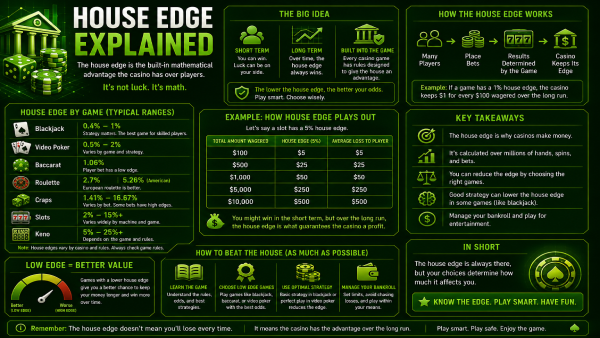
- The edge is the casino's built-in advantage, the percentage of all wagering it expects to keep over time.
- It comes from expected value, the odds and payouts of a game, not a fee on each bet.
- House edge and RTP are two sides of one coin, always adding to 100%.
- It varies hugely by game, from about 0.5% on blackjack to 15% on some slots.
- It is a long-run average, so it guarantees nothing about any single session.
What the House Edge Actually Is
The house edge is the mathematical advantage the casino holds in every game, expressed as the percentage of each bet it expects to keep over the long run. Put a 2% edge next to a night's play and it means this: for every 100 units wagered, the casino expects to hold on to 2 and return 98, averaged across a huge number of bets. That small, permanent tilt is why casinos are reliably profitable while individual players still win often enough to keep coming back.
The most common misconception is that the edge is a fee skimmed from each bet, like a commission. It is not. You can bet 100 units and win 3,500 on a single roulette number; the edge is not taken from that win. Instead it lives in the gap between the true odds of an outcome and the payout the casino offers for it. Because the payout is always set a little short of the fair odds, the average result across all players drifts steadily in the casino's favour, even though any one result is wide open. It is the same logic that lets our how casinos make money guide describe the casino as a business rather than a gamble.
House Edge and RTP: The Same Thing Twice
If you have read about slots you have met RTP, and if you have read about table games you have met house edge. Here is the tidy secret: they are the same number seen from opposite ends, and they always add up to 100%.
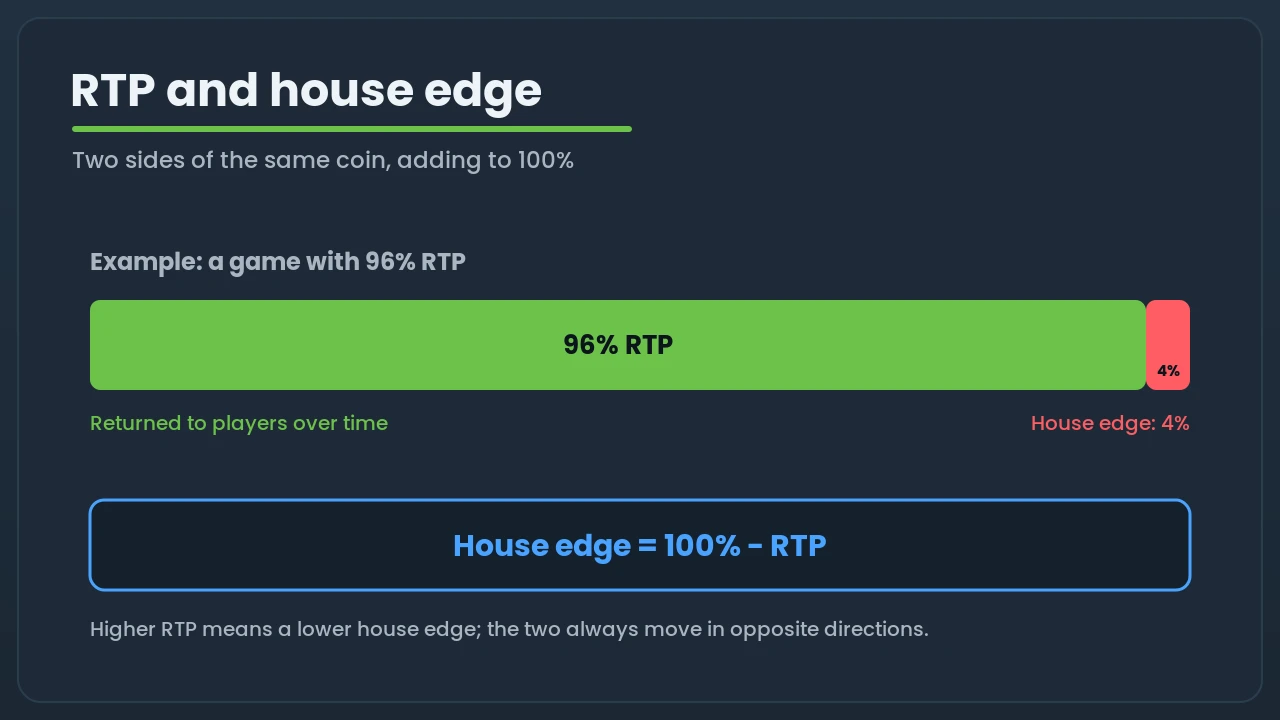
RTP, or return to player, is the percentage a game pays back to players over time. The house edge is the percentage it keeps. So a slot advertised at 96% RTP carries a 4% house edge, because house edge = 100% minus RTP. The two move in perfect opposition: raise the RTP and the edge falls, and vice versa. The industry just tends to quote RTP for slots and house edge for table games out of habit, but you can convert between them in your head, and our RTP and volatility guide digs into the return side in detail.
The Maths Behind It
You do not need to be a mathematician to see where the edge comes from, because the whole thing rests on one idea: expected value. For every possible outcome of a bet, you multiply how likely it is by what it pays, then add those pieces together. A negative total is the house edge, expressed per unit staked.
European roulette gives the cleanest example. Bet one unit on a single number: you win once in every 37 spins and are paid 35 to 1, and you lose the other 36 times. Run the expected value:
That minus 2.7 cents on the dollar is the house edge, and it is no accident. The true odds of hitting one number in 37 are 36 to 1, but the casino pays only 35 to 1. That missing unit, spread across the whole wheel, is the entire edge. Every casino game is built the same way: the payouts are set fractionally below the fair odds, and the size of that shortfall is the house edge. It really is that simple, and that unavoidable.
The House Edge by Game
Here is where the theory turns practical, because the edge is not one number, it is a range, and the spread between games is enormous. The game you sit down at can matter more to your bankroll than anything else you decide all night.
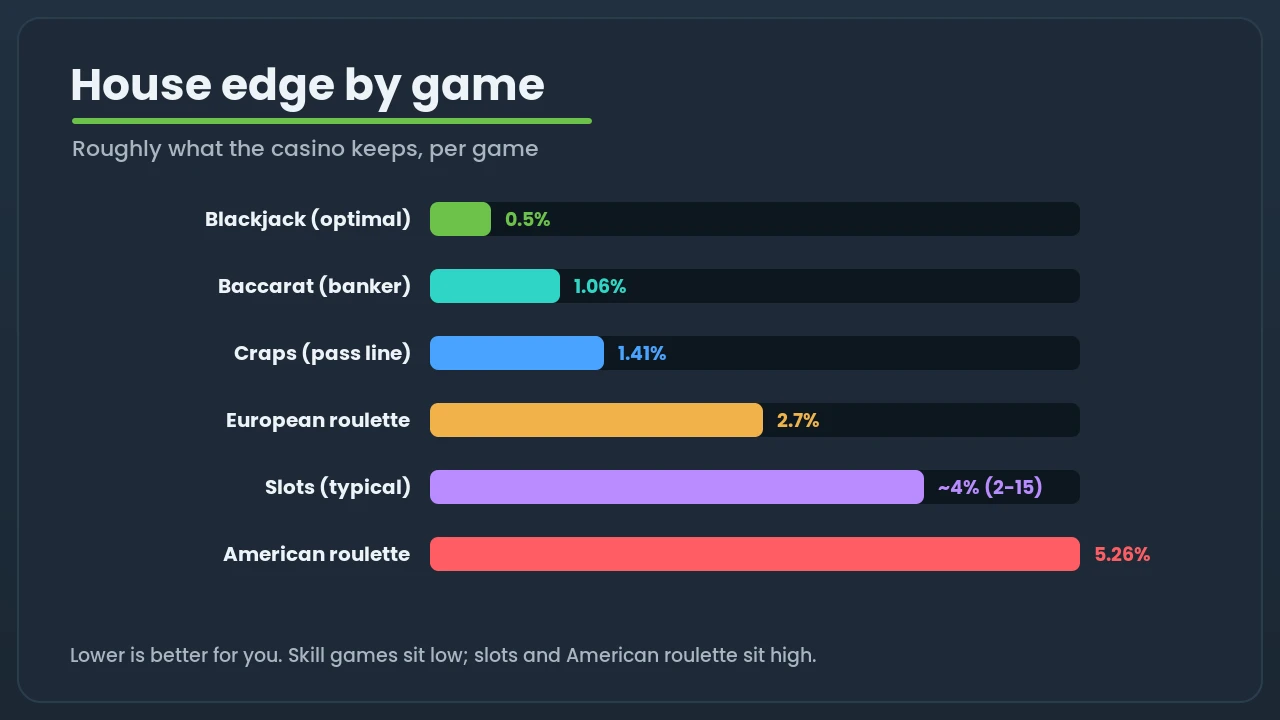
Blackjack, played with correct basic strategy, is the leader, with an edge that can drop to around 0.5%. Baccarat's banker bet is about 1.06%, and craps pass-line bets sit near 1.4%. European roulette holds a flat 2.7% on almost every bet, while American roulette nearly doubles that to 5.26% purely because of its extra double-zero pocket. Slots are the wild card, commonly ranging from about 2% to as much as 15% depending on the specific game, which is why checking a slot's RTP is worth the ten seconds it takes.
| Game | Typical house edge | Equivalent RTP |
|---|---|---|
| Blackjack (basic strategy) | ~0.5% | ~99.5% |
| Baccarat (banker) | ~1.06% | ~98.9% |
| Craps (pass line) | ~1.41% | ~98.6% |
| European roulette | 2.7% | 97.3% |
| Slots (varies) | ~2% to 15% | 85% to 98% |
| American roulette | 5.26% | 94.74% |
One number in that table does the most damage to unaware players: the jump from European to American roulette. Same game, same payouts, double the cost, decided entirely by one extra pocket. If you take a single practical lesson from this guide, let it be to check which wheel you are playing.
The Long Run vs a Single Session
This is the part players most often get wrong, in both directions. Some assume a 4% edge means they will lose 4% of their money tonight; others, after a big win, decide the edge is a myth. Both misunderstand what the number describes.
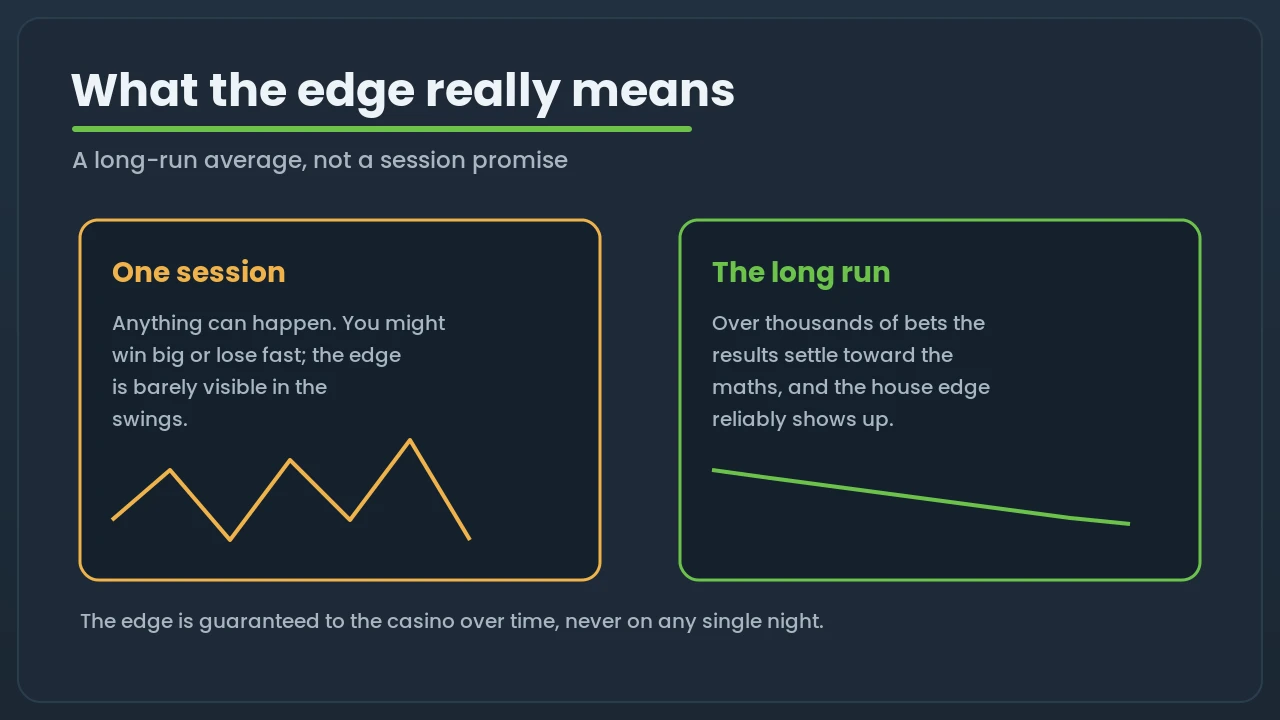
The house edge is a long-run average, and the phrase matters. Over a single session, luck swamps the edge entirely: you can win big, lose fast, or anywhere in between, and the 2% or 4% is barely a whisper against the swings. It is only across thousands or millions of bets, the casino's timescale, not yours, that results settle toward the maths and the edge shows up with near-certainty. That is why the casino is guaranteed to win over time while never being guaranteed to win from you on any given night. Volatility, covered in the RTP and volatility guide, is what governs how wild those short-term swings feel.
Keeping the Edge as Low as Possible
You can never flip the edge in your favour, but you have real control over how large it is, and small choices add up over a long session. Playing smart is entirely about minimising the tilt against you.
How to face the smallest edge
- Choose low-edge games. Blackjack, baccarat and craps beat roulette and most slots on pure maths.
- Learn the right strategy. Blackjack only reaches ~0.5% with correct basic strategy; guessing costs you several percent.
- Pick the best bet in a game. The pass line in craps and even-money bets in roulette carry the lowest edge available.
- Always choose European roulette over American, and prefer higher-RTP slots where you can check the figure.
- Skip the side bets. Flashy extras and jackpots usually carry a far higher edge than the base game.
None of this turns a losing proposition into a winning one, and it is important to be honest about that. What it does is stretch your bankroll and your playing time, so the same budget buys a longer, more enjoyable session. Think of the edge as the price of the entertainment, and these habits as shopping around for a better price rather than a way to get paid.
House Edge Is Not the Same as Rigged
It is worth clearing up a suspicion that the edge naturally raises: if the game is designed for me to lose, is it not just rigged? The answer is no, and the distinction is important. The house edge is a disclosed, mathematical feature of games that are otherwise completely fair. The dice are honest, the wheel is balanced, the cards are random; the casino simply pays out at slightly less than true odds, and it does so openly.
Rigging is something else entirely: dishonestly altering outcomes so a game does not pay at its stated rate. At a licensed casino that cannot happen to a certified game, because independent labs test the random number generators and regulators enforce the published returns, as our licensing guide explains. A marked-up shop is not cheating you, and neither is a casino with a house edge; a rigged game, on an unlicensed site, is. That difference is exactly why licensing is the first thing to check before you play anywhere.
A Responsible-Gambling Note
Understanding the house edge is itself a responsible-gambling tool, because it sets honest expectations. The edge means the mathematically expected outcome of any real-money play is a loss, so casino games should be treated as paid entertainment, not a way to make money. Play is for adults only, 18+, and no knowledge of the maths changes the fact that the odds favour the house.
Let the maths keep you grounded
Set a budget you can afford to lose before you start, and treat the house edge as the built-in price of the fun rather than an obstacle to beat. Never chase losses in the belief the edge "owes" you a win, because each bet is independent and the maths does not balance out in your favour. If play stops feeling fun or starts to feel compulsive, step away and use the operator's limit and self-exclusion tools. Our responsible-gambling guide explains every tool and where to find free, confidential support.