
Crypto wallets
Before you can play with crypto, you need somewhere to keep it. A wallet is that place, and choosing one is mostly about a single question: who holds the keys, you or someone else. This guide explains what a wallet really is, the types on offer, how you fund a casino from one, and the handful of habits that keep your money safe.



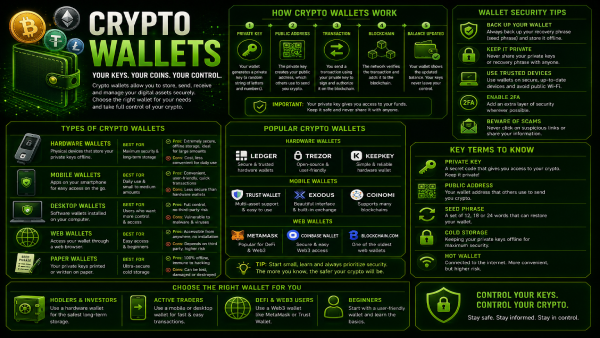
The word "wallet" is a little misleading. A crypto wallet does not hold your coins the way a leather one holds notes, because the coins never leave the blockchain. What it actually holds are the keys that prove those coins are yours and let you move them. Get comfortable with that one idea and everything else about wallets, the jargon, the types, the security warnings, falls neatly into place.
For a casino player, the wallet is simply the tank your fuel sits in before you drive it over to the table. You buy or hold crypto in a wallet, send some to the casino to play, and receive your winnings back into it. Which wallet you choose does not change the games or the odds one bit; it changes how safely your money is stored and how much of that safety is your responsibility versus someone else's. This guide walks through the choices in plain English, with a clear eye on what actually matters for playing, not for day-trading.
Key takeaways
- A wallet stores keys, not coins. The coins live on the blockchain; the keys prove they are yours.
- Custody is the big divide. Custodial means someone else holds the keys; non-custodial means you do.
- Hot is convenient, cold is safest. Online wallets suit spending; offline hardware suits larger holdings.
- The seed phrase is everything. Lose it on a non-custodial wallet and the funds are gone for good.
- Match security to the sum. A small casino balance needs less protection than a life savings.
What a Wallet Really Is
Start with what is not happening: your Bitcoin or Ethereum is not sitting inside an app on your phone. Every coin exists only as an entry on a public ledger, the blockchain, which records who owns what. A wallet is the tool that lets you interact with that ledger, proving you own a particular balance and authorising it to move. It is closer to online banking, an interface to money held elsewhere, than to a purse.
What the wallet does store are your keys, and it usually wraps them in a friendly interface: a balance, a "receive" button that shows your address, and a "send" button that asks for a destination and an amount. Everything technical, the cryptography that signs a transaction, happens quietly underneath. For a casino player, that means using a wallet is genuinely simple in practice, even though the machinery beneath it is clever. The complexity only matters when it comes to keeping the keys safe, which is where the rest of this guide focuses.
Keys, Addresses and the Seed Phrase
Three terms come up constantly, and they are worth pinning down because the security advice later depends on them. Your public address is the string you share to receive funds, like an account number or an email address; there is no harm in anyone seeing it. Your private key is the secret that authorises spending from that address, the equivalent of the password and signature combined, and it must never be shared. Whoever holds the private key controls the money, full stop.
Because a raw private key is an unwieldy string, non-custodial wallets give you a seed phrase instead: a human-readable list of usually twelve or twenty-four ordinary words that can regenerate all your keys. That phrase is the master backup of your entire wallet. Anyone who has it can recreate your wallet on any device and take everything, and if you lose it, there is no reset link and no support desk that can bring your funds back. This single fact, that the seed phrase is both your backup and your biggest vulnerability, is the reason self-custody carries the warnings it does.
Custodial vs Non-Custodial: The Choice That Matters
If you remember only one distinction from this guide, make it this one. Wallets split into two camps based on who holds the private keys, and that single fact shapes convenience, security and responsibility all at once.
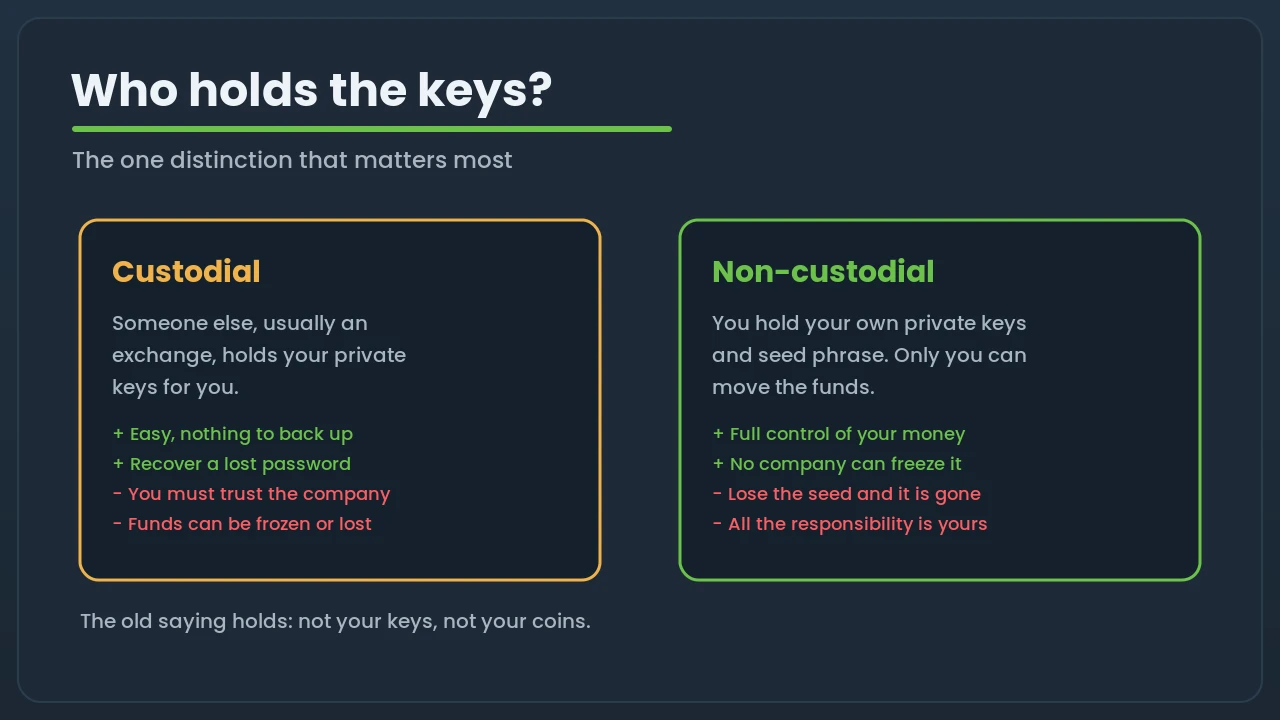
A custodial wallet is one where a third party, typically the exchange where you bought your crypto, holds the keys for you. This is the easy path: there is nothing to back up, and if you forget your password you can recover the account like any other login. The trade-off is trust and control. You are relying on the company to stay solvent and secure, and in principle it can freeze or restrict your funds. A non-custodial wallet puts the keys entirely in your hands. No company can touch your money, but no company can help you either; the responsibility for the seed phrase is completely yours. The crypto world sums it up bluntly: not your keys, not your coins. Neither model is "right"; they simply suit different needs and different sums.
The Main Wallet Types
Those two ideas, custody and connectivity, combine into the handful of wallet types you will actually meet. The other axis is whether a wallet is hot, meaning connected to the internet and convenient, or cold, meaning kept offline and far harder to attack. Put together, three practical options cover almost everyone.
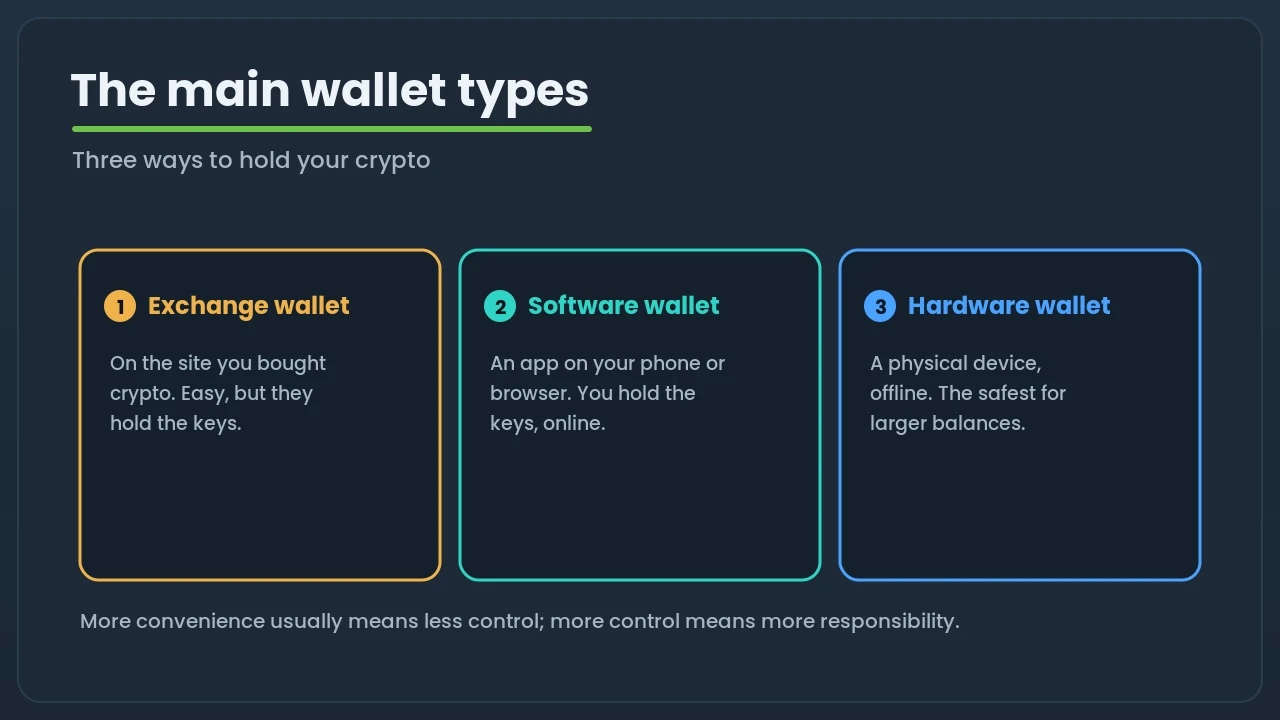
The exchange wallet is the account you get when you buy crypto on a platform. It is custodial and hot, which makes it the simplest starting point and the one most casino players already have. The software wallet is a free app on your phone or browser that you control yourself; it is non-custodial and hot, giving you the keys while staying convenient for everyday sending. The hardware wallet is a small physical device that keeps your keys offline; it is non-custodial and cold, and it is the safest option for holding meaningful sums, because a transaction cannot be signed without the device in hand.
| Type | Custody | Connectivity | Best for |
|---|---|---|---|
| Exchange wallet | Custodial | Hot | Beginners and small, active balances |
| Software wallet | Non-custodial | Hot | Everyday self-custody and spending |
| Hardware wallet | Non-custodial | Cold | Larger, longer-term holdings |
A widely used approach combines them: keep the bulk of your crypto in a hardware or software wallet you control, and a small, topped-up balance somewhere convenient for actually playing. That way a problem with the casino or the hot wallet only ever exposes your play money, not your savings.
Funding a Casino From Your Wallet
Here is where the wallet meets the casino, and it is more straightforward than the jargon suggests. The casino never reaches into your wallet; you always push funds to it, and it pushes winnings back. The flow is the same one covered in our how crypto casinos work guide, seen from the wallet side.
To deposit, you open the casino cashier, choose your coin, and it shows you a deposit address, usually as text and a QR code. You copy that address into your wallet's "send" screen, enter the amount, and confirm. After the network posts enough confirmations, your casino balance updates. To withdraw, you give the casino a receive address from your wallet, and it sends the coins back to you. Two cautions matter more than any other: always double-check the address, since a crypto transfer cannot be reversed, and make sure the coin and network match on both sides, because sending on the wrong network can lose the funds. Beyond that, funding a casino from your own wallet is a couple of taps, and it keeps you in control of everything except the balance you chose to move across.
Keeping a Wallet Safe
Most crypto losses are not exotic hacks; they are avoidable mistakes and scams. A short list of habits prevents the overwhelming majority of them, and none of it requires technical skill, only discipline.
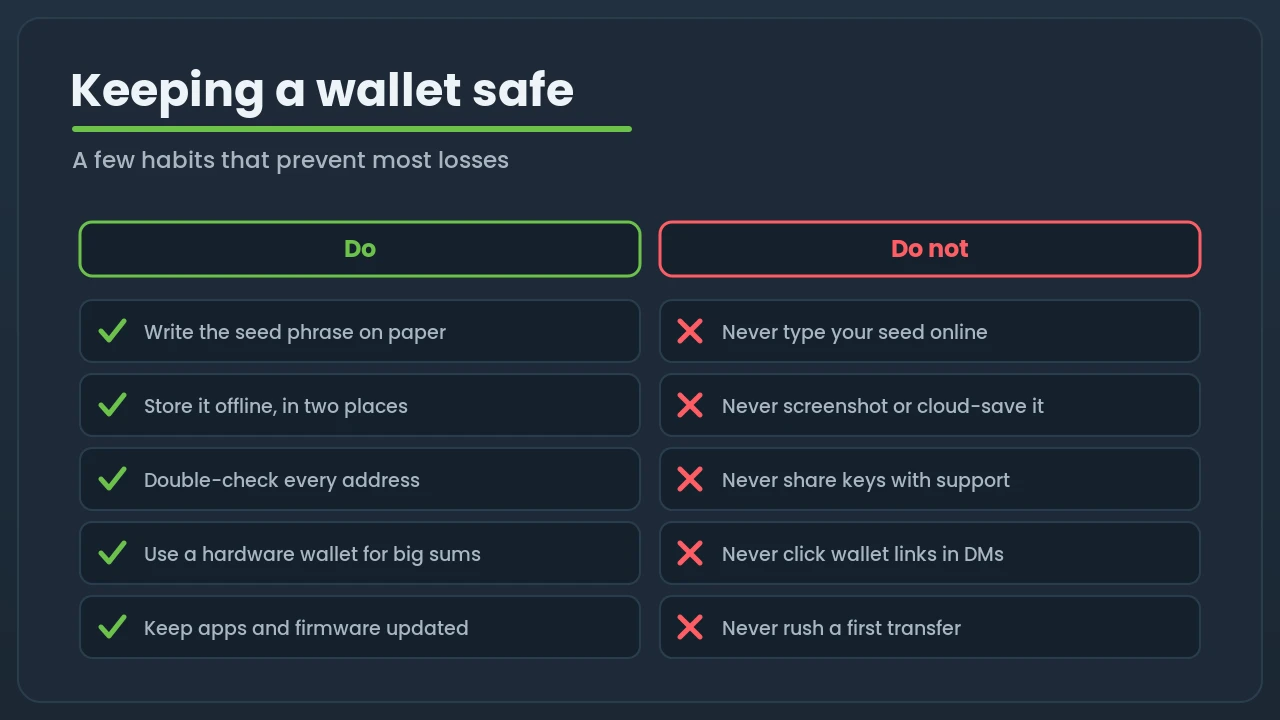
The single most important rule is to protect your seed phrase. Write it on paper, store it offline in more than one safe place, and never type it into a website, save it to the cloud, or photograph it, because malware and phishing sites hunt for exactly that. No legitimate wallet, exchange or casino will ever ask for your seed phrase or private key, so anyone who does is trying to rob you. Beyond that, verify every address before you send, keep your wallet apps and any device firmware updated, enable two-factor authentication on custodial accounts, and be deeply suspicious of unsolicited links, giveaways and support messages, which are the most common routes to a drained wallet. For larger balances, a hardware wallet adds a layer that even a fully compromised computer cannot bypass.
Which Wallet for Casino Play?
Pulling it together for the specific job of playing at a crypto casino, the answer is refreshingly practical, and it is not the most hardcore option. Most players do not need a hardware wallet to move modest sums to a casino; they need something convenient, reasonably secure, and easy to top up.
A sensible setup for players
- Starting out: a reputable exchange wallet is fine. It is custodial, but simple, and recoverable if you forget a password.
- Wanting control: a well-known software wallet gives you the keys while staying easy to use for deposits.
- Holding real money: keep long-term funds in a hardware wallet and move only your play balance to a hot wallet.
- Whatever you choose: keep only what you are willing to gamble in the wallet you play from.
- First, the casino: a great wallet cannot protect you at a bad casino, so vet the operator before anything else.
That last point deserves emphasis. Your wallet secures your crypto up to the moment you send it; after that, whether you get paid depends entirely on the casino. So the wallet decision, while worth getting right, sits second to choosing a licensed, trustworthy operator in the first place, exactly as our guide to what to look for before joining a casino lays out. Pick the casino carefully, hold only your play money in a convenient wallet, and keep anything larger in cold storage, and you have the balance of safety and simplicity that suits the vast majority of players.
A Responsible-Gambling Note
A wallet makes moving money quick, and that convenience has a flip side worth naming. Because a self-custody wallet lets you deposit in seconds, without a bank in the way, it can make it easier to spend more than you intended or to top up in the heat of a session. Crypto casino play is for adults only, 18+, and the house edge means the games are built to win over time whatever wallet funds them.
Let the wallet help, not hurt
Keep only your set gambling budget in the wallet you play from, so a bad session cannot reach your wider savings, and think in your home currency rather than coins so a deposit always feels like real money. Set deposit and session limits at the casino before you start. If play stops feeling fun or starts to feel compulsive, step away and use the operator's limit and self-exclusion tools. Our responsible-gambling guide explains every tool and where to find free, confidential support.