
Bitcoin vs Ethereum casinos
If you have decided to play with crypto, the next question is which coin. Bitcoin and Ethereum are the two you will meet everywhere, and they do the same job in noticeably different ways. This guide compares them where it actually counts for casino play: speed, fees, features and the scaling networks that quietly change the whole calculation.



Ask a crypto casino which coin to use and it will happily take either. Ask a room of players and you will get an argument. Bitcoin loyalists point to its reach and simplicity; Ethereum fans talk about speed and clever features. Both camps are a little bit right, which is exactly why the question is worth answering properly rather than picking whichever coin you happened to buy first.
The good news is that this is a smaller decision than it looks. Whatever you deposit with, the slot spins and the cards fall the same way, because the coin never touches the game, only the cashier. So the honest comparison is narrow and practical: which coin gets your money in and out faster, cheaper and with less hassle. On that ground, Bitcoin and Ethereum genuinely differ, and a third option, the humble stablecoin, quietly beats both for a lot of players. Here is how they stack up.
Key takeaways
- The coin only touches the cashier. Games, odds and house edge are identical whichever you use.
- Bitcoin wins on acceptance. It is taken almost everywhere and is the simplest starting point.
- Ethereum wins on speed and features. Faster confirmations, smart contracts and cheap Layer-2 networks.
- Fees swing with demand. Both can be pricey at peak, but Lightning and Layer-2 cut costs to near zero.
- A stablecoin often beats both. Same speed and low fees, without the price swings while you play.
Why the Coin Matters (a Bit)
Let us set expectations before diving in, because the crypto crowd can make this sound more important than it is. Your choice of coin does not change your odds, your bonuses or the fairness of any game. It changes three things and only three: how fast your money moves, how much you pay to move it, and which extra features, if any, you can tap into. If you keep that frame in mind, the whole comparison stays grounded.
All of the deeper mechanics, how deposits confirm, why payments cannot be reversed, what provably fair means, are covered in our broader guide to how crypto casinos work. This piece assumes you are already sold on crypto and simply want to know whether to reach for Bitcoin or Ethereum, and when a stablecoin is the smarter call. So the yardstick throughout is a practical one: which coin makes your casino cashier faster, cheaper and less fiddly.
What Each Coin Actually Is
A quick grounding helps, because the two coins were built with different goals. Bitcoin is the original cryptocurrency and, in most people's minds, digital money or digital gold. It was designed to do one thing exceptionally well: move and store value without a bank. That focus is its strength. It is the most recognised, most widely held and most widely accepted coin, which is why practically every crypto casino lists it first.
Ethereum was built for more than payments. It is a programmable platform, a network on which developers deploy self-executing code called smart contracts. Payments are just one of the things it does. For casinos, that programmability matters, because it underpins features like on-chain provably fair games and, crucially, the Layer-2 networks that have transformed Ethereum's cost and speed. So while both can pay for a spin, Bitcoin is a specialist and Ethereum is a general-purpose platform that happens to handle money too.
Bitcoin vs Ethereum, Head to Head
Put the two side by side on the things that matter at a cashier and the trade-off comes into focus. Neither sweeps the board; each leads on different fronts.
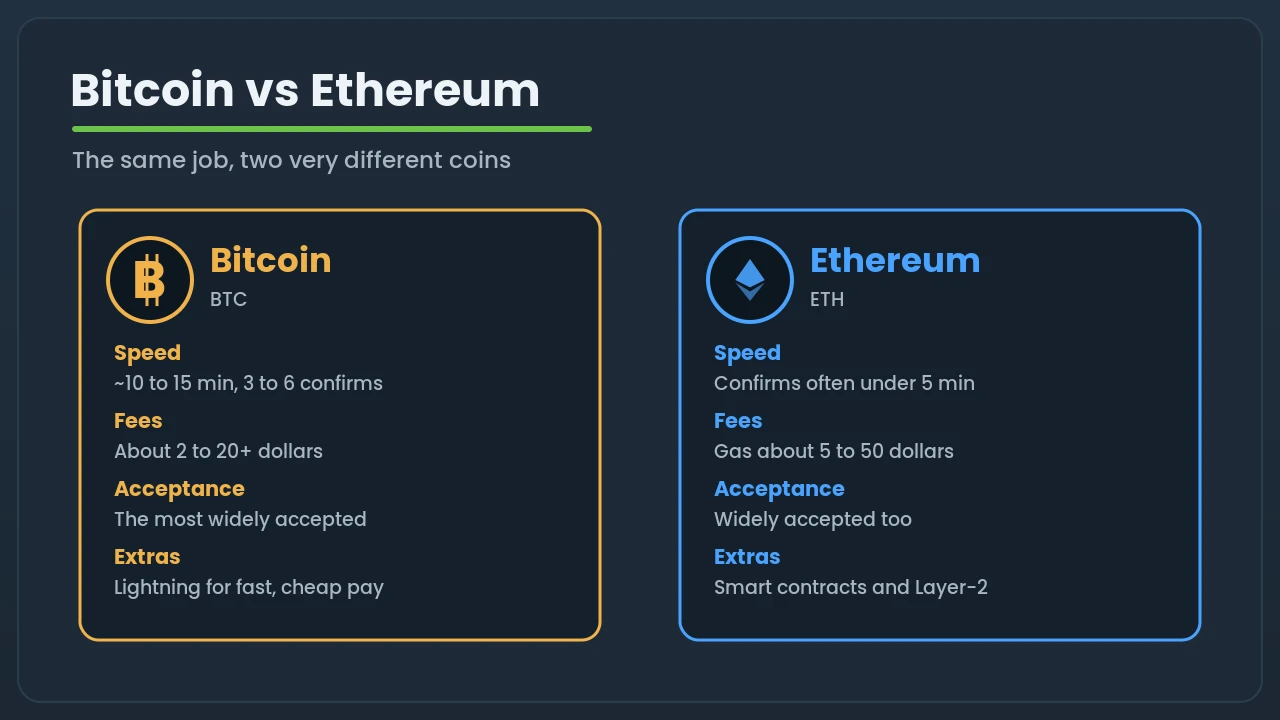
| Factor | Bitcoin (BTC) | Ethereum (ETH) |
|---|---|---|
| Base-layer speed | ~10 to 15 minutes, several confirmations | Often under 5 minutes to confirm |
| Typical fees | About 2 to 20+ dollars with demand | Gas roughly 5 to 50 dollars at peak |
| Scaling option | Lightning Network | Layer-2 (Arbitrum, Optimism, Base) |
| Extra features | Simple, focused payments | Smart contracts, on-chain fairness |
| Acceptance | The widest of any coin | Very widely accepted |
| Best for | Simplicity and universal support | Speed, features and Layer-2 value |
Read across the rows and a pattern emerges. Bitcoin is the safe, everywhere-accepted default that just works. Ethereum is the faster, more capable option that rewards a little extra knowledge, particularly around its Layer-2 networks. The figures move with market conditions, so treat them as typical ranges rather than fixed prices, but the shape of the comparison is stable.
Speed and Confirmations
Speed at a crypto casino is really two things stitched together: how quickly the network confirms your transaction, and how many confirmations the casino insists on before crediting you. On the base layer, Ethereum generally has the edge, confirming in a few minutes, while a Bitcoin deposit commonly takes ten to fifteen minutes and needs several confirmations to be considered settled.
In practice, though, the casino's own policy often matters more than the coin. One site may credit a Bitcoin deposit after a single confirmation, another may wait for three, and that choice can swing your waiting time more than the difference between the two networks. Withdrawals add another step, since the casino runs its own review first. The upshot is that Ethereum is usually a little faster on paper, but neither coin is truly instant on its base layer, which is exactly the problem the scaling networks were built to solve.
Fees: The Real Difference
If speed is close, fees are where Bitcoin and Ethereum diverge most, and where the honest answer is "it depends on the day". Both charge a network fee that rises and falls with congestion rather than a fixed price. Bitcoin fees tend to sit anywhere from a couple of dollars when things are quiet to twenty dollars or more when the network is busy. Ethereum's base-layer gas fees often run higher still, in the rough range of five to fifty dollars at peak times.
For a large, occasional deposit, a few dollars either way is noise. For frequent, smaller top-ups, those fees become the whole story, and paying ten dollars to move twenty is obviously absurd. This is the single biggest practical reason to care about the scaling networks below, and also why a cheaper coin like Litecoin is popular for high-frequency play. On the base layer alone, neither Bitcoin nor Ethereum is ideal for small, regular casino deposits.
The Game-Changer: Lightning vs Layer-2
Here is the part most quick comparisons skip, and it flips the fees-and-speed story on its head. Both Bitcoin and Ethereum now have a second, faster and far cheaper lane sitting on top of the main network, and where a casino supports them, the old complaints largely disappear.
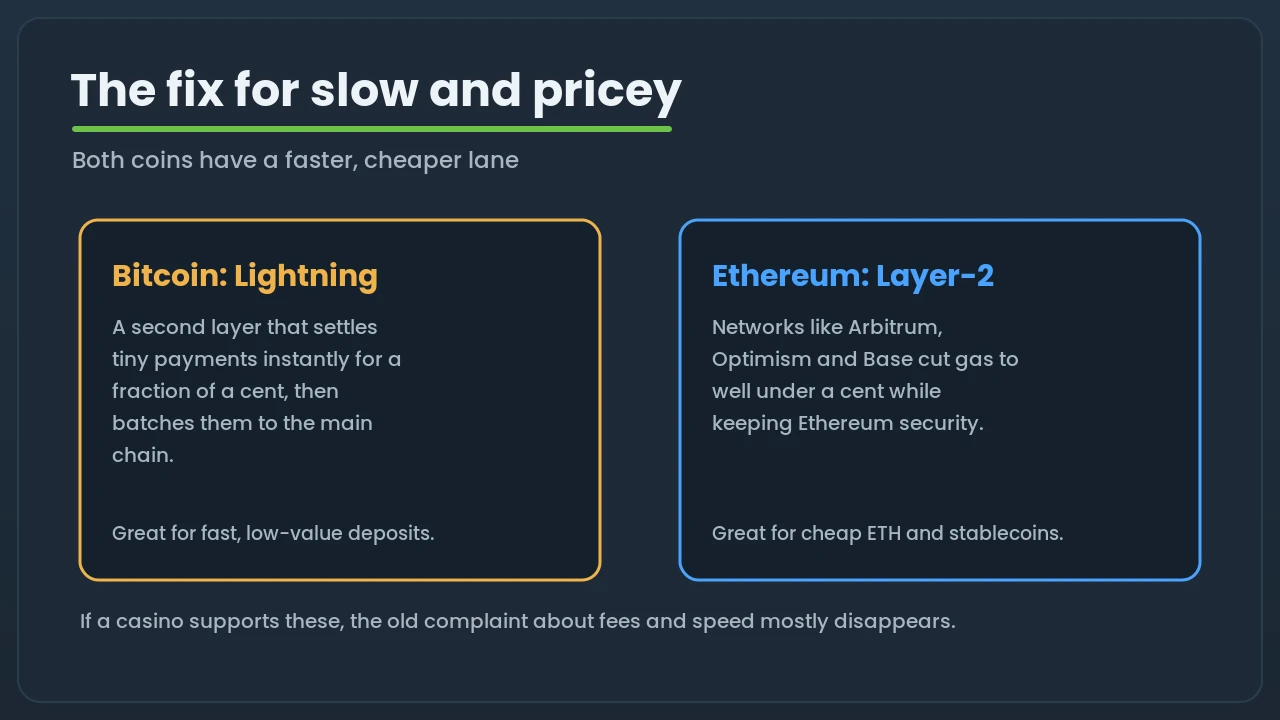
For Bitcoin, that lane is the Lightning Network, a second layer that settles tiny payments almost instantly for a fraction of a cent, then periodically batches them back to the main chain. For Ethereum, it is Layer-2 networks such as Arbitrum, Optimism and Base, which inherit Ethereum's security but push gas fees to well under a cent and settle in seconds. Both are increasingly supported at crypto casinos, and both make the base-layer fee ranges above look like a worst case rather than the norm.
The practical takeaway is simple but important: before you judge a coin on cost or speed, check whether your casino supports its scaling network. A casino that takes Lightning makes Bitcoin genuinely fast and cheap; one that takes Ethereum Layer-2, especially for stablecoins, is arguably the best value in crypto. One caution: these networks are not interchangeable, so always send to the exact network the cashier lists, because sending Layer-2 funds to a base-layer address, or vice versa, can lose them for good.
Features and Provable Fairness
Beyond moving money, Ethereum brings something Bitcoin does not: programmability. Its smart contracts allow casinos to run certain functions on-chain, and the most player-relevant example is provably fair gaming, where the fairness of a result can be verified against the blockchain rather than simply trusted. Some crypto-native games lean on this directly, and it is a genuine, if niche, advantage of the Ethereum ecosystem.
Bitcoin, by design, keeps things minimal. It does not run smart contracts in the same way, and it is not trying to. For the average player depositing to spin slots from a major studio, none of this changes the experience, because those games run on the casino's own certified software regardless of the coin. But if provably fair, on-chain games appeal to you, Ethereum and its ecosystem are the more natural home. We explain the mechanics of provable fairness in the crypto casinos guide if you want to go deeper.
The Weakness They Both Share
For all their differences, Bitcoin and Ethereum have one thing in common that matters more than any of it: their value moves. Deposit in either and win at the tables, and you can still walk away with less in your home currency if the coin falls between your deposit and your cash-out. That is a second bet layered on top of the gambling one, and it is a bet you did not choose to make.
This is why, for casino play specifically, many experienced players sidestep the whole Bitcoin-versus-Ethereum question and reach for a stablecoin instead. Coins such as USDT and USDC are pegged to hold a steady value, usually one US dollar, so your balance does not swing while you play. Better still, they often run on the very Ethereum Layer-2 networks discussed above, which means you get the speed and near-zero fees of scaled Ethereum without the price risk of holding ETH itself. If your goal is simply fast, cheap, predictable casino payments, a dollar-pegged stablecoin is frequently the smartest answer of all.
So Which Should You Use?
Strip away the tribalism and the decision is refreshingly personal. There is no single winner, only the right fit for what you value and what your casino supports.
Match the coin to your priority
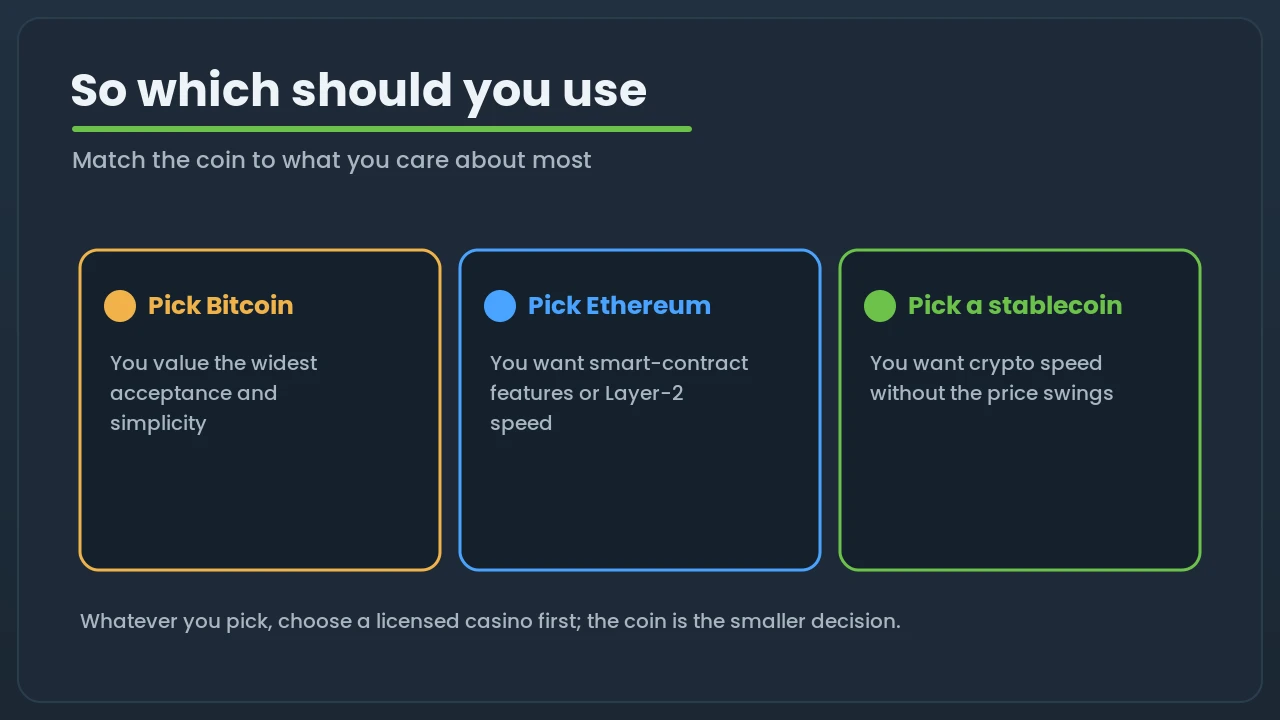
- Choose Bitcoin if you want the widest acceptance and the simplest experience, and especially if your casino supports Lightning.
- Choose Ethereum if you value faster confirmations, smart-contract features, or cheap Layer-2 deposits.
- Choose a stablecoin if you want crypto speed and low fees without your balance swinging while you play.
- Let the cashier decide ties. Use whichever coin and network your casino supports with the lowest fees.
- Check the network every time. Send only to the exact network listed, since crypto transfers cannot be reversed.
The honest bottom line is that for most players the coin is the smaller decision. Pick the one you already hold or find easiest to buy, prefer its scaling network for anything but large one-off deposits, and consider a stablecoin if price swings bother you. Then spend your real attention on the choice that actually protects your money: a properly licensed casino, checked the way our guide to what to look for before joining describes.
A Responsible-Gambling Note
Comparing coins can make crypto gambling feel like a technical optimisation problem, which quietly sidelines the thing that matters most. Whichever coin you choose, casino play is for adults only, 18+, and the house edge means the operator profits over time. Fast, cheap deposits are convenient, but that same frictionlessness can make it easier to spend more than you intended, and betting in coins rather than your own currency can blur how much real money is in play.
Keep the money real
Think in your home currency, not in BTC or ETH, so a stake always feels like real money, and set deposit and session limits before you start. A stablecoin removes price risk but not gambling risk, and no coin changes the odds of a game. If play stops feeling fun or starts to feel compulsive, step away and use the operator's limit and self-exclusion tools. Our responsible-gambling guide explains every tool and where to find free, confidential support.