
Cashback and Reload Deals Gain Ground Over Big Welcome Offers



The giant welcome bonus is no longer the whole story, and quietly it is ceasing to be the main one. A steady shift is under way in how casinos reward players, away from the splashy one-time offer that greets you at sign-up and toward ongoing deals, cashback on your losses and reload bonuses for coming back, that keep paying out week after week.
It is a change of emphasis rather than an overnight revolution. Welcome bonuses still exist and still grab attention, but operators are pouring more of their promotional budget into keeping existing players happy rather than luring new ones with a single big number. For players who stick with a casino, that means the real value increasingly sits in the offers that arrive after the welcome, not in the welcome itself.
This piece explains what is changing and why, how cashback and reload deals actually work, and how to weigh their steady, repeatable value against the one-off appeal of a welcome bonus. It also covers a genuine caveat, because money back on losses is not always the unqualified good it can appear to be.
What is changing
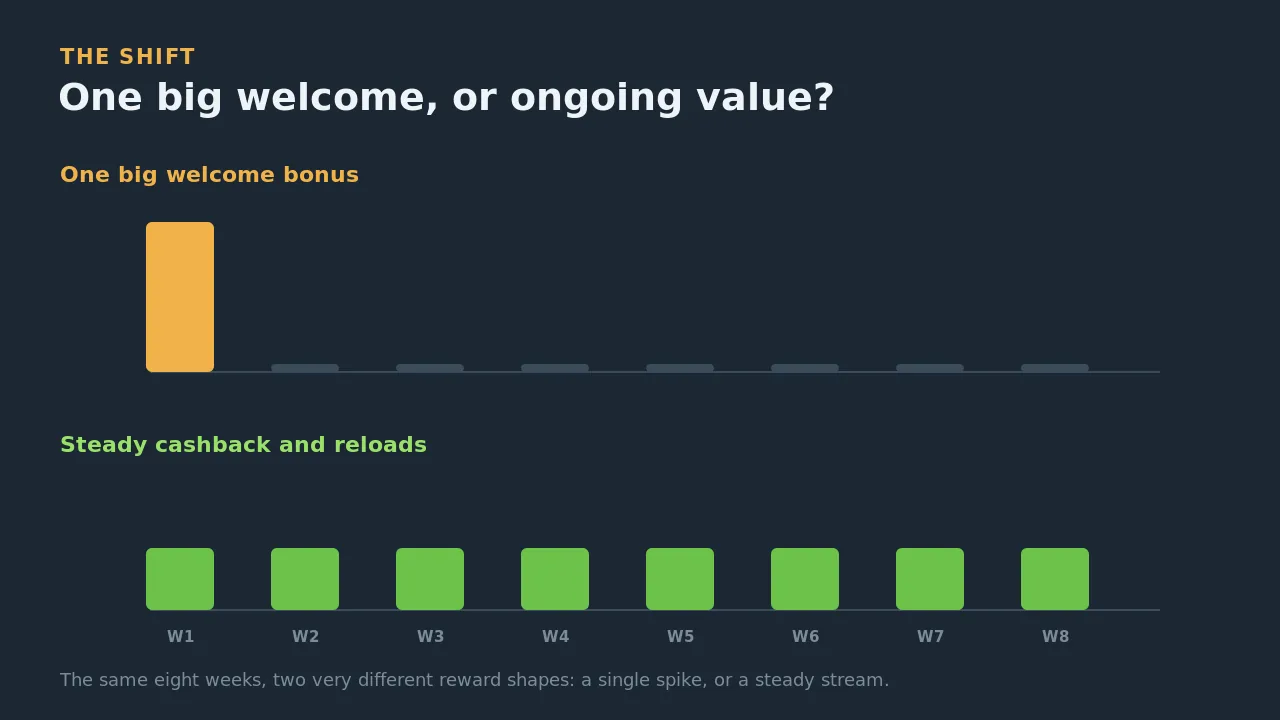
For most of online gambling's history, the welcome bonus was the headline act. A big matched deposit, advertised in bold, was how casinos competed for new players, and everything else was an afterthought. That model is giving way to one built around the long term, where the offers a player receives in their second month matter as much as the one that greeted them on day one.
The practical result is a broader, steadier menu of promotions: weekly cashback that returns a slice of your losses, reload bonuses that top up later deposits, recurring free spins, and loyalty schemes that reward regular play. Increasingly these are personalised, tuned to how and what someone plays rather than offered as a blanket deal. The welcome bonus has not vanished; it has simply been demoted from the whole relationship to the first step in it.
The trouble with the big welcome bonus
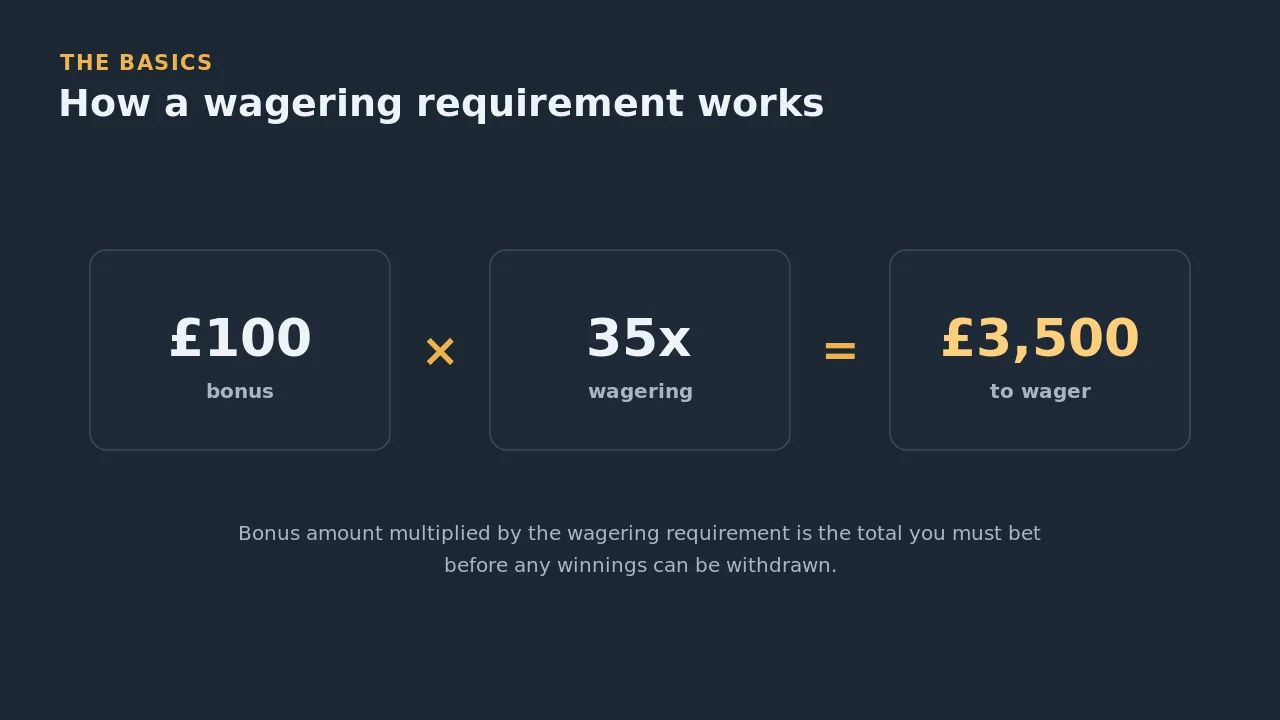
To see why the shift makes sense, it helps to be honest about the welcome bonus's flaws. Its headline size was always its most attractive and least meaningful feature, because a large match usually came with high wagering that made the advertised value hard to realise. Many players never cleared it, which meant the impressive number was, for them, largely fiction.
It also created the wrong incentives on both sides. For operators, huge welcome offers attracted bonus-hunters who claimed and left, inflating acquisition costs without building loyalty. For players, the focus on a one-time hit encouraged a scattergun approach of chasing sign-up offers across sites rather than settling with a casino that treated them well over time. Ongoing rewards fix both problems at once, which is a large part of why they are winning ground.
Cashback, explained
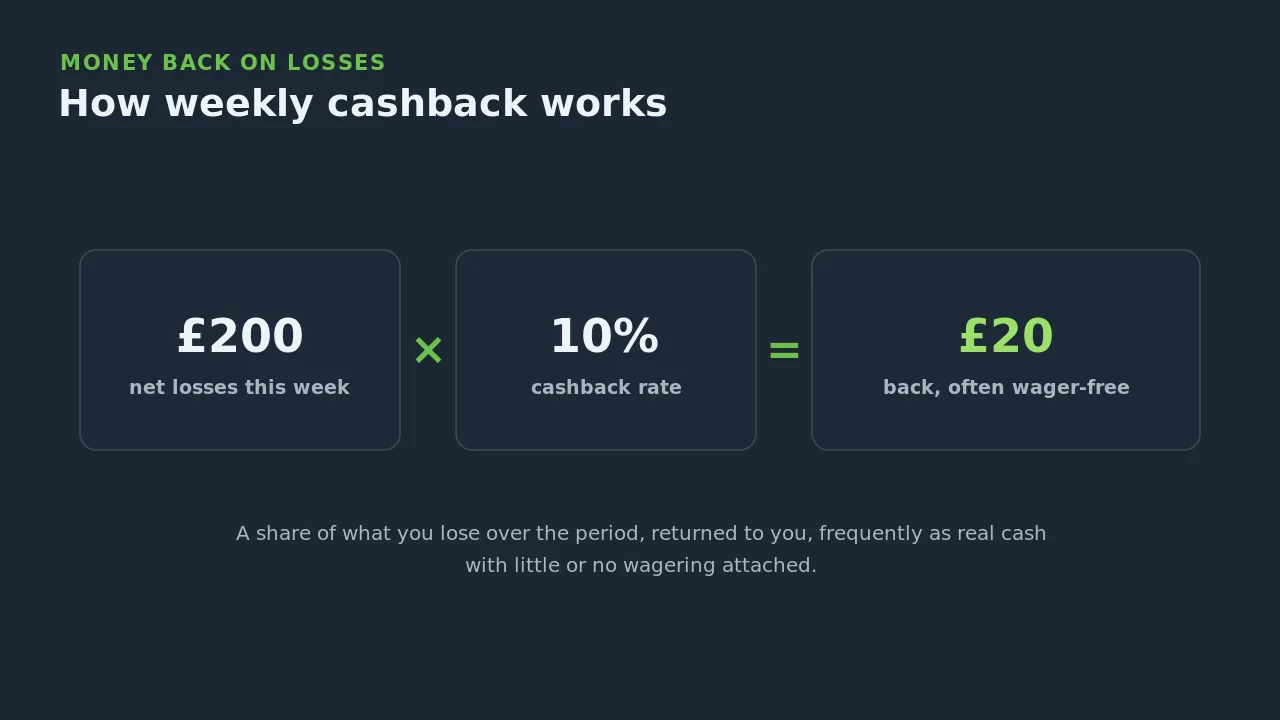
Cashback is the offer doing the most to reshape the landscape, because at its best it is refreshingly simple. It returns a percentage of your net losses over a period, typically a week, and the most player-friendly versions pay it as real cash with no strings attached. If you lose, a little comes back; if you win, there is nothing to give back.
On losses versus on deposits
Most cashback is calculated on net losses, meaning your losses minus any wins across the period, so it only pays when you are genuinely down. A less common variant pays back a percentage of deposits instead, which is really a reload bonus in disguise. The distinction matters: loss-based cashback is a cushion against a bad run, while deposit-based cashback rewards spending regardless of outcome, so always check which kind an offer actually is. Our casino glossary spells out the difference in plain terms.
Wager-free cashback
The single most important thing to check is whether the cashback is wager-free. Paid as real cash with no wagering, it is one of the most genuinely valuable promotions in the market, because there is no catch to undo it: the money is yours to keep or withdraw. Some offers instead credit cashback as a bonus with its own wagering requirement, which is far less generous and much closer to an ordinary bonus than true money back.
Rates, caps and periods
Cashback rates commonly sit between 5 and 20 percent, though higher figures appear, especially in loyalty tiers, and they almost always come with a maximum. The period is usually weekly, running Monday to Sunday and paid at the start of the next week, though daily and monthly versions exist. A headline rate means little without the cap and period beside it, since a generous percentage capped at a small figure returns less than a modest rate with a high ceiling.
Reload bonuses, explained
If cashback softens losses, the reload bonus tops up future play. It is essentially a welcome bonus for existing customers: a match on a later deposit, but recurring and typically smaller, often in the range of 25 to 75 percent. Where the welcome offer is a one-time greeting, the reload is a standing invitation to come back, frequently tied to a particular day or offered as a weekly promotion.
The appeal for players is regularity. A reasonable reload every week is a dependable way to stretch a bankroll, and because operators increasingly personalise them, a reload can be tailored to the games you actually play. The same rules of thumb apply as to any deposit bonus, though: the wagering requirement and the terms decide whether a reload is worth taking, and a modest match with fair terms beats a bigger one you cannot clear.
The three offer types compared
It helps to line up the three side by side, because they are not rivals so much as different tools for different moments. A welcome bonus is a one-time greeting, a reload is a recurring top-up, and cashback is a safety net, and the modern casino uses all three.
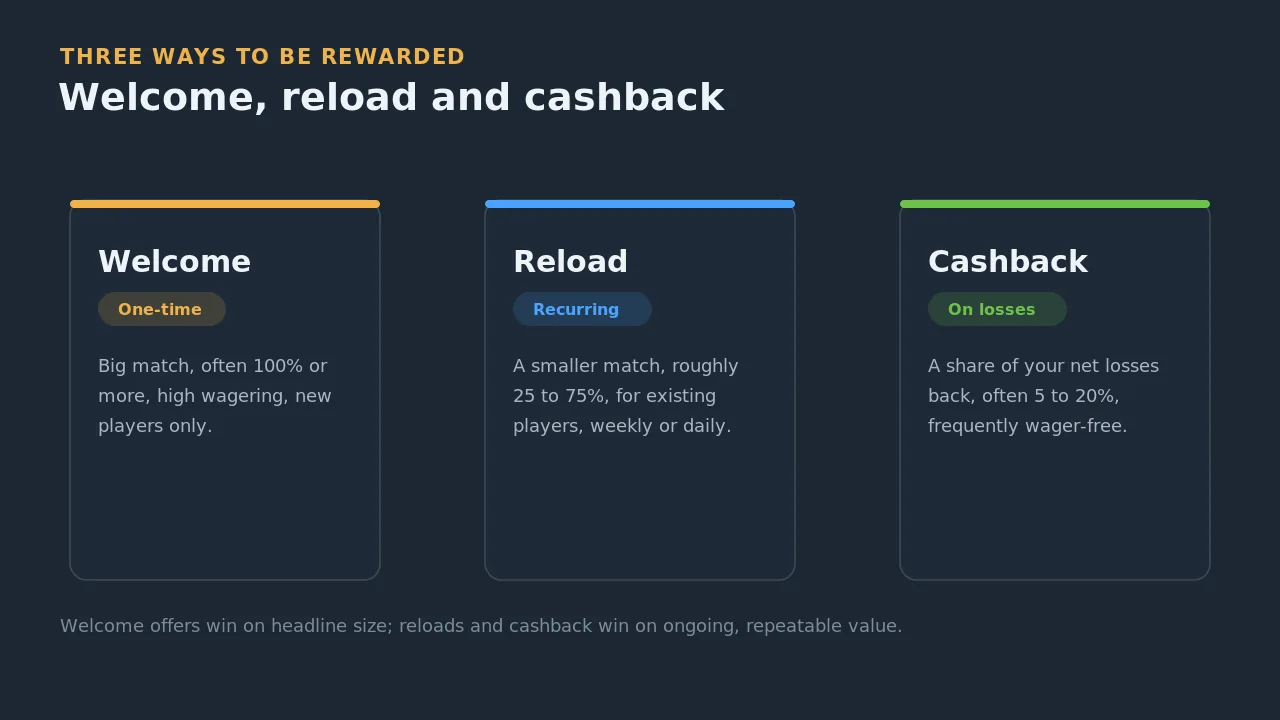
| Offer | Frequency | Typical value | Best for |
|---|---|---|---|
| Welcome | One-time | Big match, often 100%+, high wagering | A strong start at a new casino |
| Reload | Recurring | 25% to 75% match, smaller than welcome | Topping up a bankroll over time |
| Cashback | Weekly, usually | 5% to 20% of net losses, often wager-free | Softening a losing run |
The clearest way to read the table is that welcome offers win on the headline and ongoing offers win on the long run. Cashback in particular stands out when it is wager-free, because it delivers real value with none of the friction that the wagering trend, which we cover in our report on wagering requirements trending lower, has been slowly stripping out of bonuses generally.
Why operators are making the switch
The move is driven by hard commercial logic as much as goodwill. Acquiring a new player is expensive, involving marketing spend, a costly welcome bonus and the risk that the person never returns, while keeping an existing player who already trusts the site is far cheaper and more profitable. Shifting budget from splashy welcome offers to ongoing rewards is simply a better investment in that light.
Data makes it possible. Casinos now know a great deal about how each player behaves, so they can personalise reloads and cashback, offering the right nudge to the right player rather than a blanket deal. That precision suits ongoing promotions far better than a one-size welcome bonus, and it lets operators reward genuine regulars while spending less on bonus-hunters. The regulation pushing clearer terms reinforces the trend, since simple, honest cashback is easier to advertise responsibly than a giant offer riddled with conditions.
A month in the life: welcome versus ongoing
To make the trade-off concrete, imagine two players at the same casino over a single month, one relying on the welcome bonus alone and the other using the ongoing offers.
| Week | Welcome-only player | Cashback and reload player |
|---|---|---|
| Week 1 | One large welcome bonus | A modest reload plus weekly cashback |
| Week 2 | Nothing left to claim | Another reload and cashback |
| Week 3 | Nothing | Reload and cashback again |
| Week 4 | Nothing | Reload and cashback again |
| Overall | One big hit, then a dry month | Steady, repeatable value all month |
Which comes out ahead depends on the player. Someone who deposits once and plays lightly may extract more from the single welcome hit, but a regular who plays every week almost always does better on the ongoing offers, because the small amounts compound across the month while the welcome bonus is long spent. For most returning players, steady beats spectacular.
Loyalty and VIP: the logical endpoint
Cashback and reloads are really the visible layer of a deeper shift toward loyalty. Beneath the weekly offers sit tiered programmes that reward continued play with points, status levels and progressively better terms, and the ongoing bonuses are how those programmes express themselves day to day. The more someone plays, the higher their tier, and the more generous the cashback rate or reload match tends to become.
For a casual player this rarely matters much, but it explains the industry's direction of travel. Retaining a valuable player for months is worth far more than a one-off sign-up, so casinos invest in ladders that keep people climbing. The healthy way to view a loyalty scheme is as a pleasant extra for play you were doing anyway, not a target to chase. A programme that tempts you to play more, or faster, to reach the next tier has stopped being a reward and become a cost, and that is the line to watch. The best schemes simply give a little back to regulars without changing how much they were ever going to spend.
Does cashback change your odds?
It is worth understanding what cashback does and does not do to the underlying maths, because the answer is easily misread. Every casino game carries a house edge, a small built-in advantage that means players lose over the long run on average. Wager-free cashback returns a slice of losses, which nudges that long-run figure very slightly in the player's favour, effectively shaving a little off the house edge.
But the operative word is slightly. A 10 percent weekly cashback does not make a game break even; it softens the average loss by a fraction, and the house still comes out ahead over time. Crucially, it only ever returns a percentage of what you have already lost, so it can never generate a profit on its own. The right mental model is a modest discount on the cost of entertainment, not a strategy or an edge. Seen that way, cashback is a genuine, honest perk; mistaken for a way to beat the casino, it becomes the thinking that leads straight to betting more than you should.
What it means for players
For players, the shift is mostly welcome, provided you know how to read it. Ongoing offers reward the behaviour most people actually have, returning to a casino they like, rather than the restless bonus-hopping the old model encouraged. Wager-free cashback in particular is a genuine improvement, giving real money back with none of the fine-print friction that made big welcome bonuses so often disappointing.
The one mindset worth dropping is the reflex to pick a casino on its welcome bonus alone. A site with a modest welcome but strong, fair, ongoing rewards will almost always serve a regular player better than one that spends everything on a headline offer and little afterward. The smart question is no longer just what will they give me to join, but what will they keep giving me once I have.
The catch: cashback and loss-chasing
Here is the honest caveat, and it matters. Because cashback returns money only when you lose, it can subtly encourage the most dangerous habit in gambling: chasing losses. The thought that a portion is coming back can make a losing session feel less costly than it is, and nudge a player to bet more than they intended in the belief that the downside is cushioned.
It is worth being clear-eyed here. Cashback never turns a loss into a profit; getting 10 percent back on a 200 pound loss still leaves you 180 pounds down. Treated correctly, it is a small softening of an outcome you had already accepted; treated as a safety net that justifies bigger bets, it becomes a trap. If an offer is changing how much you are willing to lose, that is the signal to step back. Our guide to responsible gambling and staying in control covers the limits and habits that keep any promotion in its proper place.
Timing and the cashback period
One practical quirk of ongoing offers is that timing can matter. Cashback almost always runs over a fixed period, commonly Monday to Sunday, and is paid at the start of the following week, so losses are pooled across the whole window rather than judged session by session. A big win late in the period can offset the net loss the cashback was based on, which is fair but worth understanding before you count on a return.
Reloads often land on a set day too, a weekly promotion or a specific offer day, so a player who deposits without checking may miss a match they could easily have had. None of this should dictate how you play, and chasing an offer's schedule is a mistake in itself, but being aware of the calendar means you claim the value already on the table rather than leaving it behind through simple mistiming.
How to judge an ongoing offer
Assessing cashback and reloads is quicker than decoding a giant welcome bonus, because the terms are usually simpler, but a few checks still matter. For cashback, confirm first whether it is wager-free, then note the rate, the cap and whether it is calculated on net losses or deposits. For a reload, treat it like any deposit bonus: the wagering requirement and eligible games decide its real worth, not the headline percentage.
Above all, weigh an offer against how you actually play. A weekly reload is only valuable if you were going to deposit weekly anyway; cashback only helps if you were going to play regardless. The best ongoing offer is the one that fits your existing habits rather than one that tempts you to expand them, a principle that applies just as much to the small no-deposit offers we cover in our report on no-deposit deals getting smaller but clearer.
The bottom line
The centre of gravity in casino promotions has moved. The giant welcome bonus, long the industry's loudest pitch, is being quietly overtaken by cashback and reload deals that reward players over time rather than just at the door. For anyone who plays regularly, that is a change worth welcoming, since steady, clearer, often wager-free value beats a big number designed to look better than it plays.
The skill is simply to judge offers by their ongoing worth and their fit with your own habits, not by the size of the headline. Check whether cashback is wager-free, treat reloads like any deposit bonus, and never let money back on losses become a reason to lose more. Do that, and the shift toward ongoing rewards becomes exactly what it should be: casinos competing to keep you rather than just to catch you, on terms you can finally read at a glance.
Frequently asked questions
What is a cashback bonus?
Cashback returns a percentage of your net losses over a period, usually a week, commonly between 5 and 20 percent. The best versions pay it as real cash with no wagering, so it simply softens a losing run rather than adding a bonus to clear.
What is a reload bonus?
A reload bonus is a deposit match for existing players, much like a welcome offer but recurring and usually smaller, often 25 to 75 percent. Casinos use it to reward players who come back, frequently on a set day or as a weekly promotion.
Are cashback and reloads better than a welcome bonus?
They offer less up front but more over time. A welcome bonus is a single large hit, while cashback and reloads deliver smaller, repeatable value week after week. For a regular player, the ongoing rewards usually add up to more real value.
Is casino cashback wager-free?
Increasingly, yes. The most player-friendly cashback is paid as real cash with no wagering, which makes it genuinely valuable. Some offers still attach a small wagering requirement, so check the terms, since wager-free is worth far more.
How is cashback calculated?
It is a percentage of your net losses, meaning losses minus wins, over the cashback period. If you lost 200 pounds net in a week at a 10 percent rate, you would receive 20 pounds back, usually up to a stated maximum.
Why are casinos moving away from big welcome bonuses?
Because keeping a player is cheaper and more valuable than chasing a new one. Ongoing cashback and reloads reward loyalty, can be personalised to how someone plays, and avoid the poor value and bonus-hunting that huge welcome offers encouraged.
Does cashback encourage you to lose more?
It can, if you let it. Getting money back on losses may tempt some players to bet more than planned, but cashback never turns a loss into a profit. Treat it as a small softening of losses, not a reason to chase them.
Go deeper
Wagering requirements trend lower
The fairness trend behind wager-free cashback, and how to judge a bonus by its terms.
Read article →
No-deposit offers: smaller but clearer
How free-spin and no-deposit deals changed, and the max-cashout catch to watch.
Read article →
Responsible gambling and staying in control
How to keep any promotion, cashback included, from nudging you past your budget.
Read guide →Editorial note
This article is independent editorial coverage of casino bonus trends, not sponsored content, and no brand has paid for inclusion. The percentages, caps and examples are illustrative and typical rather than offers from any specific casino; real terms vary widely, so always read an offer's full terms before claiming. Nothing here is betting advice, and cashback never makes gambling profitable over time. Play only at licensed casinos, 18+, and within limits you set in advance.