
Operators Lean into AI-Driven Personalisation in 2026



Walk into any major online casino in 2026 and no two players see quite the same thing. The games at the top of the lobby, the size and timing of the next bonus, even the tone of a support chat are increasingly shaped by machine-learning models working quietly in the background. Personalisation has moved from a buzzword to the default way operators build their products, and the shift is changing the player experience in ways that are worth understanding.
The technology itself is not new. Recommendation engines have steered what we watch and buy for over a decade. What has changed is the speed, the reach and the stakes of applying the same techniques to real-money gambling, where the line between a helpful, tailored experience and a nudge that costs players money is thin. This feature looks at what operators are actually doing, why they are doing it, and the questions it raises for players and regulators alike.
Two things are true at once, and holding both is the key to making sense of the trend. Personalisation can genuinely improve a sprawling, confusing product, and the same models can be turned toward protecting players who show signs of harm. It can also be used to maximise time and spend in ways that do not serve the player at all. Which of those wins out depends less on the technology than on how each operator, and each regulator, chooses to use it.
The story in brief
- Personalisation is now standard, shaping lobbies, offers, messaging and support at most large operators.
- It changes presentation, not maths. A game's certified RTP and randomness are untouched by where it appears.
- The same AI cuts both ways, powering both engagement engines and safer-gambling systems that flag harm.
- Regulators are catching up, with GDPR, the EU AI Act and gambling watchdogs all circling the practice.
- Your controls still matter most: limits, self-exclusion and checking a game's RTP yourself.
What AI-driven personalisation actually means
Strip away the marketing and personalisation is simply this: software that adjusts what an individual player sees and is offered, based on data about how they behave. Instead of every visitor landing on the same static lobby, the page reorders itself around the titles, themes and stakes a given player is most likely to engage with. The same logic extends to promotions, notifications and the help experience.
Crucially, and this is the point most often lost in the hype, personalisation operates on the surface of the product, not its core. It decides which games are promoted to you, not how those games pay. The certified maths inside a slot or table game, explained in our guide to how online casinos work, is fixed and independently tested. A game does not become more or less generous because an algorithm moved it up your homepage.
The data that powers it
Personalisation runs on behavioural data, and casinos collect a lot of it. Every session generates signals: which games you open and for how long, the studios and themes you return to, your typical stake and deposit sizes, the times of day you play, and how you react to a given offer. Layered on top are account details and, in regulated markets, verification and payment records. Individually these points are mundane; together they form a detailed portrait of a player.
From rules to models
Early versions of this were simple rules: show new players the popular titles, email lapsed players a comeback offer. What defines the 2026 wave is the shift to machine-learning models that predict, rather than follow fixed instructions. These systems estimate the probability that a particular player will enjoy a particular game, respond to a particular message, or reach a particular value over time, and they update those predictions continuously as new data arrives.
Why operators are leaning in
The commercial case is straightforward, and operators are refreshingly open about most of it. Modern casino libraries are enormous, often several thousand titles, and a static lobby buries all but the best-known games. A personalised front page helps players find something they actually want to play, which improves the experience and, not coincidentally, keeps them on the site longer. Discovery and engagement are two sides of the same coin.
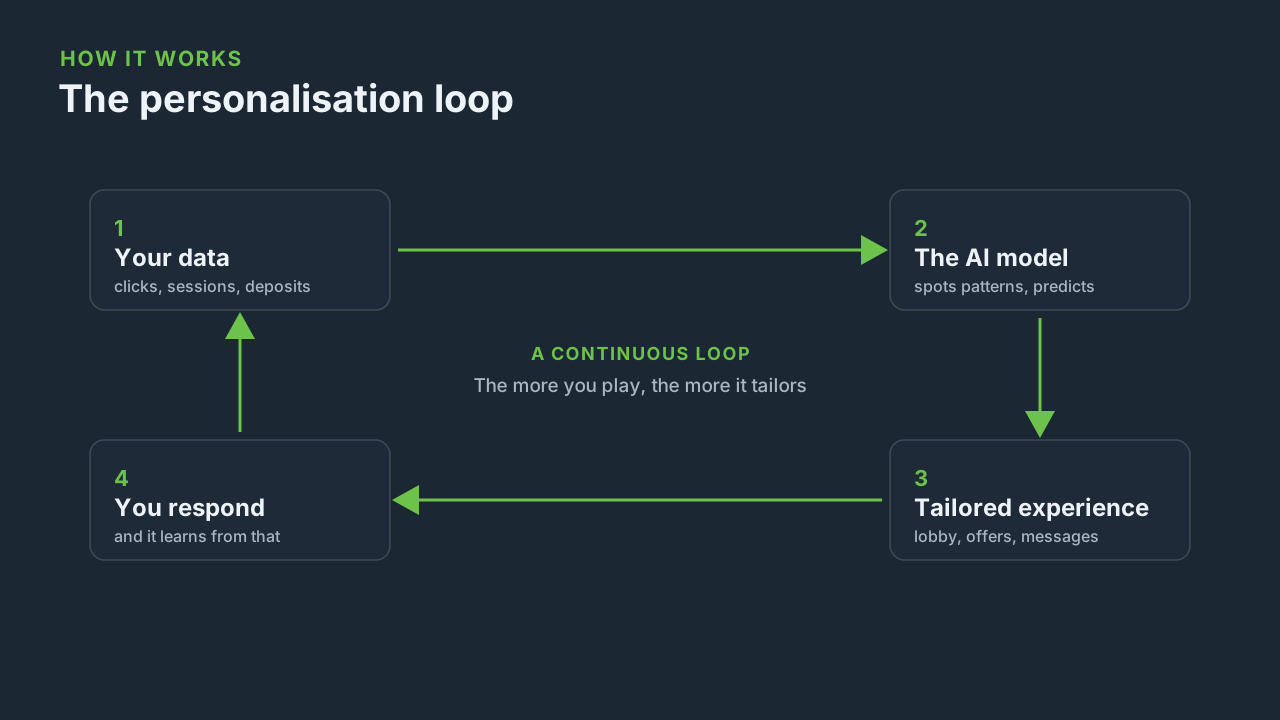
Beyond discovery, three forces are pushing adoption. Retention is the big one: keeping an existing player engaged is far cheaper than acquiring a new one, and tailored experiences measurably improve retention. Efficiency is the second, as models let smaller marketing teams target offers precisely rather than blasting everyone with the same promotion. And competition is the third, because once a few large operators make personalisation the norm, a plain, one-size-fits-all product starts to feel dated by comparison.
There is also a defensive motive that operators mention less often. As the cost of acquiring new players rises and regulators tighten advertising rules, squeezing more loyalty and value from existing players becomes central to the business model. Personalisation is the main lever for that, which is why investment in it has grown even where marketing spend elsewhere is being trimmed.
Where players actually encounter it
Personalisation is easy to talk about in the abstract and easy to miss in practice, because good personalisation is invisible by design. Here is where it shows up across a typical 2026 casino, and what each touchpoint means for you.
| Where | What the AI does | What it means for you |
|---|---|---|
| Game lobby | Reorders and promotes titles it predicts you will play | Faster discovery, but not RTP advice |
| Bonuses and offers | Times and sizes promotions to your behaviour | More relevant deals; still read the terms |
| Support chat | Predicts your issue and drafts or routes answers | Quicker help; a human should be reachable |
| Emails and notifications | Personalises the timing and content of messages | Useful reminders, or pressure; you can opt out |
| Safer-play prompts | Surfaces limits and tools when risk signals appear | Can genuinely protect you; worth engaging with |
Personalised lobbies and game discovery
The lobby is where most players meet personalisation first. Rather than an alphabetical wall of games, you get a front page built around your history: more of the studios you favour, themes you return to, and stakes in your usual range. For a library of thousands of titles this is a real convenience. The caveat is that "relevant to you" is defined by the operator's goals, so a promoted game is one you are likely to play, not necessarily one that suits your budget or offers strong value.
Dynamic bonuses and offers
Promotions have become the most sophisticated frontier. Models estimate which offer a given player is most likely to accept and when, then serve it at that moment: a free-spin nudge after a quiet week, a deposit match timed to payday, a cashback tuned to recent activity. Tailored offers can be genuinely better value than generic ones, but the same precision can encourage more play than a person intended. Whatever the offer, the wagering terms still decide its real worth, which is why understanding a game's RTP and volatility matters more than the headline.
Conversational support and onboarding
Generative AI has reshaped support. Chat assistants now handle routine questions instantly, walk new players through verification, and hand off to human agents when a query is complex or sensitive. Done well, this cuts waiting times and smooths the first-deposit journey. The risk is a system that makes reaching a human harder rather than easier, particularly when a player is distressed and needs more than a scripted reply.
Smarter communications
Behind the scenes, customer-relationship tools decide who hears from the casino, about what, and through which channel. The move is away from mass emails toward individually timed messages predicted to re-engage a specific player. This is efficient marketing, and for many players it simply means fewer, more relevant notifications. For others it can mean well-timed prompts that are hard to ignore, which is precisely why the ability to opt out matters.
The same tools, aimed at safety
Here is the part of the story that gets less attention than it deserves. The very models that maximise engagement can be pointed in the opposite direction, toward spotting and reducing harm. In several regulated markets that is no longer optional; operators are expected to use their data to identify players who may be in trouble and to act on it.
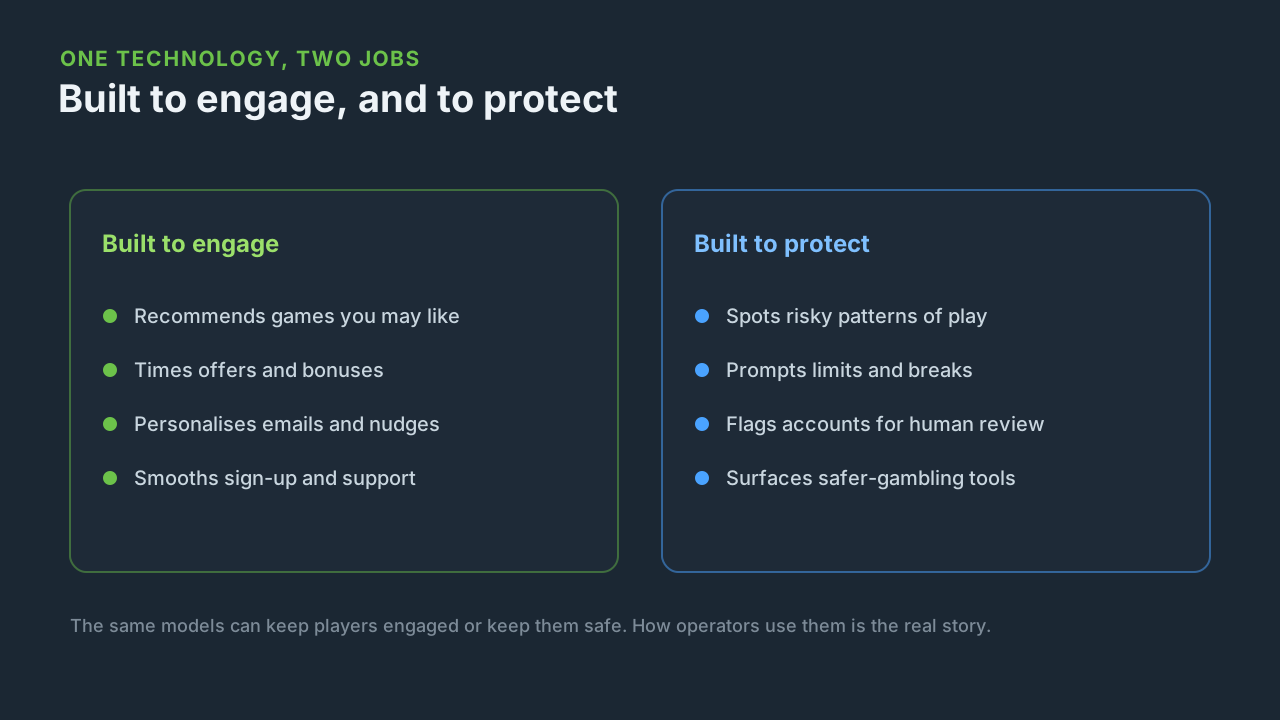
Safer-gambling AI works by watching for behavioural signals associated with harm rather than by reading minds. A sudden jump in deposit frequency, a pattern of chasing losses late at night, or a rapid escalation in stake size can all raise a flag. The best implementations treat that flag as a prompt for a human to review, not an automatic verdict, and respond with a proportionate step: a gentle check-in, a nudge toward deposit limits, or in serious cases a referral to support.
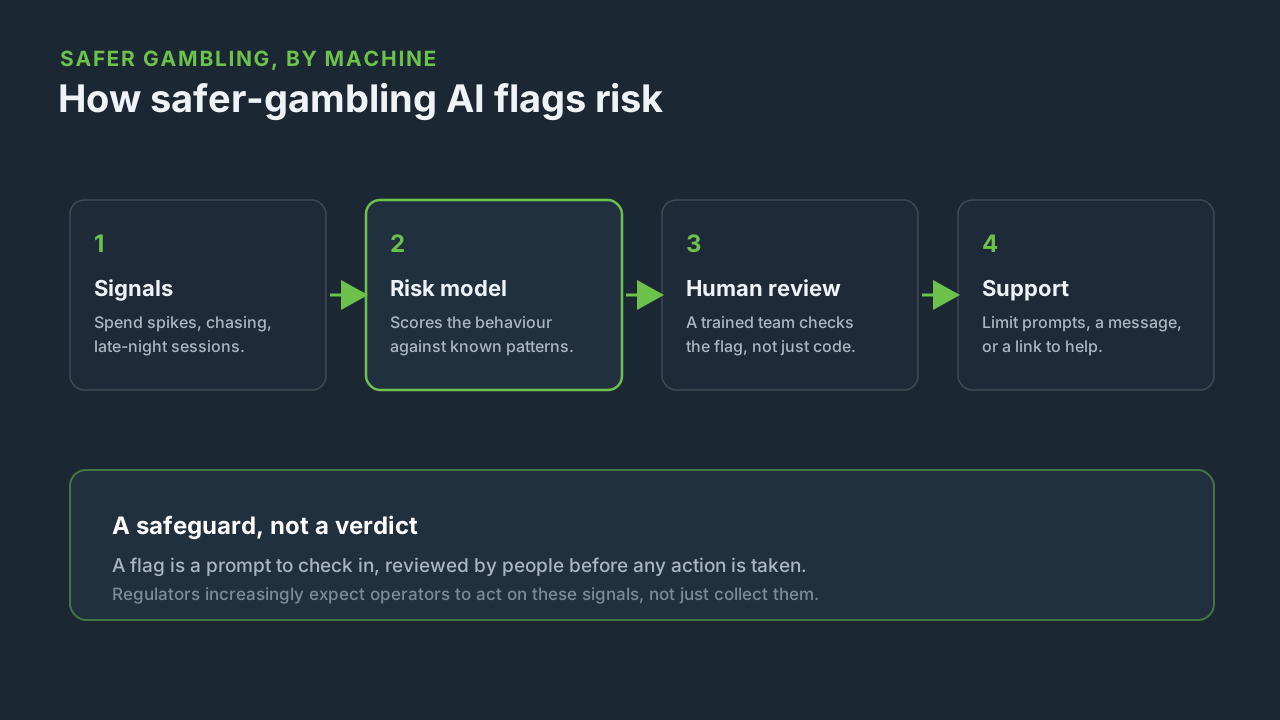
This dual-use nature is the crux of the whole debate. A model that knows a player well enough to time the perfect offer also knows them well enough to notice when they are sliding into trouble. Whether that knowledge is used to sell harder or to intervene earlier is a choice, and it is increasingly a choice regulators are willing to enforce.
The risks and the hard questions
For all its upside, personalisation in a gambling context carries risks that streaming or shopping never had to weigh. When the product being tailored can cost people money they cannot afford, "engaging" and "exploitative" can look uncomfortably similar. A handful of concerns come up again and again.
| The promise | The pressure |
|---|---|
| Easier discovery in huge libraries | Promotes what is profitable, not what suits you |
| Offers that are more relevant | Offers timed to moments of weakness |
| Faster, smarter support | Humans harder to reach when it matters |
| Early detection of harm | Deep profiling of vulnerable players |
The sharpest question is about intent. A system that can predict the perfect moment to send an offer can, in theory, target exactly the players least able to resist it. There are also fairness and transparency issues: players rarely know why they see what they see, cannot easily audit it, and have limited say in how their behaviour is modelled. And there is the subtler risk of over-personalisation, a lobby so tuned to past behaviour that it quietly narrows a player's world and reinforces habits rather than broadening choice.
What the regulators are watching
Regulation is racing to keep pace, on three fronts at once. Data-protection law comes first: under the GDPR, using personal data to profile people and make automated decisions about them is tightly constrained, with specific safeguards around solely automated decisions and a requirement to be transparent about how data is used. Marketing personalisation also leans on consent that players can withdraw.
On top of that sits the EU AI Act, whose obligations are phasing in across 2025 and 2026. It introduces stricter duties for higher-risk uses of AI, and while the precise timeline for those high-risk obligations has been subject to proposed adjustments, the direction of travel is clear: systems that materially affect people will face documentation, oversight and transparency requirements. Gambling-specific regulators add the third layer, increasingly expecting licensed operators to use their data not only to sell but to protect, and treating a licence as covering conduct as well as fairness. It is one more reason a casino's licence and the regulator behind it matter so much.
The privacy trade-off
None of this works without data, and that is the quiet cost of a tailored experience. Personalisation depends on building a detailed behavioural profile, and the more granular that profile, the sharper the results, for engagement and for protection alike. For players, the sensible posture is awareness rather than alarm: know that your activity is being analysed, read the privacy and marketing settings, and use the controls you are given, including the right to opt out of marketing and to object to certain profiling.
Reputable operators handle this data under strict security and disclose how it is used. The warning sign is a site that is vague about what it collects or makes opting out difficult. Transparency about data tends to travel with fair treatment everywhere else, much as it does with published game information.
It is worth remembering, too, that data gathered to personalise can be reused. The same profile that powers recommendations may feed affordability checks, identity verification or shared industry databases, depending on the market. That is not inherently sinister, but it is a good reason to treat your gambling data with the same care you would any other financial footprint.
What it means for you as a player
The practical takeaways are refreshingly simple, because the things that protect you have not changed. Treat a personalised lobby as a convenient shortcut, never as a recommendation in your interest, and pick games on your own criteria. Judge every tailored offer by its wagering terms rather than its timing or headline. And lean into the safer-gambling side of the same technology by setting your own limits before you play.
Above all, keep the controls you own front of mind. Deposit and loss limits, reality checks and self-exclusion work regardless of what any algorithm promotes, and they are the real counterweight to a product designed to hold your attention. Our guide to responsible gambling and staying in control covers each of them, along with where to find free, confidential support in every market.
A quick checklist for players
If you take nothing else from this, keep these five habits and personalisation stays a convenience rather than a trap:
- Treat the lobby as a shortcut, not a recommendation made in your interest.
- Check a game's RTP yourself before you play anything the site promotes.
- Judge offers by their wagering terms, not by their timing or headline.
- Set deposit and loss limits before you start, while you are clear-headed.
- Review your data and marketing settings, and opt out of anything you did not choose.
What comes next
If 2026 is the year personalisation became standard, the next phase is already visible. Generative AI is moving from support chat into the experience itself, producing tailored content and dynamic interfaces on the fly. Real-time systems are shrinking the gap between a player's action and the product's response from hours to milliseconds. And "agentic" tools that act on a player's behalf, from managing limits to comparing offers, may eventually put some of the same power back in players' hands.
Whether that future tilts toward players or away from them will be decided less by the models and more by the rules around them, and by the choices operators make. The technology is genuinely neutral; a recommendation engine does not care whether it surfaces a game you will enjoy responsibly or one that empties your balance. The guardrails, and the intent behind them, are everything.
The bottom line
AI-driven personalisation is now woven through the online casino experience, and on balance that is neither the disaster some fear nor the pure convenience operators advertise. It makes big products easier to navigate, it can catch harm earlier than any human could, and it can just as easily be tuned to extract more time and money from players who can least afford it. For now, the most reliable protections remain the oldest ones: a trustworthy licence, a clear head about how the maths works, and the limits you set for yourself before the algorithm ever gets a say.
Frequently asked questions
What is AI-driven personalisation in online casinos?
Does personalisation change a game's RTP or odds?
Is casino AI personalisation safe for players?
How do operators use my data for personalisation?
What is markers-of-harm AI?
How is AI personalisation regulated?
Can I turn off casino personalisation?
Go deeper
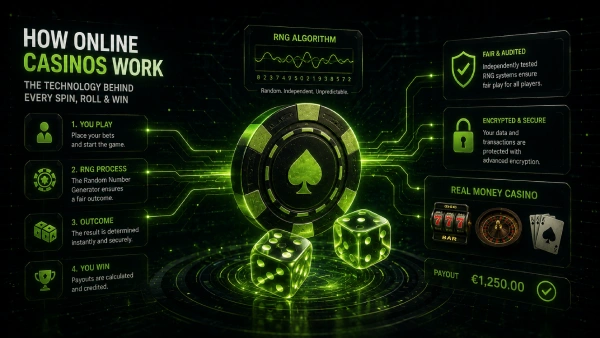
How online casinos work
Why personalisation never touches the certified maths behind the games.
Read guide →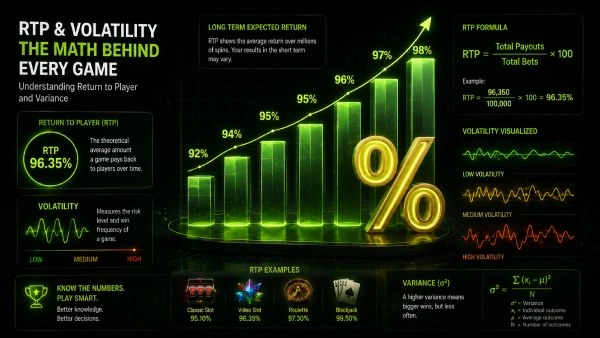
RTP & volatility
Judge any promoted game on its real value, not its placement.
Read guide →
Responsible gambling
The limits and tools that outweigh any algorithm, plus where to get help.
Read guide →