
Mobile casinos explained
Most casino play now happens on a phone. This guide explains how mobile casinos actually work: whether to play through an app or the browser, which games and payments are built for a small screen, and how to spot a mobile casino worth your time.



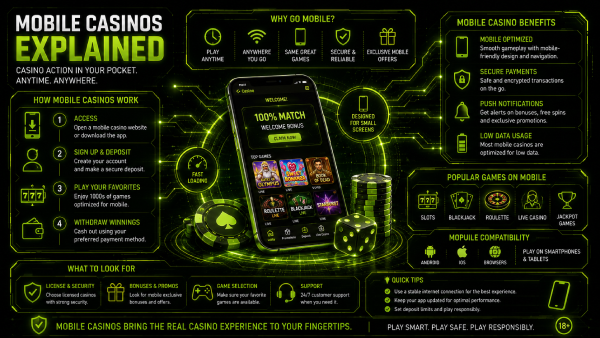
For most players today, the casino lives in a pocket. More than half of all online casino sessions now start on a phone, and for many people the phone is the only device they ever use to play. That shift has changed how casinos are built: sites are designed for a thumb first and a mouse second, games are made to fit a vertical screen, and payments are tuned so a deposit takes a couple of taps rather than a form full of card details.
Yet "mobile casino" is a slippery term. It can mean a dedicated app you download, a website that reshapes itself to fit your screen, or simply the mobile version of a casino you already use on a laptop. This guide clears that up. It explains what a mobile casino really is, the two ways you can play, what separates a good mobile experience from a frustrating one, and how the games, bonuses and payments carry over from the desktop world you may already know.
Key takeaways
- Mobile is the default. Most casino play happens on phones, so leading sites are now designed for small screens first.
- Two ways to play. A dedicated app or the mobile browser, and both use the same account, games and payments.
- The browser usually wins. Instant access, no download and always up to date make browser play the most common choice.
- Same games, same odds. HTML5 titles adapt to any screen, so the mobile library and the house edge match desktop.
- Payments feel native. Apple Pay, Google Pay and biometric login make mobile deposits fast and, often, safer.
What a Mobile Casino Actually Is
A mobile casino is not a different kind of casino. It is the same licensed operator, the same account and the same games you would find on a computer, delivered in a form that works on a phone or tablet. Nothing about the odds, the licence or the money changes when you switch to a smaller screen. What changes is the packaging: the layout, the controls and the way you get in and out.
The technology that makes this possible is HTML5, the modern web standard that games and casino sites are built in. An HTML5 game runs in any up-to-date browser and automatically adapts its layout to the screen it is on, so the same slot can fill a widescreen monitor or stack neatly into a phone in portrait mode. This is why the mobile library so closely matches desktop: it is usually the very same games, not cut-down copies. If you want the full picture of the machine behind any casino, our how casinos work guide walks through it end to end.
Because a mobile casino shares everything important with its desktop version, the sensible way to judge one is not to ask whether it is "a mobile casino" at all, but whether it is a good casino that also happens to work beautifully on a phone. Licensing, fair games, fast payouts and honest bonus terms matter first. A slick mobile interface on top of a poorly run casino is still a poorly run casino.
App vs Mobile Browser: The Two Ways to Play
There are exactly two ways to play a casino on your phone, and knowing the difference removes most of the confusion around the term "mobile casino". You either install a dedicated app, or you visit the site in your phone's browser. Both connect to the same casino, the same balance and the same games. The choice is about convenience, not capability.
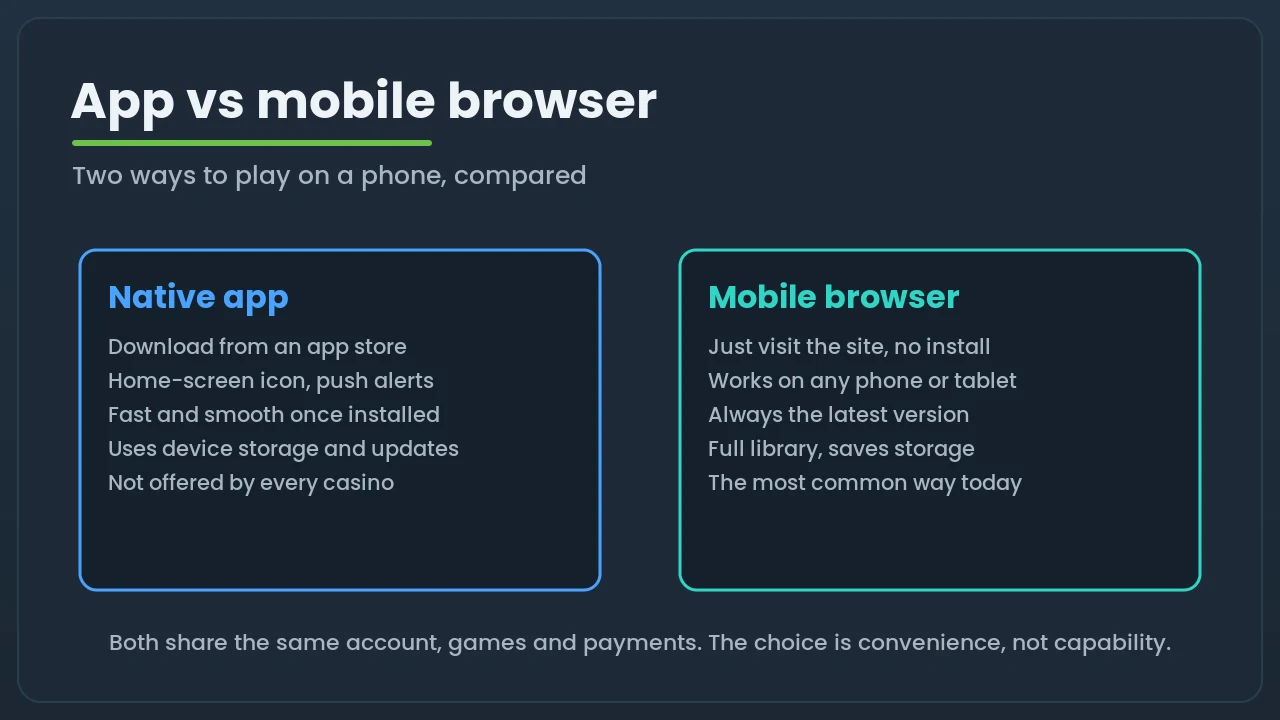
A native app is a program you download from the App Store or, on Android, sometimes directly from the casino, because Google's store restricts real-money gambling apps in many regions. Once installed, it gives you a home-screen icon, generally the smoothest performance, and push notifications for offers or when a withdrawal clears. The trade-offs are that it takes up storage, needs occasional updates, and is simply not offered by every casino. Apps also tie you to one device, so switching phones means installing again.
The mobile browser route means opening the casino's website in Safari, Chrome or any browser and playing straight away, with nothing to install. You always get the latest version of the site, it works on any phone or tablet regardless of the operating system, and it saves your storage entirely. Because responsive design has become so good, browser play now delivers effectively the full desktop library on a phone, which is why it has become the most common way people play. Many players add the site to their home screen anyway, giving an app-like icon without an actual download.
| Aspect | Native app | Mobile browser |
|---|---|---|
| Installation | Download and install required | None, just visit the site |
| Availability | Only some casinos offer one | Every modern casino |
| Storage used | Takes space, needs updates | Effectively none |
| Always current | Update to get changes | Always the latest version |
| Extras | Push alerts, home-screen icon | Add to home screen manually |
For most people the browser is the simpler, more flexible choice, and there is no downside to trying it first. If you play at one casino constantly and it offers a polished app with useful notifications, the app can be worth the install. Either way you lose nothing in games or payments by picking one over the other.
What Makes a Great Mobile Casino
Once you know a casino is licensed and fair, the mobile experience comes down to a handful of practical things. A great mobile casino gets all of them right so the phone never feels like a compromise; a weak one gets two or three right and leaves you pinching to zoom or waiting for games to load.
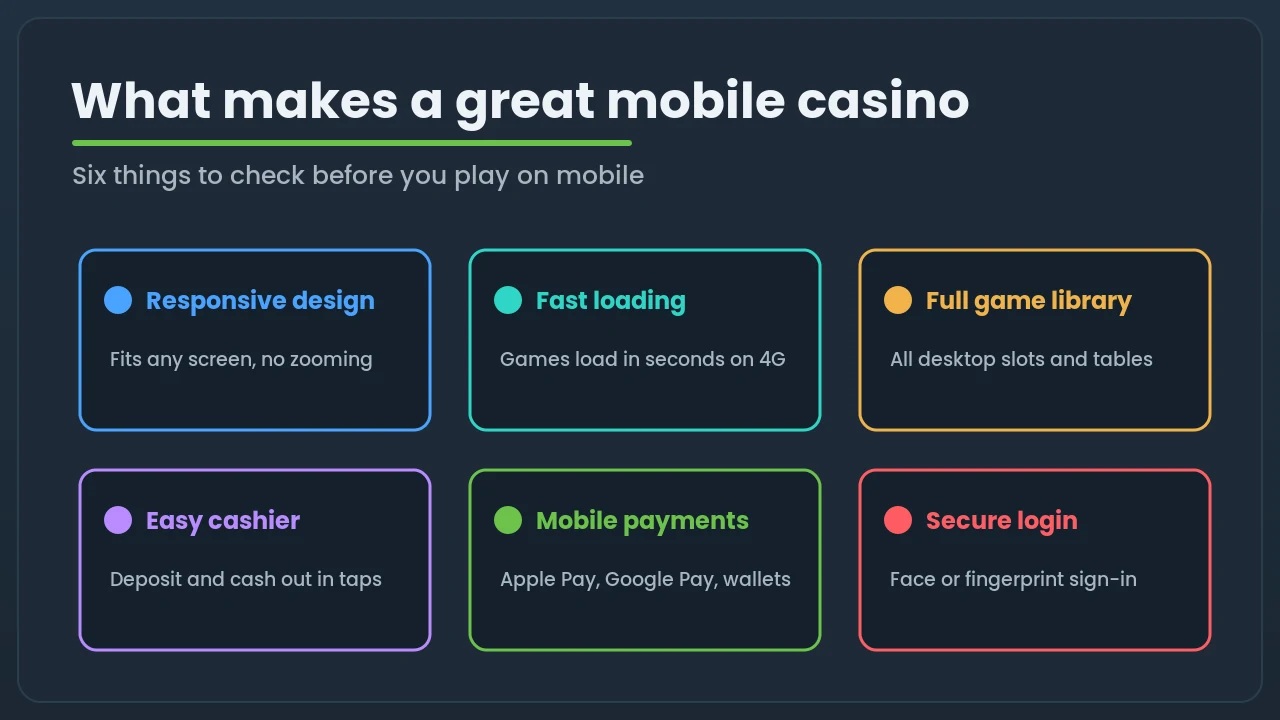
Responsive design is the foundation. The whole site should reflow to fit your screen so buttons are thumb-sized, text is readable without zooming, and the lobby scrolls naturally in portrait. Fast loading matters just as much on mobile, where you may be on 4G or 5G rather than home broadband; a good site keeps games opening in a few seconds and does not stall between screens.
A full game library is the sign the casino takes mobile seriously. On the best sites the mobile catalogue matches desktop almost title for title, with search and filters that actually work on a small screen. The cashier should be just as easy: depositing and withdrawing in a few taps, with your preferred method remembered, rather than a fiddly desktop form squeezed onto a phone. Supporting mobile payments such as Apple Pay and Google Pay is a strong signal, and secure login using your face or fingerprint both protects your account and saves you typing a password every time.
Quick mobile quality check
- Does it fit? No horizontal scrolling or pinch-to-zoom on the lobby or in games.
- Is it quick? Games open in a few seconds on mobile data, not just on wifi.
- Is the cashier simple? Deposits and withdrawals take a few taps with a saved method.
- Does it support mobile pay? Apple Pay, Google Pay or a one-tap e-wallet is available.
- Can you log in securely? Face or fingerprint sign-in is offered, not just a typed password.
Games on Mobile
The single most common worry about mobile play is that you will only get a stripped-down selection of games. On a well-built casino, that worry is misplaced. Because games are made in HTML5, the same slots, table games and live dealer streams that run on desktop run on your phone, redrawn to fit the screen rather than rebuilt from scratch.
Slots are the most mobile-friendly category by far. They are designed vertically, need only a tap to spin, and studios often optimise the interface specifically for phones, with the reels filling the screen and the controls tucked into a corner. Table games such as blackjack, roulette and baccarat translate well too, with betting layouts that scale down cleanly. Live dealer games stream real tables to your phone and work impressively well on a modern connection, though they use more data and benefit from a larger screen or a stable wifi signal.
The handful of exceptions are worth knowing. A few older games built in outdated technology may not run on mobile at all, and some feature-heavy live tables or complex multi-hand games are occasionally offered on desktop only. These are the minority. If a casino has done its job, you can open its full lobby on a phone and find the vast majority of what you would see on a computer, including new releases, which now launch mobile-ready by default.
Payments and Security on Mobile
Money is where mobile casinos genuinely improve on the desktop experience. Everything you can do on a computer, you can do on a phone, and the phone adds faster, more secure options on top. The diagram below sums up how deposits and protection work in your hand.
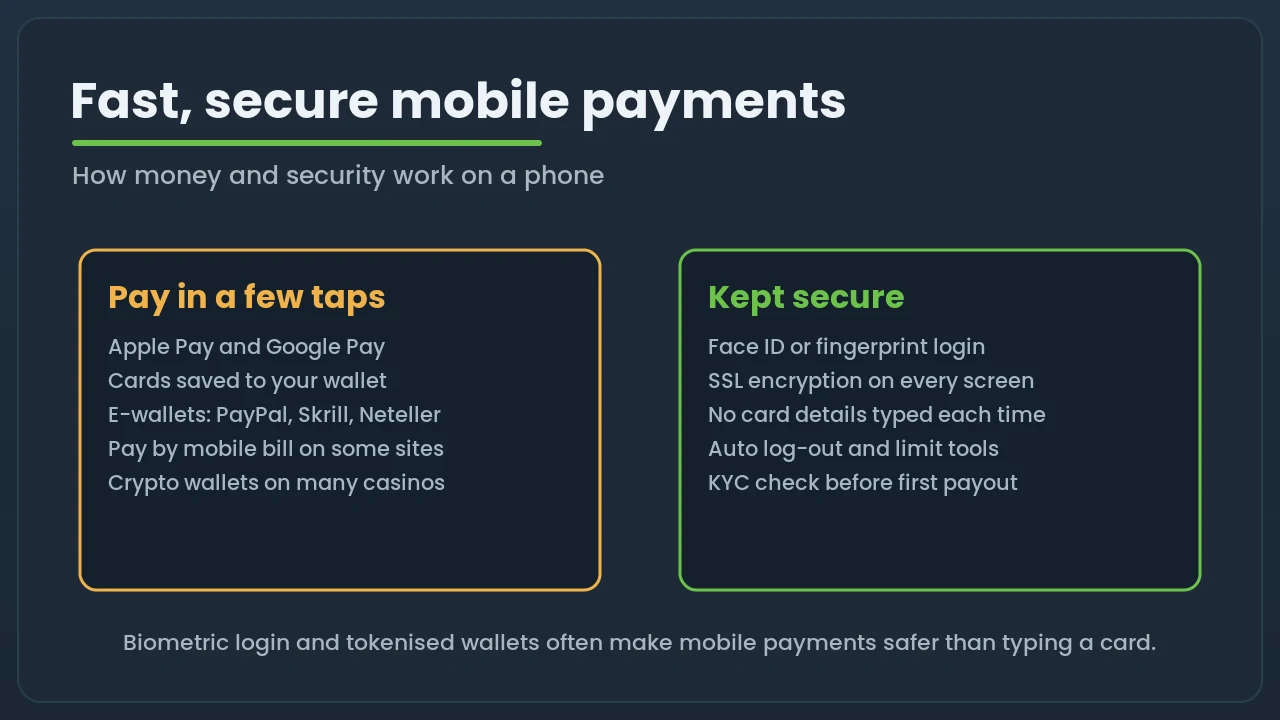
On the deposit side, a mobile casino supports the familiar methods, debit cards, e-wallets such as PayPal, Skrill and Neteller, bank transfers and increasingly cryptocurrency, and layers on Apple Pay and Google Pay. These let you deposit with a fingerprint or a glance instead of typing card numbers, because the card is already stored securely on your device. Some operators also allow pay-by-mobile deposits that appear on your phone bill, though these usually cannot be used for withdrawals and can carry limits.
Security is where the phone quietly shines. A licensed casino uses the same SSL encryption on mobile as on desktop, so your data is protected in transit either way. On top of that, biometric login means your account is guarded by your face or fingerprint, tokenised wallets mean your real card number is never sent to the casino, and automatic log-out protects you if you put the phone down. The one constant from desktop is KYC: you will still verify your identity before your first withdrawal, wherever you play. For the full detail on moving money in and out, see our casino payments guide.
| Method | Deposit speed | Best for |
|---|---|---|
| Apple Pay / Google Pay | Instant | Fastest, most secure mobile deposits |
| Debit card | Instant | Familiar, widely accepted |
| E-wallet (PayPal, Skrill, Neteller) | Instant | Fast withdrawals and privacy |
| Cryptocurrency | Minutes | Speed and lower fees where offered |
| Bank transfer | Slower | Larger balances, no third party |
Getting Started on Mobile in Five Steps
Starting to play on a phone is quick, and the steps are the same whether you choose the app or the browser. The goal is to get set up safely rather than as fast as possible, so a couple of the steps are about protection rather than speed.
From nothing to your first spin
- 1. Pick a licensed casino. Check the regulator and read a review before anything else. A good mobile site is worthless if the operator is not trustworthy.
- 2. Open the site or install the app. Visit in your browser for instant access, or download the official app if the casino offers one you will use often.
- 3. Register and verify. Create your account and complete identity checks early, so your first withdrawal is not delayed later.
- 4. Set your limits, then deposit. Set deposit and session limits first, then fund your account with a mobile-friendly method such as Apple Pay or an e-wallet.
- 5. Claim any bonus and play. Read the wagering terms, opt in if it suits you, and start with low stakes while you learn the interface.
Doing steps three and four in that order is the small trick most guides skip. Verifying your identity and setting limits before you have won anything keeps the process calm and removes the temptation to raise limits in the moment. It takes a few extra minutes now and saves friction later.
The Pros and Cons of Playing on Mobile
Mobile play is not automatically better or worse than desktop; it is a set of trade-offs. For most players the advantages clearly outweigh the drawbacks, but it is worth seeing both sides honestly, especially where convenience and self-control pull against each other.
| Pros | Cons |
|---|---|
| Play anywhere, in short or long sessions | Small screen suits some games better than others |
| Faster deposits with Apple Pay and Google Pay | Live dealer and streaming use more data |
| Biometric login adds security | Constant access can make it harder to take breaks |
| Nothing to install with browser play | Battery drain during long sessions |
| Same games, bonuses and odds as desktop | Notifications from apps can nudge you to play |
The most important item on that list is not technical. Because a mobile casino is always with you, it is easier to play more often and in more places than you might on a computer, and app notifications are designed to bring you back. That convenience is the whole appeal, but it is also the reason the limit and reminder tools covered below matter more on mobile than anywhere else.
Choosing a Mobile Casino
Choosing well is mostly about applying the same standards you would use for any casino, then adding a short mobile-specific check on top. Start with the essentials: a recognised licence, a fair set of games, reasonable bonus terms and a track record for paying out. A beautiful app cannot make up for failing any of those.
With the fundamentals confirmed, test the mobile experience directly. Open the site on your own phone before depositing and see how it feels: does the lobby fit the screen, do a couple of games load quickly, is the cashier easy to reach, and can you find your preferred payment method? Spending five minutes in the real interface tells you more than any feature list. Our casino reviews flag mobile quality and note which operators run a dedicated app.
Match the setup to how you play
- You play at many casinos: stick with the browser for instant, install-free access everywhere.
- You have one favourite site: a dedicated app can add a smoother feel and useful alerts.
- You love live dealer: favour a casino with a strong live app and play on wifi or a tablet for the bigger screen.
- You want the fastest deposits: choose a site that supports Apple Pay or Google Pay.
- You care most about control: pick an operator with clear, easy-to-find limit and reminder tools on mobile.
Availability and the Law
Whether you can use a mobile casino, and how, depends on the same laws that govern online casinos in general, not on the fact that you are on a phone. Where real-money online play is licensed and legal for you, mobile play is simply part of that offer. Where it is restricted, using a mobile site or app is restricted too.
The one mobile-specific wrinkle is app distribution. Apple allows licensed real-money gambling apps in regions where they are legal, but Google historically limited them on the Play Store in many countries, which is why some Android casinos ask you to download an app directly from their website instead. That is normal for the sector, but it is also why you should only ever install an app from the casino's own official link, never from an unknown third-party store.
As always, this is general background rather than legal advice. Confirm what is permitted where you live, check that any operator is licensed to serve your region, and remember that a site being reachable on your phone does not by itself mean it is lawful for you to use. Our country pages set out the licensed options market by market.
A Responsible-Gambling Note
Everything that makes mobile casinos convenient also makes them easy to overuse, so the responsible-gambling basics matter even more here than on desktop. Casino play is for adults only, 18+, and the house edge means the operator is built to win over time. A phone in your pocket removes the friction that a computer naturally adds, which is helpful when you want to play and unhelpful when you should stop.
Keep mobile play in check
Set deposit and session limits before you start, turn off casino push notifications if they tempt you to play, and treat any money spent as the cost of entertainment rather than an investment. Never chase a loss, and use reality-check reminders so a quick session does not quietly stretch out. If play stops feeling fun or starts to feel compulsive, use the operator's limit and self-exclusion tools. Our responsible-gambling guide explains every tool and where to find free, confidential support.