
Casino Licensing & Safety
A licence is the single most important signal of whether an online casino is safe. Here is what it really guarantees, which regulators to trust, how to check one in seconds, and the red flags that mark a site worth avoiding.



Every reputable online casino is built on a foundation you rarely see: its licence. That single legal permit shapes everything about how the operator must treat you, from the fairness of its games to what happens to your money if the company folds. An unlicensed site can promise all the same things, but nothing forces it to keep those promises. Understanding what a licence covers, and what it does not, is the quickest way to tell a trustworthy casino from a risky one.
This guide explains what a licence actually protects, ranks the main regulators by how strict they are, shows you how to verify a licence for yourself in under a minute, and lists the warning signs that should make you close the tab. Checking the licence is always the first step in every review we publish, and it should be yours too.
Key takeaways
- A licence sets binding rules. Segregated player funds, certified games, responsible-gambling tools and a formal complaints route are all conditions the operator must meet.
- Not all regulators are equal. The UK Gambling Commission and Malta Gaming Authority are strict; Curacao, Anjouan, Kahnawake and others are lighter-touch.
- Costa Rica is not a gambling licence. A Costa Rican company registration is not the same as being regulated for gambling.
- Verify in seconds. Match the footer licence number against the regulator's own public register.
- Watch for red flags. Fake seals, missing licence numbers and vague terms all signal an unsafe site.
What a Licence Actually Guarantees
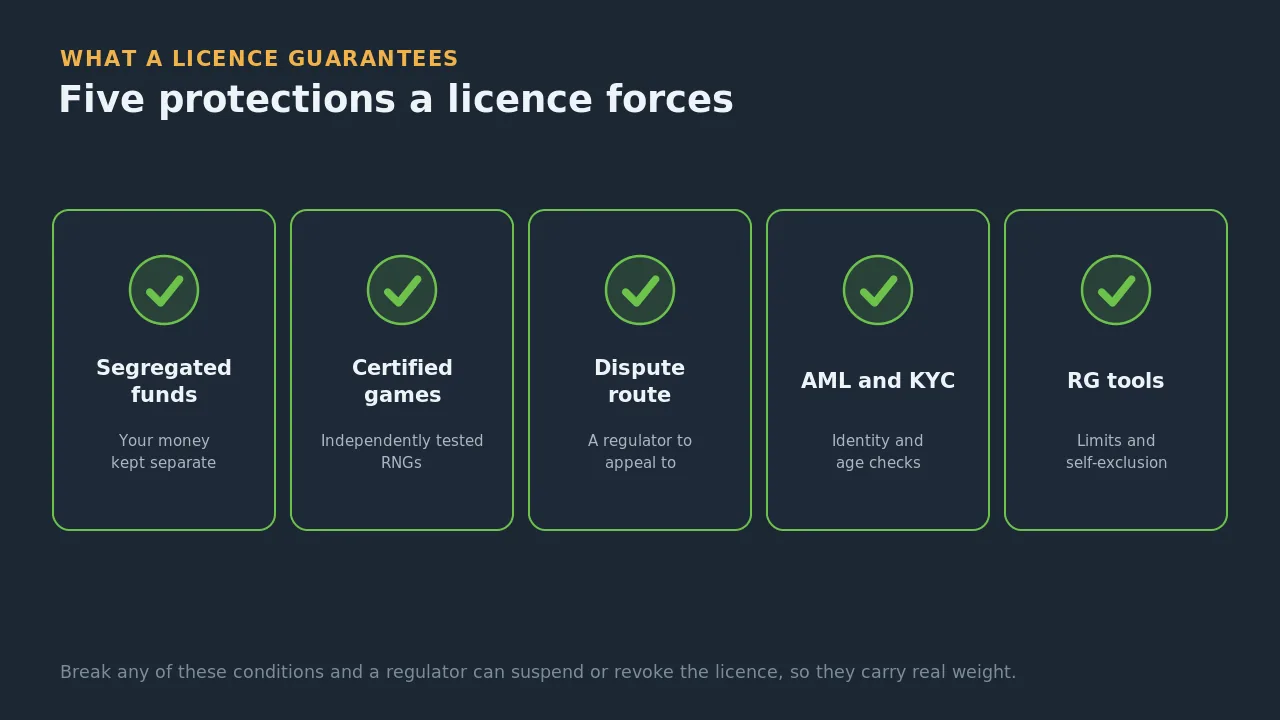
A gambling licence is not a rubber stamp. It is a legal permit issued by a regulator, and to keep it an operator has to meet a set of ongoing conditions. Break them and the licence can be suspended or revoked, which is why a genuine licence carries real weight. The specific rules vary between regulators, but the strongest protections appear in every serious framework.
Segregated player funds
A well-regulated casino must keep the money you deposit separate from its own operating cash, often in a ring-fenced or trust account. If the business runs into trouble, your balance is not simply swallowed up alongside the company's debts. Weaker regulators may not require this at all, which is one of the clearest differences between strict and lax licensing, and it directly affects whether you can actually get a withdrawal when it counts.
Tested and certified games
Licensed operators may only offer games whose random number generators have been checked by independent laboratories such as eCOGRA, iTech Labs or GLI. That certification is what stops an operator quietly altering how a slot pays. Our guide to how online casinos work explains this game-fairness layer in more detail.
A real dispute-resolution route
A licence obliges the casino to publish a formal complaints process and, in stricter jurisdictions, to sign up to an independent alternative dispute resolution (ADR) service. If the casino will not pay you and you have done nothing wrong, you have somewhere impartial to escalate rather than shouting into the void.
AML, KYC and responsible-gambling duties
Anti-money-laundering rules and know-your-customer identity checks keep criminal money out and confirm you are who you say you are and old enough to play. Licences also mandate responsible-gambling tools such as deposit limits, time-outs and self-exclusion, and require the safe handling of your personal data. The checks can feel like a nuisance, but they are a sign the operator is following the rules rather than ignoring them.
| Protection | What it means for you |
|---|---|
| Segregated funds | Your balance is protected if the operator fails |
| Certified games | RNGs tested by independent labs, results not rigged |
| Dispute resolution | A formal complaints route and an ADR to escalate to |
| AML and KYC | Fraud and underage play kept out |
| Responsible gambling | Limits, time-outs and self-exclusion built in |
Licensed vs Unlicensed at a Glance
The quickest way to see why the licence matters is to put a regulated site next to an unregulated one. On paper they can look identical, but they behave nothing alike the moment something goes wrong.
| Feature | Licensed casino | Unlicensed casino |
|---|---|---|
| Game fairness | Independently tested and certified | No guarantee, no oversight |
| Your deposits | Segregated and protected | Mixed with company money |
| If you are not paid | Escalate to the regulator | No one to appeal to |
| Responsible-gambling tools | Required by law | Optional or absent |
| Data protection | Legally mandated | Not assured |
The Main Regulators and How Strict They Are
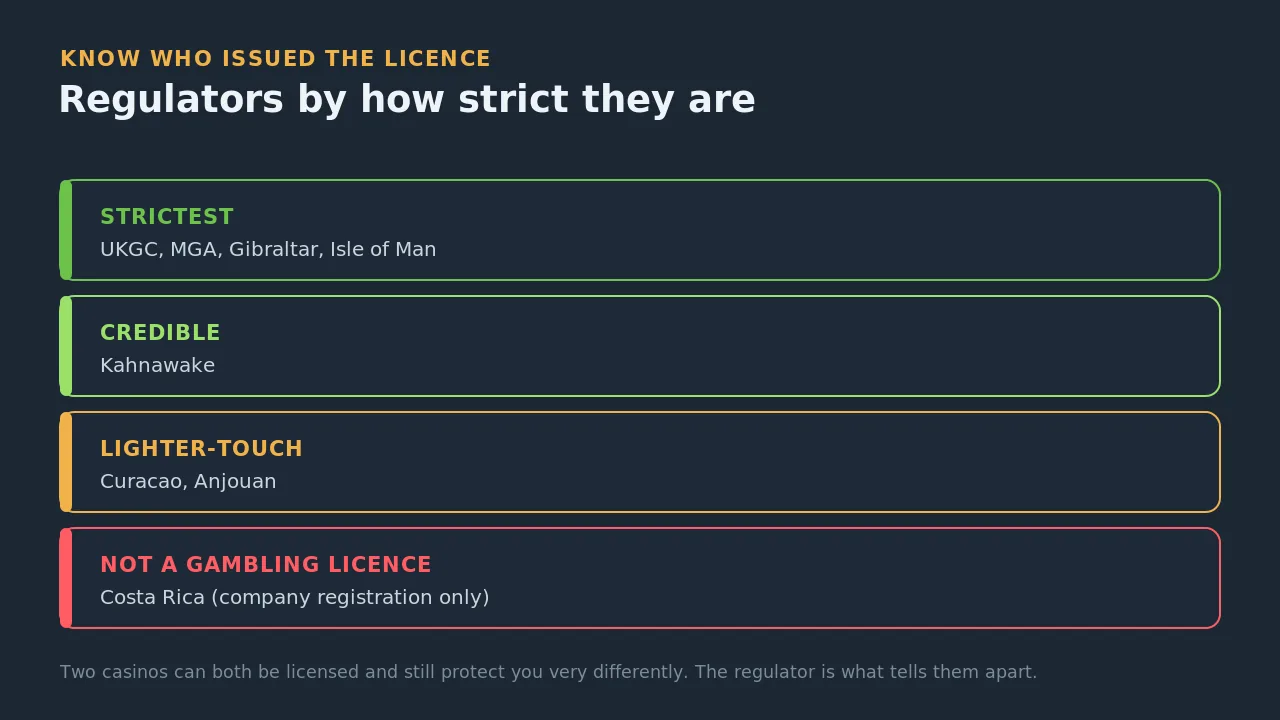
Two casinos can both be licensed and still offer very different levels of protection, because the body behind the licence matters enormously. Regulators range from famously demanding to barely there, so knowing who issued a licence tells you a great deal about how a site is likely to behave.
The strict top tier
The UK Gambling Commission (UKGC) is widely regarded as the strictest mainstream regulator. It enforces tough rules on advertising, bonus terms, affordability checks and responsible gambling, mandates segregated funds and requires membership of an approved ADR scheme. A UKGC licence is hard to obtain and easy to lose, which is exactly why it offers players such strong protection. The Malta Gaming Authority (MGA) is the other heavyweight and the most common licence across the European market, demanding audited games, segregated funds and clear complaints procedures. Gibraltar and the Isle of Man sit alongside them as reputable, well-run jurisdictions.
The lighter-touch regulators
Curacao licenses a very large number of casinos and has historically been quick and cheap to obtain, with lighter oversight than the UKGC or MGA. Its framework has been undergoing reform, but a Curacao seal on its own tells you less about how a site will treat you. Newer offshore options such as Anjouan are even lighter, popular with crypto and start-up casinos precisely because the requirements are minimal. Kahnawake, based in Canada, is long-established and more credible than the newest offshore licences, but still less demanding than the top tier.
The Costa Rica trap
Watch out for a common trap: Costa Rica registration is not a gambling licence. Costa Rica does not issue a dedicated online-gambling licence, so operators simply register as ordinary companies there. That gives them a nominal home base but no gambling-specific oversight, no mandated player-fund segregation and no regulator to complain to. Treat a Costa Rica "licence" as effectively unlicensed for safety purposes.
| Regulator | Tier | Known for |
|---|---|---|
| UK Gambling Commission | Strictest | Tough rules, strong player protection |
| Malta Gaming Authority | Strict | The common EU-facing licence |
| Gibraltar / Isle of Man | Reputable | Well-run, established jurisdictions |
| Kahnawake | Credible | Long-established, mid-strength |
| Curacao / Anjouan | Lighter-touch | Fast, cheap, common at crypto sites |
| Costa Rica | Not a licence | Company registration only |
How to Verify a Licence in Seconds
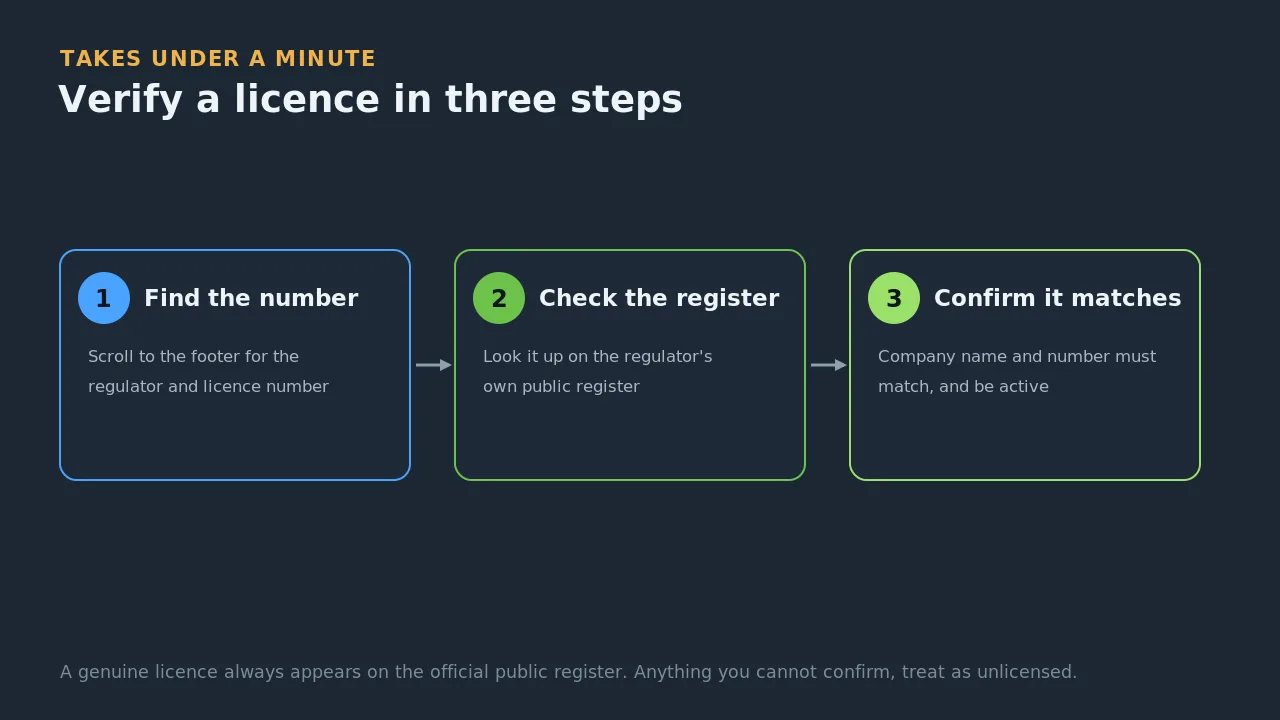
A licence is only worth something if it is real, and the good news is that checking takes less than a minute. The whole process rests on one simple idea: a genuine licence appears on the regulator's own public register, and a fake one does not.
1. Check the footer
Start by scrolling to the footer of the casino. A legitimate operator lists its licensing regulator and, crucially, a licence number, usually near the company name and address. On many sites the seal is clickable and links directly to the regulator's verification page. Click it and check that it lands on the regulator's official domain rather than a page hosted by the casino itself.
2. Match it against the register
Take the licence number and the company name and look them up on the regulator's public register. The UKGC, MGA and other serious authorities all publish searchable databases of who they license. The company name and licence number on the register should match what appears in the casino's footer exactly. If the operating company is different, or the licence is listed as expired, surrendered or suspended, stop there.
3. Know when to walk away
If the seal is just a static image that links nowhere, or the licence number returns no results on the register, treat the site as unlicensed no matter what the badge claims. Genuine regulation is always verifiable; anything you cannot confirm should be assumed to be false.
Red Flags of an Unsafe Casino
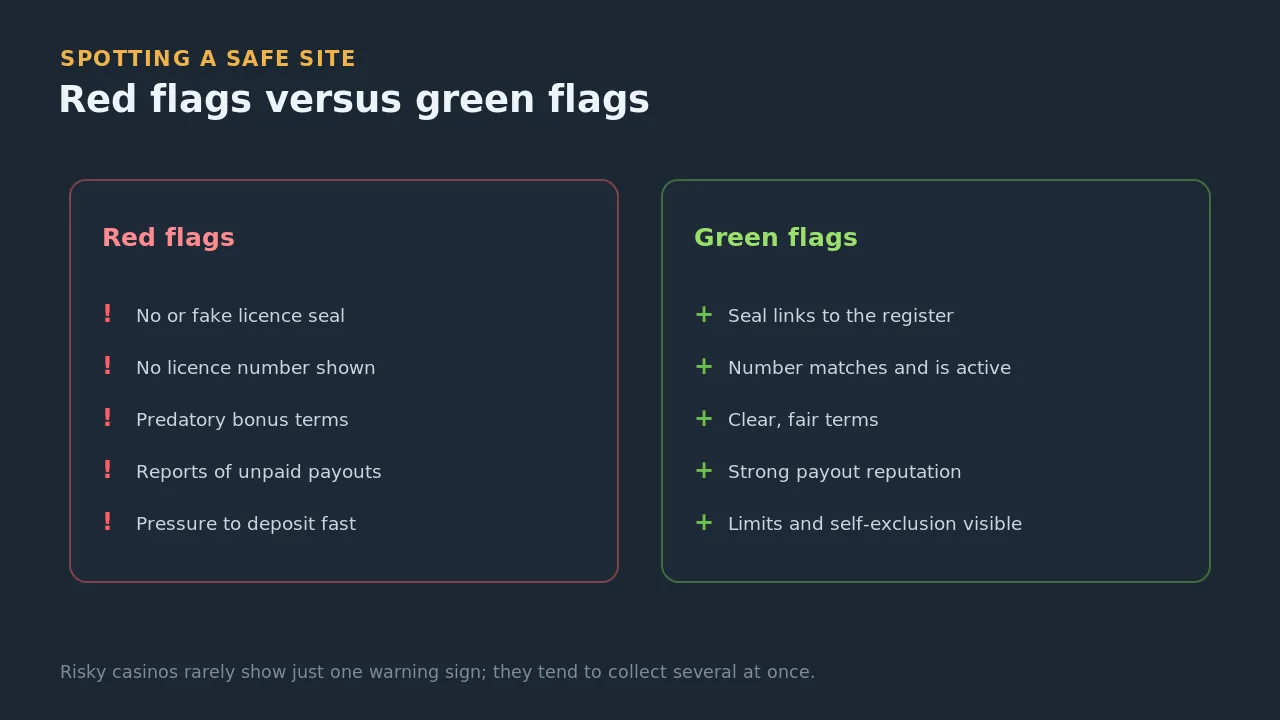
Once you know what a properly licensed casino looks like, the warning signs of an unsafe one become easy to spot. Rarely is there a single giveaway; instead, risky sites tend to collect several of these red flags at once.
A missing or fake licence
The most obvious red flag is a missing or unverifiable licence: no licence number, a seal that links nowhere, or details that do not appear on any regulator's register. Close behind are fake or copied seals, where a site displays a UKGC or MGA logo it has no right to use. Always test the badge rather than trusting it.
Vague or predatory terms
Be wary of enormous wagering requirements buried in the small print, maximum-win caps on withdrawals, or clauses that let the casino void winnings for loosely defined "irregular play". These are designed to stop you cashing out, so read the bonus and withdrawal terms in full before you deposit rather than after you win.
Other warning signs
Round out the list with no clear ownership or contact details, reports of unpaid or endlessly delayed withdrawals from other players, aggressive unsolicited marketing, missing responsible-gambling tools, and pressure to deposit quickly to claim a "limited" offer. A safe casino has no reason to rush or corner you; if a site does, that in itself is the reddest flag of all.
What a Licence Cannot Do
A licence is powerful, but it has clear limits, and understanding them keeps your expectations realistic.
It cannot beat the house edge
A licence is not a guarantee that you will win. It protects the fairness of the process, not the outcome of your bets. The house edge still applies, so over time the casino is designed to come out ahead however well regulated it is. A licence ensures the games are honest and that you can complain if you are treated unfairly; it cannot override the maths or turn gambling into a reliable source of income.
It is the first filter, not the last word
Treat the licence as the first thing you check, not the only thing. Confirm a casino is properly regulated, then still read its terms, check its payout reputation and use the responsible-gambling tools it provides. If you ever feel your play is slipping out of control, our responsible-gambling guide explains the support available and how to step back.