
How casino VIP programs work
Almost every online casino runs a VIP or loyalty program, and almost all of them promise the same thing: play more, get rewarded more. This guide explains what is really on offer, how tiers and points work, which perks matter, and whether the rewards are worth the extra play.



Every regular casino player eventually meets the VIP program. It might be a discreet "Loyalty" tab in the menu, a progress bar that fills as you play, or an email inviting you to a private club. The pitch is always simple and always appealing: the more you play, the more the casino gives back. Cashback, free spins, faster withdrawals, a personal contact and, at the very top, gadgets and holidays.
What that pitch rarely explains is the mechanism underneath. A VIP program is not a gift; it is a marketing tool designed to reward loyalty and encourage more play, funded by the same house edge that powers the rest of the casino. Understanding how the tiers, the points and the perks actually fit together is what lets you enjoy the genuine value on offer without being nudged into spending more than you meant to. That is exactly what this guide sets out to do.

Key takeaways
- Loyalty is a ladder. You climb tiers, from an entry level up to VIP, by wagering and earning points.
- Points do two jobs. They lift you through the tiers and can be redeemed for cashback, bonuses or, sometimes, cash.
- Perks grow with the tier. Higher levels add better cashback, faster payouts, higher limits and a personal manager.
- It softens, never beats, the edge. Rewards return a small slice of your wagering; the house still wins over time.
- Never chase a tier. Playing more to climb faster usually costs more than the reward is worth.
What a Casino VIP Program Actually Is
A VIP or loyalty program is a rewards scheme that gives you something back in proportion to how much you play. At its simplest, the casino tracks your wagering, converts it into points, and uses those points both to place you on a tier and to fund rewards you can claim. The more you wager, the more points you earn, the higher you climb, and the better the rewards become.
It is worth being clear-eyed about why casinos run these schemes. They are a retention tool. In a market where a player can switch sites in seconds, a program that quietly rewards you for staying is a powerful reason not to leave. That does not make the value fake, the cashback and perks are real, but it does mean the program is designed around the casino's interest in keeping you playing. The house edge, which our how casinos make money guide explains in full, is what pays for every reward, so a program can only ever return a fraction of what the casino expects to win from you.
The two words you will see, "loyalty" and "VIP", describe the same machine from two ends. The loyalty program is the open, everyone-can-join system of points and tiers. VIP normally refers to the upper, often invite-only levels of that system, where the rewards become personal and generous. Throughout this guide, think of loyalty as the ladder and VIP as its top rungs.
The Tier Ladder
Almost every program is built as a ladder of tiers, and picturing it that way makes the whole system click. You start at the bottom and move up as you accumulate points or wagering, with each tier unlocking a better set of rewards than the one below. Most casinos use four to six levels with names borrowed from metals and gems.
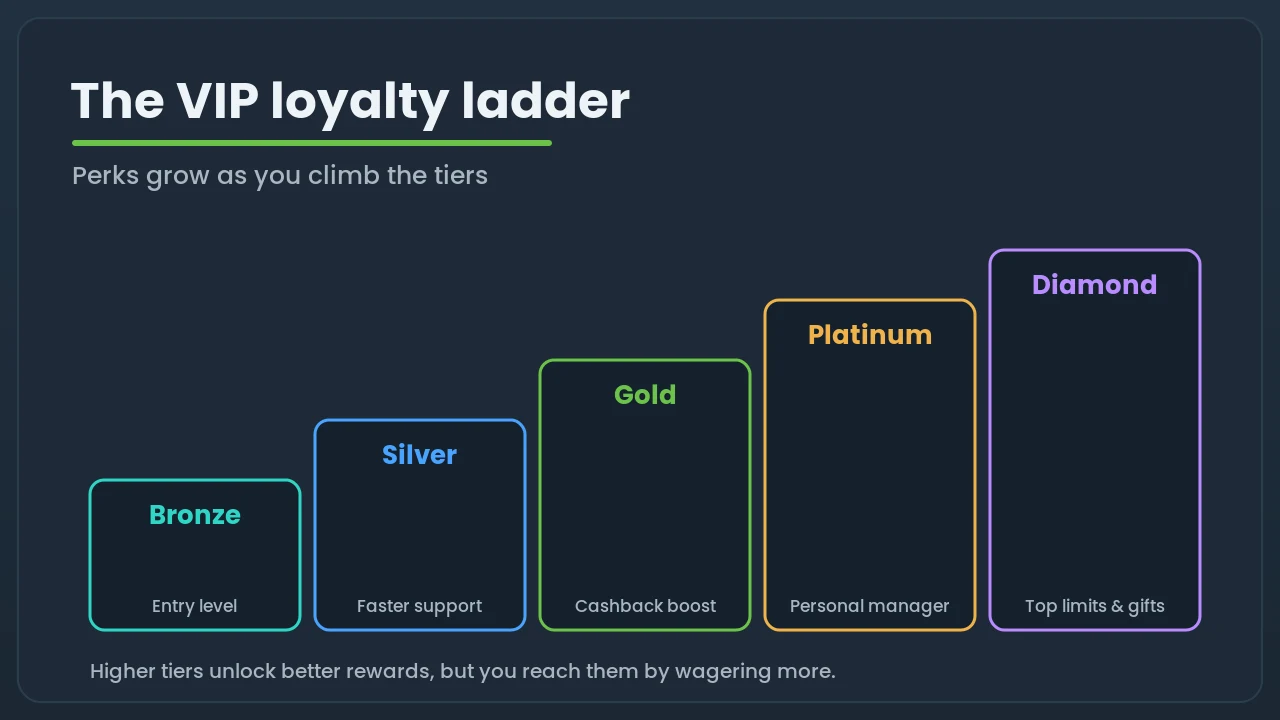
A typical structure runs from an entry level such as Bronze, where you simply start earning, up through Silver and Gold, into Platinum and a top Diamond or equivalent. Early tiers unlock modest, automatic rewards: a slightly better points rate, occasional free spins, faster support. Middle tiers introduce real cashback and reload offers. The top tiers are where the headline perks live, a personal account manager, custom bonuses, the highest deposit and withdrawal limits, and invitations to events.
Two details about the ladder matter more than the names. First, the gap between tiers usually widens as you climb, so reaching Diamond takes far more play than reaching Silver. Second, many programs require you to maintain a tier, not just reach it: if your play drops below a threshold, you can slide back down. That maintenance requirement is a quiet pressure to keep wagering, and it is one of the first things to check before you get attached to a level.
How Loyalty Points Work
Points are the currency that drives the whole program, and they do two jobs at once: they measure your progress up the ladder and they act as a balance you can spend. Understanding how they are earned and redeemed is the single most useful thing to grasp about any VIP scheme.
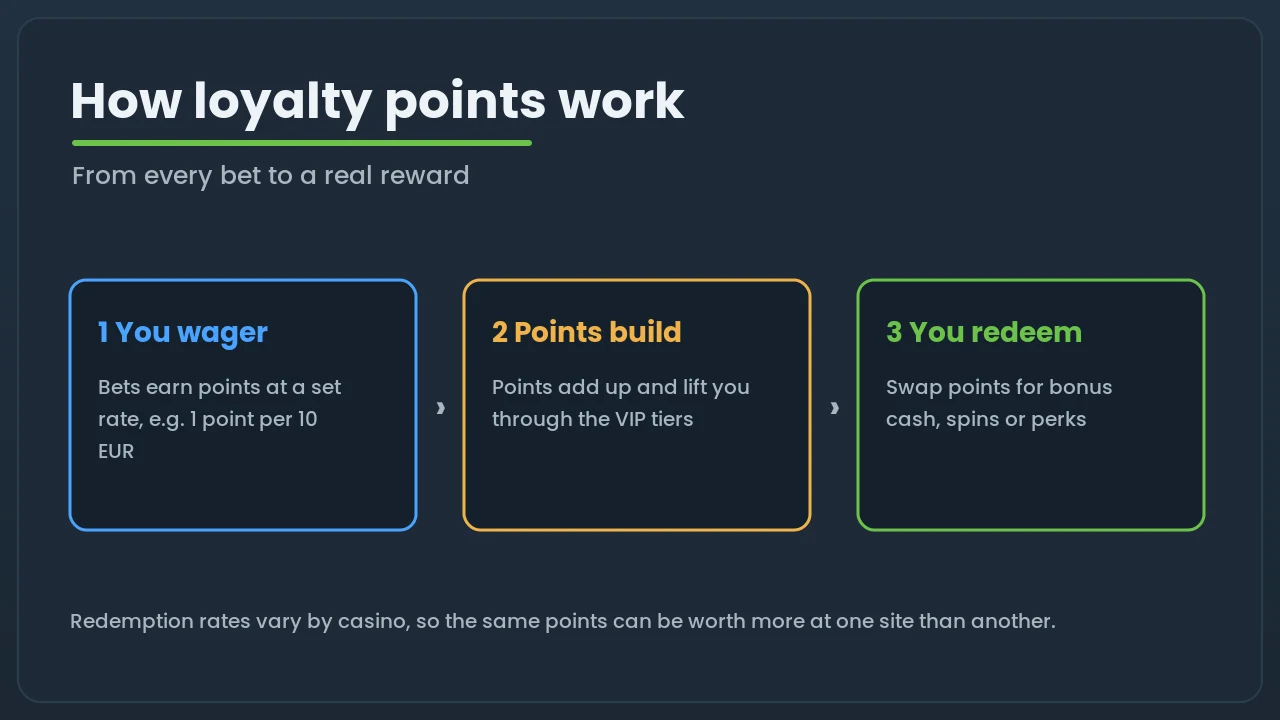
You earn points by wagering, at a rate the casino sets, for example one point for every ten euros staked. Crucially, the rate often depends on the game. Slots usually earn at the full rate, while blackjack, roulette and other low-edge table games earn far more slowly or sometimes not at all, because the casino makes less money from them. This is the same logic behind game weighting in bonus wagering: the house rewards the play that is most profitable for it.
Points then build, and here they split into their two roles. Status points push you up the tiers and often cannot be spent, while redeemable points act as a balance. When you redeem, you exchange points for a reward, most often bonus funds, sometimes free spins, and at higher tiers occasionally withdrawable cash. The catch is the conversion rate, which varies enormously between casinos. A thousand points might be worth a few euros at one site and far less at another, so a big points balance is not automatically a big reward.
Reading a points rate honestly
- Check the earn rate. How much must you wager for one point, and does it differ by game?
- Check the redemption rate. How many points equal one euro of bonus or cash? This is where real value hides.
- Check what you get. Bonus funds with wagering are worth less than the same amount in cash.
- Check expiry. Points that lapse after inactivity are worth nothing if you take a break.
The Perks Explained
The rewards themselves are the reason anyone cares about a program, so it helps to know what the common perks actually deliver rather than what they are called. The diagram below groups the perks you will meet most often.
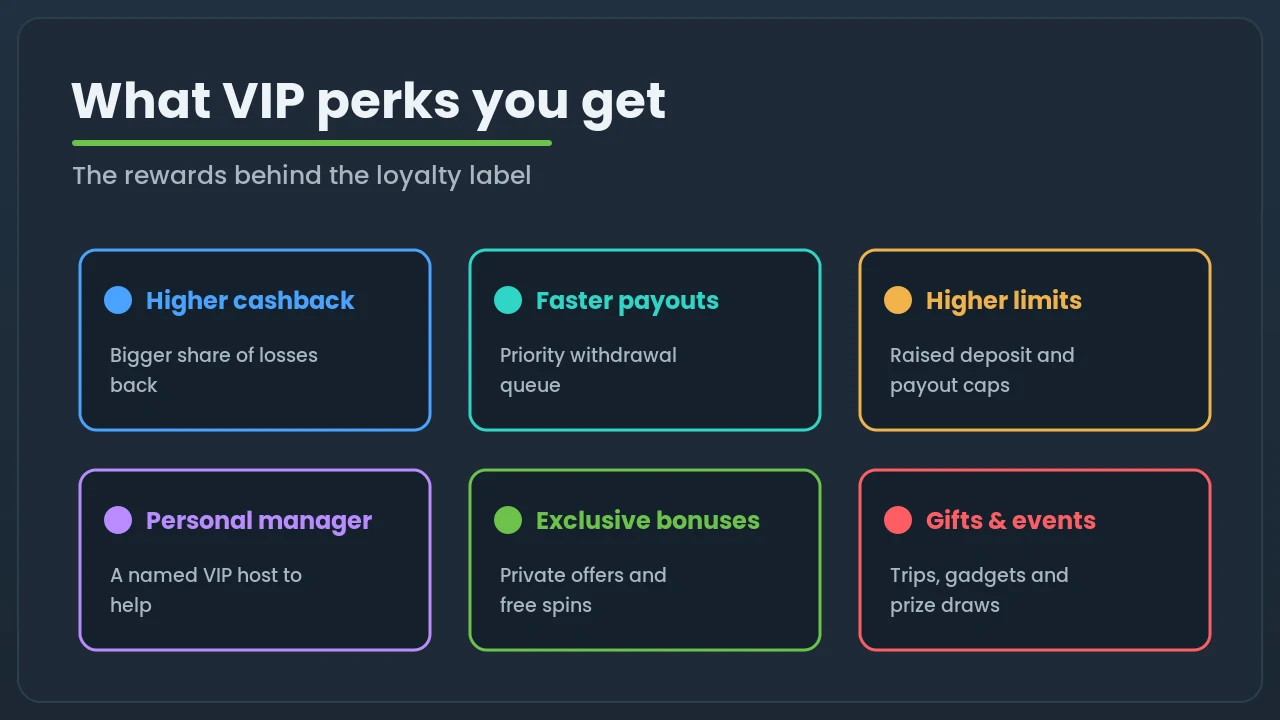
Cashback is the workhorse and usually the most valuable perk. It returns a percentage of your net losses over a period, so a higher tier with better cashback genuinely reduces the cost of play. Faster payouts move you to a priority withdrawal queue, and higher limits raise the caps on deposits and cash-outs, which matters mainly to bigger players. Exclusive bonuses are private offers and reload deals not shown to ordinary players.
Higher up, a personal VIP manager becomes the headline feature: a named contact who handles your account, arranges custom offers and resolves issues quickly. This is a genuine convenience, but it is worth remembering the manager's job is also to keep you engaged, so treat their offers with the same clear head you would any other. At the very top come gifts and events, physical presents, prize draws, sports tickets and trips. These make the best headlines and are the least reliable value, since the wagering behind them dwarfs the prize. As a rule, judge a program by its everyday cashback and terms, not by its holidays.
Open Programs vs Invite-Only VIP
Programs come in two broad shapes, and knowing which you are looking at sets your expectations correctly. Most casinos run an open, automatic loyalty scheme: anyone can join, points accrue from your first bet, and you move up the published tiers by hitting clear thresholds. Everything is visible, and the rewards, while modest at the lower levels, are transparent.
The highest levels are often invite-only. Instead of a published threshold, the casino identifies consistent players and offers them a place, sometimes silently upgrading an account, sometimes through a manager making contact. These tiers can carry the best rewards in the whole program, but their terms are private and their perks are discretionary, which means they can be adjusted or withdrawn. You cannot usually apply, and you certainly should not try to spend your way into an invitation.
That distinction matters for how you treat the program. An open scheme is a straightforward bonus on play you were doing anyway. An invite-only tier is a relationship the casino manages in its own interest, so the value can be real but the terms are less certain and the pull to keep playing is stronger. Neither is a reason to play more than you planned; both are simply context for reading what is on offer.
Are VIP Programs Worth It?
The honest answer is that a VIP program is worth it for play you were always going to do, and a trap for play you would not otherwise do. Because every reward is funded by the house edge, a program can only ever hand back a fraction of what the casino expects to win from your wagering. It softens the edge; it never reverses it.
The one rule that matters
If you already play regularly at a casino, join its program, because you will collect cashback and perks on wagering you were making anyway. That is free value. The moment you find yourself placing an extra bet, making an extra deposit or staying logged in longer to climb a tier or keep a status, the program has stopped rewarding you and started costing you. The reward is almost never worth the extra you will lose to reach it.
Put simply, let the rewards follow your play, and never let your play chase the rewards. A good program adds a little value on top of a habit you already have and can afford. It is not a strategy, an income or a reason to raise your stakes, and any program that seems to be nudging you toward playing more is doing exactly what it was designed to do.
The Terms Worth Reading
Loyalty programs bury most of their real value, and most of their catches, in the terms. A few minutes reading them tells you whether a scheme is generous or just glossy. These are the clauses that decide it.
| Term | Why it matters |
|---|---|
| Points earn rate | Sets how fast you accrue, and often differs sharply by game type |
| Redemption rate | Turns points into value; the real measure of how generous a program is |
| Reward type | Cash is worth more than bonus funds that carry wagering requirements |
| Points expiry | Points can lapse after inactivity, wiping out a balance you were saving |
| Tier maintenance | You may need continued play to hold a tier, or you drop back down |
| Cashback rules | Whether it is real cash or bonus, how often it pays, and any cap |
The two most overlooked clauses are expiry and tier maintenance, because both quietly turn the program into pressure to keep playing. If points expire and tiers reset when you take a break, then stepping away costs you the value you built, which is precisely the feeling a retention tool is meant to create. Knowing that in advance lets you treat any balance as a nice extra rather than something you must protect.
Judging a Program at a Glance
You do not need to model every points rate to size up a program. A short, practical check tells you most of what matters before you commit any play to it, and it starts, as always, with the casino itself rather than the scheme.
A quick VIP quality check
- Is the casino good first? A generous program on an unlicensed or slow-paying site is worthless. Start with the licence and the reviews.
- Is cashback real and clear? Look for transparent, regular cashback as cash rather than a vague promise of rewards.
- Are the tiers reachable? Check that lower tiers give value at a level of play you would do anyway.
- Are the terms published? Clear earn and redemption rates are a good sign; hidden ones are not.
- Do points and tiers last? Reasonable expiry and maintenance rules beat aggressive ones that punish a break.
Our casino reviews assess loyalty programs as part of the overall picture, so you can see how a scheme stacks up against the site's licensing, payouts and bonus terms rather than in isolation. A strong program on a strong casino is a real plus; a flashy program used to distract from a weak casino is a warning sign.
A Responsible-Gambling Note
VIP programs deserve extra care precisely because they are built to encourage more play. Casino play is for adults only, 18+, and the house edge means the operator profits over time, program or no program. The risk with loyalty schemes is subtle: they reframe extra spending as progress, so a bigger deposit can feel like a smart move toward a tier rather than a larger loss.
Keep the rewards in their place
Set your budget and limits based on what you can afford, never on the tier you want to reach, and treat any cashback or perk as a small rebate rather than a reason to play on. Be especially wary if a personal manager encourages bigger deposits or a "one more session" to hold your status. If chasing a tier is changing how much or how often you play, that is the signal to step back and use the operator's limit and self-exclusion tools. Our responsible-gambling guide explains every tool and where to find free, confidential support.